6.4 - The Human Genome
The human genome and the Human Genome Project
- The genome of an organism is its entire genetic material - all of the DNA found in that organism.
- The whole human genome has now been worked out.
The Human Genome Project
- A major international effort in which thousands of scientists from all over the world worked together to find and map every single human gene and record where it sits.
- It officially began in 1990 and a complete map was finished in 2003.
- The map gives the locations of around 20,000 to 25,000 genes.
- Now that all the genes have been found, scientists are working out what each one actually does - so far around 1,800 genes linked to disease have been identified.
Why understanding the genome is useful
- Working out and understanding the human genome is a powerful tool for science and medicine.
- The human genome is almost identical from one person to the next. The small differences between individuals, and the link between particular genes and particular characteristics or conditions, are what make this knowledge so useful.
- Knowing the full sequence lets scientists:
- Compare the genomes of many people
- Connect specific genes to specific diseases
- Study and treat inherited disorders
- Learn more about human biology and history
- This opens up the medical applications that genome research is now being used for.
Using genome research in medicine
- Understanding the human genome lets scientists use it in medicine, all based on linking particular genes to particular diseases.
- There are two main uses.
Searching for genes linked to disease
- Scientists compare the genomes of people who have a particular disease with those who do not.
- This lets them identify the genes - and the particular versions (alleles) of genes - involved in the disease.
- It's the first step towards diagnosing, preventing, or treating those diseases.
Understanding and treating inherited disorders
- Inherited disorders are conditions caused by inheriting one or more faulty alleles from a parent, such as cystic fibrosis.
- Once scientists know which genes and alleles are linked to a disorder, they can:
- Identify the faulty allele in a person much more quickly than before
- Understand the condition far better
- Work towards more effective treatments or, eventually, a cure
Tracing human migration
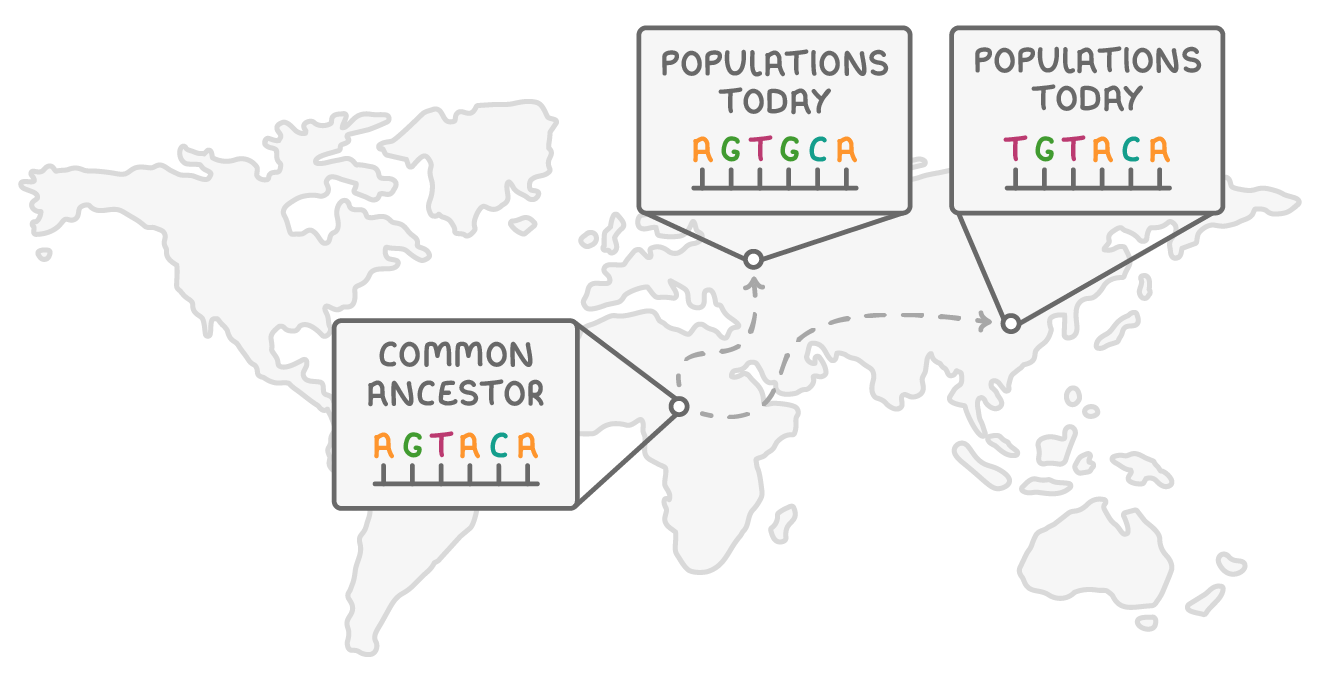
- The human genome can be used to trace how human populations spread across the world in the past.
- All modern humans are descended from a common ancestor who lived in Africa, and the human genome is almost identical in everyone.
- As different groups of people migrated away from Africa, each group gradually built up its own tiny differences in its genome.
Reading migration from the genome
- Scientists compare these small differences between the genomes of populations living in different parts of the world today.
- From these comparisons they can work out:
- When one population split off from another
- Which route it most likely took as it migrated
- Patterns in the genome act as a record of human migration, letting scientists reconstruct the journeys that spread people out of Africa and around the planet from the genetic evidence alone.
TermDefinition
GenomeThe entire genetic material of an organism.
Human Genome ProjectA major international scientific effort that found and mapped every single human gene.
Inherited disorderA condition caused by inheriting one or more faulty alleles from a parent.
Key points to remember
How were these notes?