1.10 - Active Transport
What active transport is
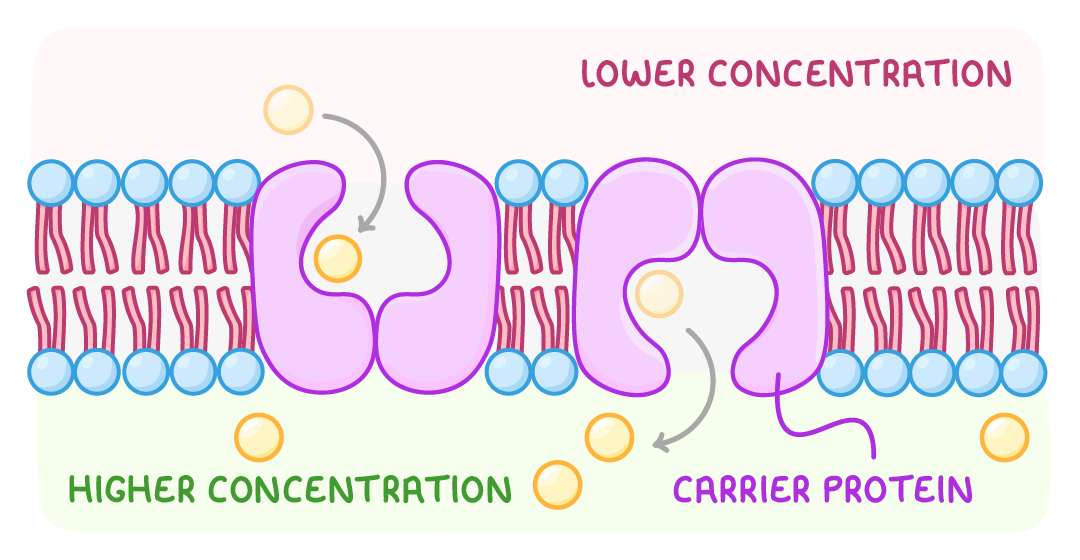
- Active transport is the movement of particles across a cell membrane against a concentration gradient - from an area of lower concentration to an area of higher concentration.
- It requires energy transferred by respiration to make it happen.
Active transport is the opposite of diffusion
- In diffusion, particles move down the concentration gradient on their own, and no energy is needed.
- Active transport moves particles the other way - up the gradient - so it cannot happen by itself.
- It has to be driven by energy from respiration. This energy is carried by a molecule called ATP, which the cell uses to power the transport.
Carrier proteins do the moving
- Carrier proteins are embedded in the cell membrane.
- They pick up the particles on one side and move them across to the other side, against the gradient.
Active transport in plant roots
- Plants need mineral ions from the soil to grow healthily. They absorb them through their root hair cells.
- The mineral ions include nitrate ions, which the plant uses to make proteins.
Why diffusion won't work
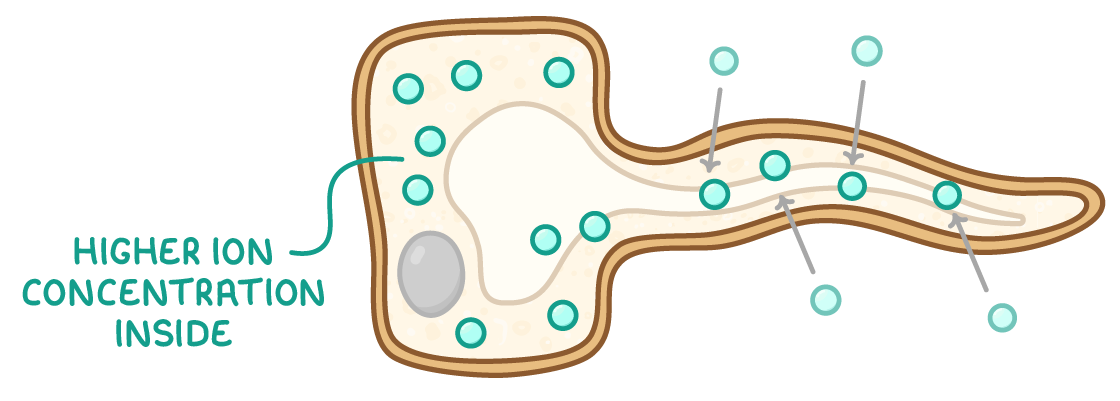
- The concentration of mineral ions is usually higher inside the root hair cells than in the soil around them.
- If the ions followed diffusion, they'd move the wrong way - out of the cells and into the soil.
- So the root hair cells use active transport to move the mineral ions in, against the concentration gradient.
- This lets the plant absorb minerals even from a very dilute soil solution, which is essential for growth.
- Active transport needs energy, which comes from respiration (carried by ATP).
Root hairs give a large surface area
- Each root hair is a long, finger-like extension of the cell that sticks out into the soil.
- A root is covered in millions of them.
- This gives the plant a large surface area for absorbing mineral ions by active transport, and water by osmosis.
Active transport in animals
- Active transport isn't just a plant process - animals use it too.
- It lets animals move substances against a concentration gradient, where diffusion alone wouldn't work.
- Two key examples are absorbing nutrients from the gut and reabsorbing useful substances in the kidney.
Absorbing nutrients in the gut
- Digested nutrients such as glucose and amino acids usually pass into the blood by diffusion, because there's a higher concentration of them in the gut than in the blood.
- Sometimes the concentration of nutrients is lower in the gut than in the blood, so the concentration gradient is the wrong way for diffusion.
- Active transport then takes the nutrients into the blood against that gradient, so the body can absorb the last of its food rather than leave it behind - essential to stop us starving.
- The cells lining the gut have many mitochondria to supply the energy from respiration that active transport needs.
Reabsorbing glucose in the kidney
- As the kidney filters the blood, all of the glucose is reabsorbed by active transport, against the concentration gradient.
- This means none is lost in the urine, so it can be used in respiration.
TermDefinition
Active transportThe movement of particles across a cell membrane against a concentration gradient (from a lower to a higher concentration), using energy transferred by respiration.
ATPA molecule that carries energy to the parts of a cell that need it, made using energy from respiration (or from light in photosynthesis).
Carrier proteinA protein in the cell membrane that picks up particles and moves them across against the concentration gradient.
Root hair cellA cell on the surface of a plant root with a long extension that provides a large surface area for absorbing water and mineral ions.
Key points to remember
How were these notes?