2.15 - Leaf Structure
The leaf's tissues
A leaf is a plant organ, built from several different tissues, each suited to a particular job.
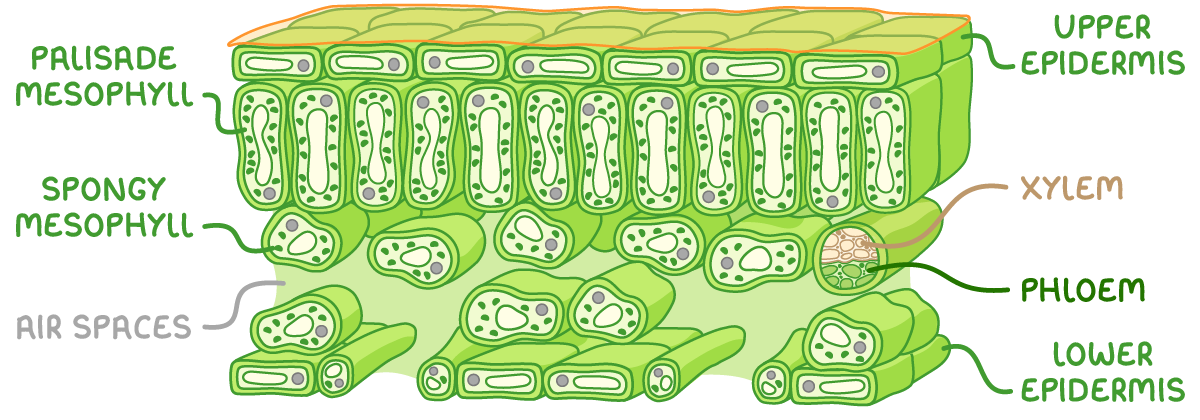
Epidermis
- A thin layer of cells covering the leaf, top and bottom.
- The upper epidermis is transparent, so light can pass straight through to the cells below.
- Apart from the guard cells around the stomata (pores), the epidermal cells contain no chloroplasts.
Palisade mesophyll
- Sits just under the upper epidermis.
- Made of tall cells packed with chloroplasts.
- Being near the top of the leaf, it receives the most light, so this is where most photosynthesis happens.
Spongy mesophyll
- A looser layer of more rounded cells below the palisade layer.
- Has large air spaces between the cells.
- The air spaces let gases such as carbon dioxide and oxygen diffuse easily to and from the cells.
Vascular bundles
- Run through the leaf and make up the vein. They contain two transport tissues:
- Xylem - Delivers water and dissolved mineral ions to the leaf.
- Phloem - Carries away the sugars made in photosynthesis.
- The vascular bundles also help to support and hold the leaf together.
Meristem tissue
- Worth knowing even though it is not part of the leaf.
- Found at the growing tips of shoots and roots.
- Its cells are stem cells, so they can differentiate - change into many different types of plant cell - which is what allows the plant to grow.
How the leaf is adapted for photosynthesis
The whole structure of a leaf is built around capturing light for photosynthesis, and many of its features are adaptations for exactly that.
Overall shape
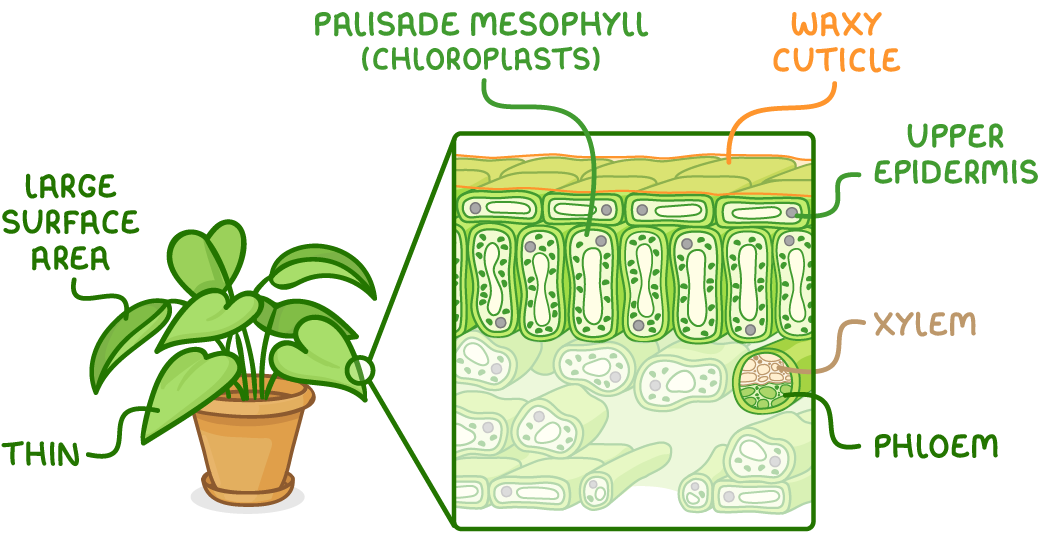
- Broad - Gives a large surface area to catch as much light as possible.
- Thin - Light and gases only have to travel a short distance inside the leaf.
Palisade mesophyll and upper epidermis
- The palisade mesophyll sits in a layer near the top of the leaf and is packed with chloroplasts.
- Putting these chloroplast-rich cells near the upper surface means they receive the most light - so most photosynthesis happens there.
- Above them, the upper epidermis is transparent, so light passes straight through to the palisade layer rather than being blocked.
The vein
- The leaf contains a network of veins - the vascular bundles - made up of xylem and phloem.
- Xylem - Brings water to the leaf for photosynthesis.
- Phloem - Carries away the sugars the leaf makes, mainly as sucrose.
- Together they also support the leaf's structure.
The waxy cuticle
- A thin, waxy cuticle covers the upper and lower surfaces.
- It is transparent, so it does not block light.
- It helps reduce water loss from the leaf by evaporation.
The leaf adapted for gas exchange
As well as capturing light, a leaf must let gases move in and out efficiently. Several features adapt it for gas exchange.
Spongy mesophyll and air spaces
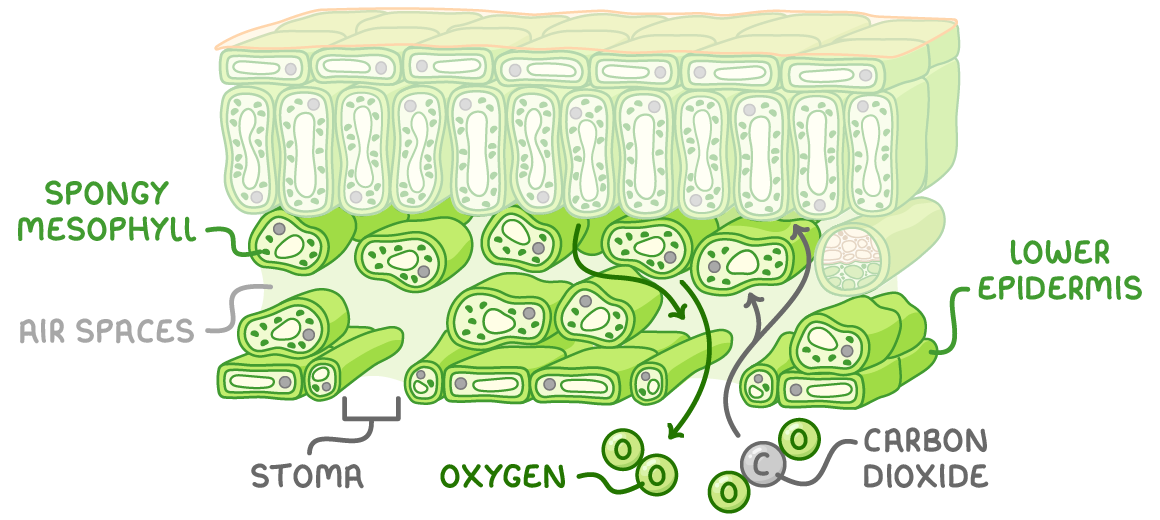
- The spongy mesophyll contains large air spaces between its cells.
- These air spaces give a large internal surface area and let gases like carbon dioxide and oxygen move freely between the cells.
- This speeds up the rate of diffusion to and from the photosynthesising cells.
Stomata in the lower epidermis
- The lower epidermis is dotted with tiny pores called stomata (a single one is a stoma).
- They let carbon dioxide diffuse into the leaf for photosynthesis, and oxygen (a product of photosynthesis) diffuse out.
- Most stomata are on the lower surface, which is shaded and cooler, so less water is lost through them than would be lost from the upper surface.
Broad and thin shape
The large surface area and the short distance gases have to travel both make gas exchange faster.
Guard cells and the stomata
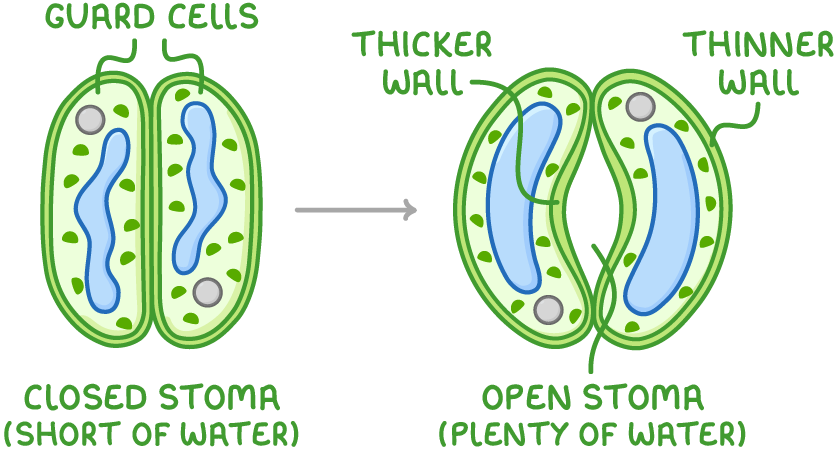
- Each stoma (pore) is bordered by a pair of guard cells, which open and close the pore to control gas exchange and water loss.
- A guard cell has a kidney shape, with:
- A thicker, less flexible wall on the inner side (next to the pore)
- A thinner wall on the outer side
- This uneven thickening is what makes the opening and closing work.
Opening and closing
- Plenty of water - Guard cells take in water and become turgid (plump and swollen). The uneven wall thickness makes the pair curve apart, so the stoma opens - letting carbon dioxide and oxygen be exchanged for photosynthesis.
- Short of water - Guard cells lose water and become flaccid (limp and floppy). They straighten and close together, so the stoma closes - helping to stop too much water vapour escaping from the leaf.
Sensitivity to light
- Guard cells are also sensitive to light.
- They close the stomata at night, when photosynthesis cannot happen.
- This saves water without any loss of photosynthesis.
TermDefinition
Palisade mesophyllA layer of tall, chloroplast-rich cells near the top of the leaf where most photosynthesis happens.
Spongy mesophyllA layer of rounded cells in a leaf, with air spaces between them that let gases diffuse easily.
XylemA plant transport tissue that carries water and dissolved mineral ions from the roots to the stems and leaves.
PhloemA plant transport tissue made of living cells that carries dissolved sugars and amino acids around the plant.
StomataTiny pores, mostly in the lower surface of a leaf, that let carbon dioxide and oxygen diffuse in and out and let water vapour escape.
Guard cellsA pair of cells that border a stoma and change shape to open and close the pore.
Key points to remember
How were these notes?