6.20 - Classification & Naming
How classification has changed
- Classification systems have changed over time as scientists gained new tools and evidence.
- Early classification used observable characteristics - features you can see, such as how many legs an animal has or whether a plant flowers.
- As microscopes improved, this grew to include features visible only under magnification, such as cell structure.
- These characteristics were used to sort living things into the five-kingdom classification system, where organisms are first split into five large groups called kingdoms, then into smaller and smaller groups.
The rise of molecular evidence
- As biochemistry and genetics developed, scientists became able to work out the sequence of DNA bases in different organisms' genes, and of their RNA, and compare them.
- The more similar the base sequence of a gene is between two organisms, the more closely related they are.
- For example, human and chimpanzee DNA is about 94% the same, showing the two are close relatives.
- This evidence is far more precise than appearance alone, because it can show:
- Two organisms that look very similar are actually only distantly related.
- Two organisms that look different are in fact close relatives.
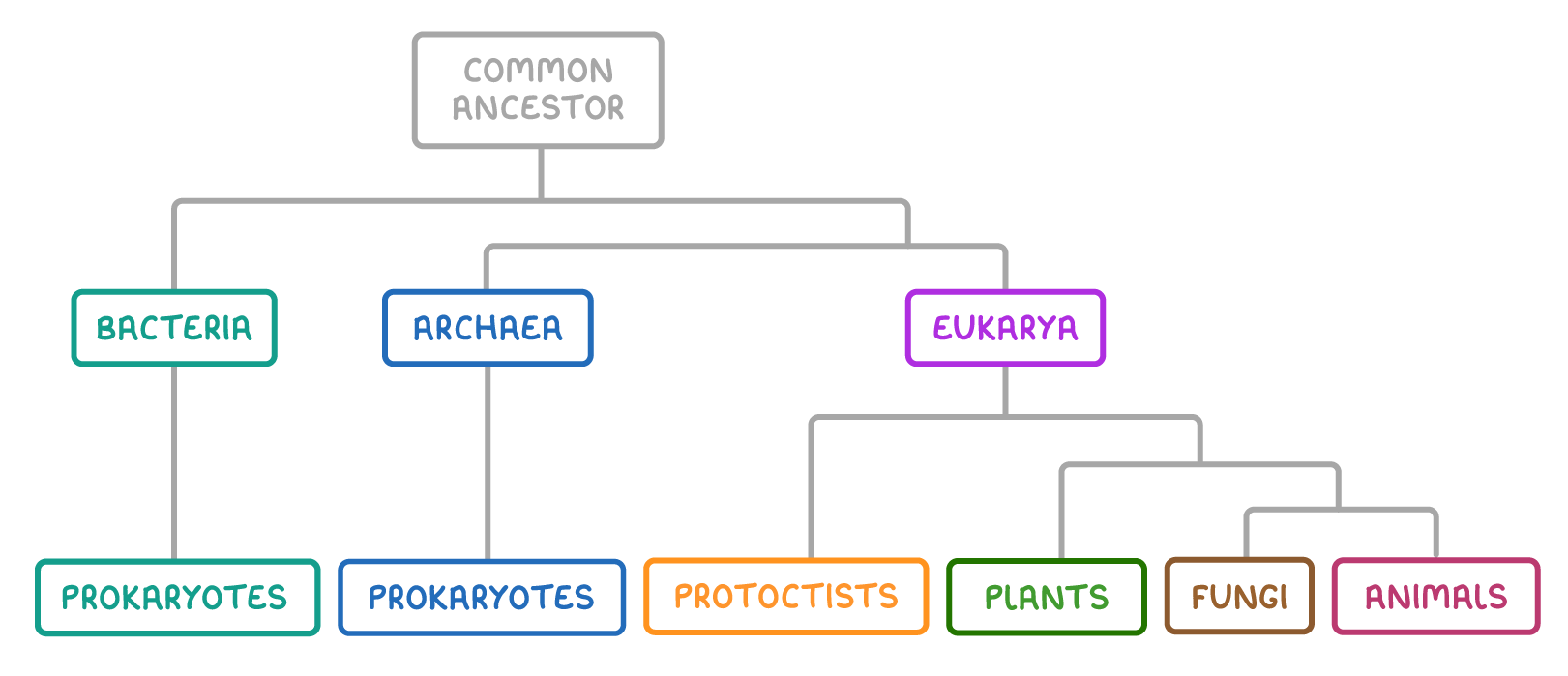
- These relationships are shown on an evolutionary tree (also called a phylogenetic tree), a branching diagram in which each branch point stands for a common ancestor. The more recently two species share a common ancestor, the more closely related they are.
The three-domain system
- Molecular evidence led to a rethink of how organisms are classified.
- Using RNA sequencing, the scientist Carl Woese found that some members of the prokaryote kingdom were far less closely related than had been assumed.
- He proposed a new top level of classification: three large groups called domains, placed above the kingdoms.
The three domains are:
- Archaea - Prokaryotic organisms once thought to be bacteria but genetically distinct, often living in extreme places such as hot springs and salt lakes
- Bacteria - The true bacteria
- Eukarya - All organisms with eukaryotic cells, including animals, plants, fungi, and protoctists
The five-kingdom scheme is still used, but the three domains now sit above it.
Species and scientific naming
- A species is the smallest group organisms are sorted into.
- It's a group of similar organisms that can reproduce with one another to give fertile offspring - offspring that can themselves go on to reproduce.
- This makes a species a natural unit: its members breed together, while members of different species generally don't produce fertile offspring.
The binomial system
- Because there are so many species, each is given its own scientific name using the binomial system - an internationally agreed, two-part naming system, mostly in Latin.
- The two parts are:
- Genus - The first part, shared with closely related organisms, giving information about ancestry
- Species - The second part, the species itself
- Example: humans are Homo sapiens - Homo is the genus and sapiens is the species.
- Writing conventions:
- The whole name is written in italics
- Only the first letter of the genus is capitalised
Why the system is used
- The point is consistency.
- The same organism is often given many different common or local names in different places and languages - over a hundred plant species are commonly called raspberries, for instance - which causes confusion.
- A single agreed scientific name means scientists anywhere in the world refer to a species by exactly the same name, so there's no doubt about which organism is meant.
The Linnaean system and evolutionary trees
- Organisms are traditionally classified using the Linnaean system, first proposed in the 1700s by Carl Linnaeus.
- It groups living things according to their characteristics and the structures that make them up.
The Linnaean hierarchy
Living things are first split into large groups called kingdoms, then divided into smaller and smaller groups in a fixed order:
- Kingdom
- Phylum
- Class
- Order
- Family
- Genus
- Species
Features of the groups:
- At each step down the levels, members of a group share more features with one another.
- The smallest group, the species, contains only a single type of organism.
- Given information about an organism, you should be able to place it in this hierarchy and read off how it is classified.
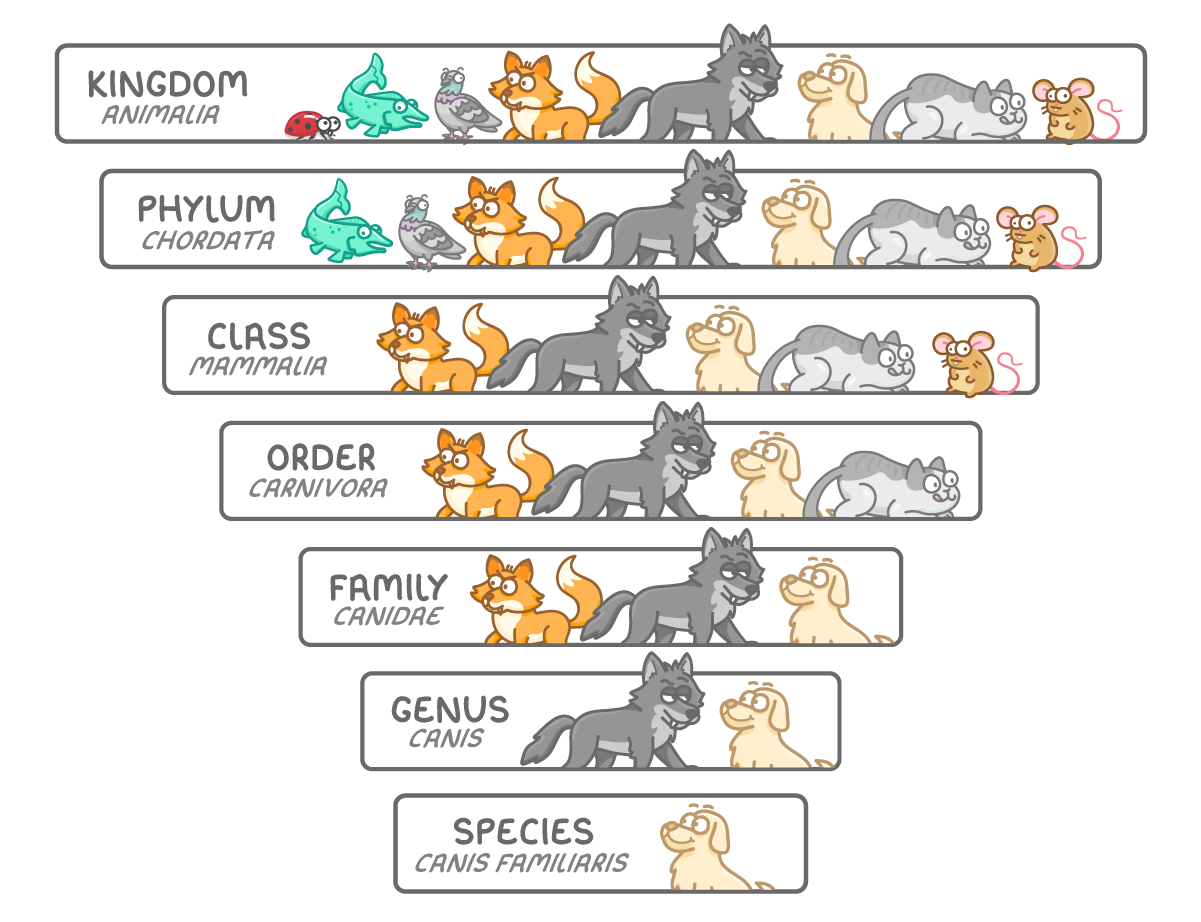
A dog placed at each level of the Linnaean hierarchy.
Evolutionary trees
- Evolutionary trees show how scientists think different species are related to one another.
- A tree shows common ancestors and the relationships between species.
- The more recent the common ancestor of two species, the more closely related they are - and the more characteristics they're likely to share.
Scientists work out these relationships from different kinds of evidence:
- Living organisms - Current classification data, such as DNA analysis and structural similarities.
- Extinct species - The fossil record.
For example, whales and dolphins share a recent common ancestor, so they are closely related. Both are only distantly related to sharks, whose shared ancestor with them lies much further back.
TermDefinition
DomainThe highest level of classification. Carl Woese introduced this level, dividing all organisms into three domains (Archaea, Bacteria and Eukarya).
Binomial systemAn internationally agreed system that gives each organism a two-part scientific name made up of its genus and species.
SpeciesA group of similar organisms that can reproduce with one another to produce fertile offspring.
Evolutionary treeA diagram that shows how different species and groups are related through common ancestors.
Linnaean systemA traditional classification system that sorts organisms into a hierarchy of seven groups, from kingdom down to species.
Key points to remember
How were these notes?