7.3 - Adaptations
Adaptations and their types
- An adaptation is an inherited characteristic or feature that helps an organism to survive and reproduce in the conditions where it normally lives.
- Because adaptations are inherited, they're passed on from parents to offspring - which is why life can exist across a huge range of environments, from freezing poles to hot deserts.
- Adaptations are grouped into three types: structural, behavioural, and functional.
Structural adaptations
Features of an organism's body structure, such as its shape, size, or colour:
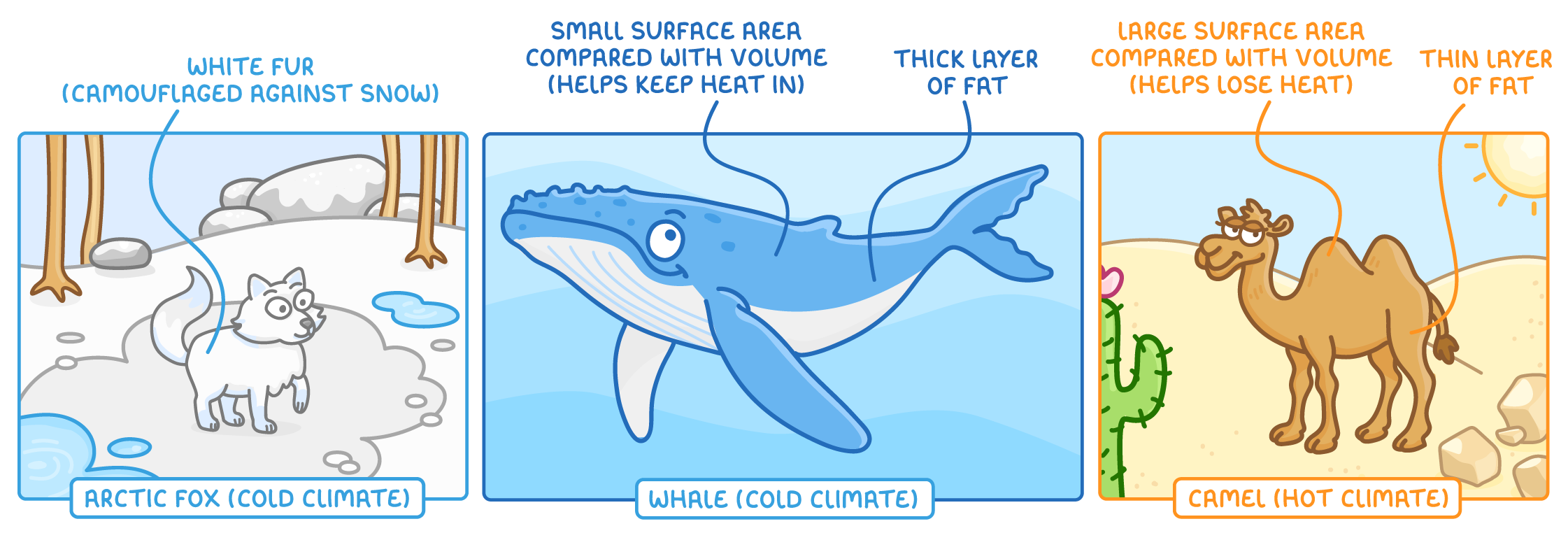
- Arctic fox - Has white fur, so it's camouflaged against the snow. This helps it avoid predators and creep up on prey.
- Cold-climate animals (e.g. whales) - Have a thick layer of blubber (fat) and a small surface area compared with their volume, which helps them keep heat in.
- Hot-climate animals (e.g. camels) - Have a thin layer of fat and a large surface area compared with their volume, which helps them lose heat.
Behavioural adaptations
The ways in which an organism behaves:
- Migration - Many birds, such as swallows, migrate to warmer climates in winter to avoid the cold and lack of food where they spend the summer.
Functional adaptations
Processes that go on inside an organism's body, related to things like metabolism (all the chemical reactions in the body) and reproduction:
- Water conservation - Many desert animals produce very little sweat and only small amounts of concentrated urine.
- Hibernation - Brown bears hibernate over winter, lowering their metabolism so they use less energy. This means they don't have to hunt when food is scarce.
Extremophiles
- Extremophiles are organisms that live in very extreme environments - for example at very high temperature, very high pressure, or very high salt concentration.
- Some live in super-hot volcanic springs, others in very salty lakes, and others at high pressure on the deep ocean floor.
- The bacteria living around deep-sea vents are extremophiles.
TermDefinition
AdaptationAn inherited characteristic that helps an organism survive and reproduce in the environment where it normally lives.
ExtremophileAn organism that lives in a very extreme environment, such as one with a very high temperature, pressure, or salt concentration.
Key points to remember
How were these notes?