6.9 - Genetic Diagrams
Setting out a genetic cross
- Inheritance is the passing on of genetic information from one generation to the next.
- A characteristic controlled by a single gene can be predicted by drawing a genetic cross - a model that works through one gene at a time.
- A gene can come in different versions called alleles. An organism normally carries two alleles for a gene, one from each parent.
- Each allele is written as a letter: a capital for the dominant allele, the same letter in lower case for the recessive one.
- The dominant allele is expressed whenever it's present, so the recessive characteristic shows only when both alleles are recessive.
Key terms
- Genotype - The pair of alleles an organism carries (e.g. AA, Aa or aa).
- Phenotype - The characteristic, also called the trait, those alleles produce.
- Homozygous - The two alleles are the same (RR or rr).
- Heterozygous - The two alleles are different (Rr).
- Monohybrid cross - A cross that follows a single characteristic.
- Pure-breeding - Two identical homozygous parents bred together; each can pass on only one kind of allele.
Example: if normal muscle in a mouse is dominant (A) and large muscle is recessive (a), a muscular mouse must be aa, while a normal mouse could be AA or Aa.
The five lines of a cross
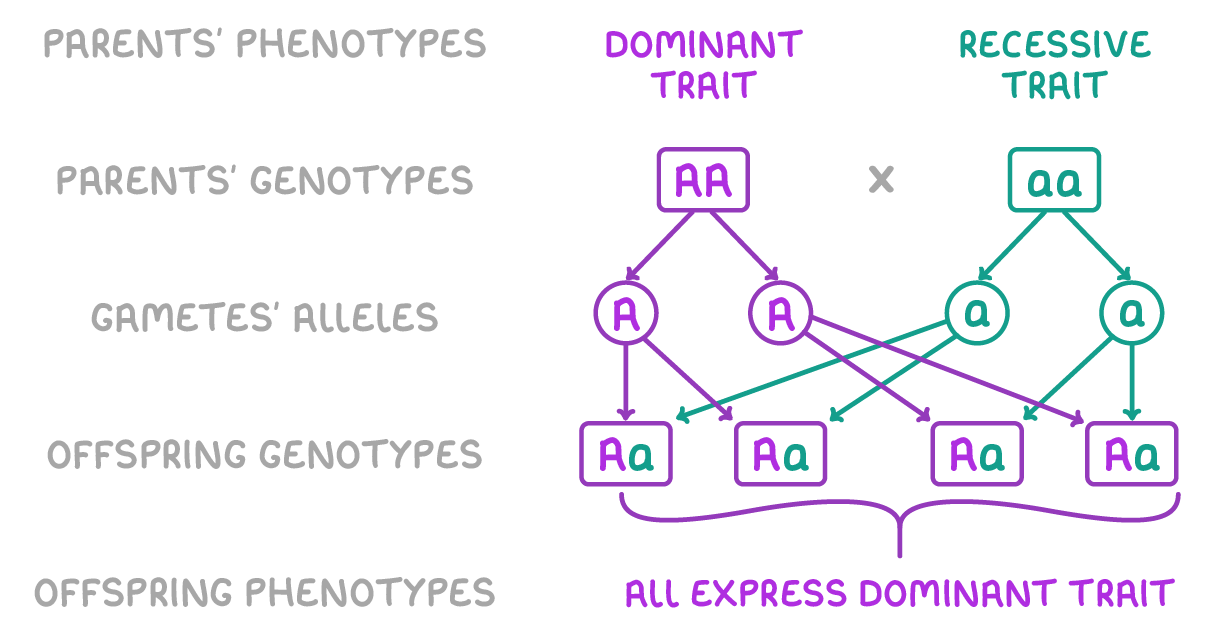
- Parents' phenotypes - The characteristic each parent shows (e.g. normal and muscular).
- Parents' genotypes - The two alleles each parent carries, written underneath (e.g. AA and aa).
- Gametes - Split each parent's two alleles into individual gametes, each carrying just one allele. An AA parent makes gametes all carrying A; an aa parent makes gametes all carrying a.
- Offspring genotypes - Combine the gametes, pairing every gamete from one parent with every gamete from the other. Each offspring gets one allele from each parent, so A gametes crossed with a gametes give offspring that are all Aa.
- Offspring phenotypes - Read each genotype as a characteristic. A single dominant allele is enough to show the dominant characteristic, so an Aa offspring shows the dominant characteristic.
Crossing two homozygous parents
- Crossing AA × aa gives offspring that are all heterozygous (Aa), so all show the dominant characteristic.
- Two homozygous parents can only give one kind of offspring.
- A gamete from one parent can only ever combine with a gamete from the other parent.
- An organism produces two different gamete types only if it is heterozygous - a homozygous parent makes just one kind of gamete.
Using a Punnett square
- A Punnett square is a grid that does the same job as the line diagram, but is quicker to draw.
- For a single gene it's a two-by-two grid (a square split into four smaller squares).
- To set it up:
- Write the two possible gametes of one parent along the top, one above each column.
- Write the two possible gametes of the other parent down the left-hand side, one beside each row.
- Fill each inner cell by combining the gamete heading its column with the gamete beside its row.
- Each inner cell is one possible offspring genotype, so the four cells together show every combination the offspring could inherit, and how many ways each one can arise.
- The grid carries almost the same information as the five-line diagram. The one thing it doesn't show directly is the parents' phenotypes - these are noted alongside.
Example - Heterozygous cross (Aa × Aa)
Two normal mice are each Aa, where A (normal) is dominant and a (muscular) is recessive. Each parent makes two kinds of gamete, one carrying A and one carrying a.
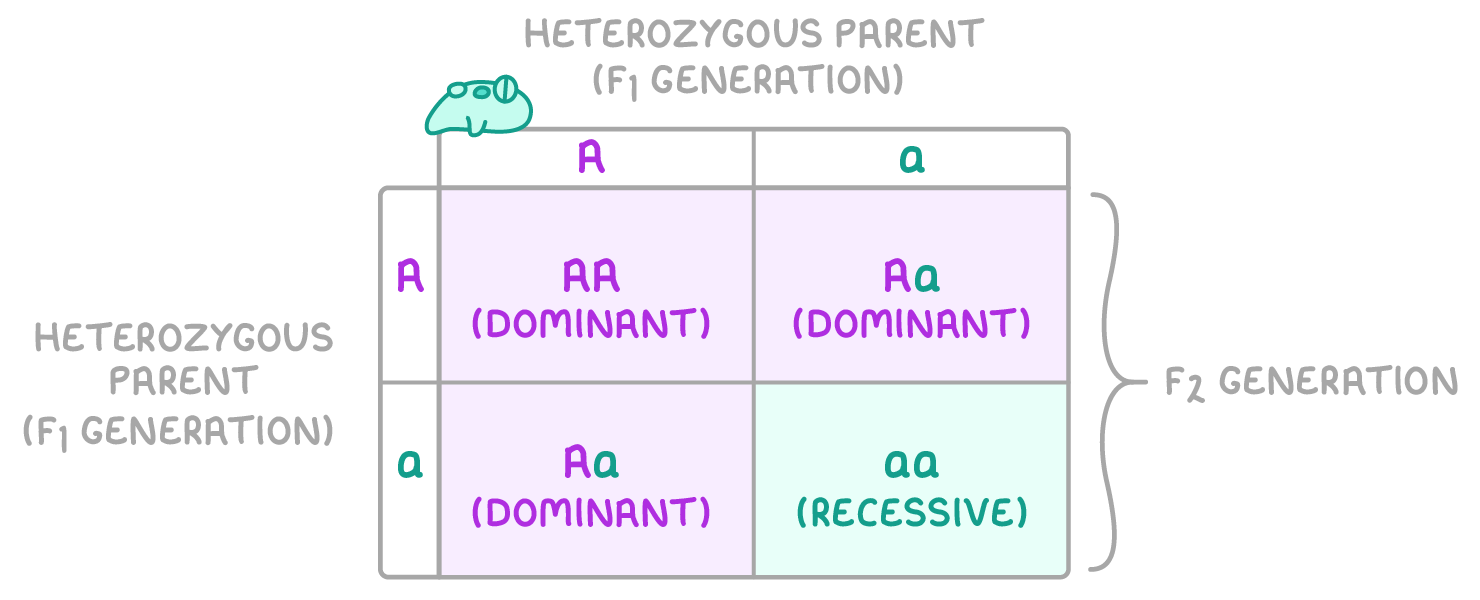
- The grid gives one AA, two Aa and one aa among the four possible offspring - the same result as the line diagram, but easier to draw and count.
- Three of the four carry at least one dominant allele, so they show the dominant (normal) characteristic.
- The single aa offspring shows the recessive (muscular) characteristic.
Filial generations
- When a cross is described in stages, the offspring of the first cross are the first filial generation (F1).
- Crossing two members of the F1 produces the second filial generation (F2).
- The heterozygous parents here are an F1 pair, and the one-AA, two-Aa, one-aa result is their F2 generation.
Ratios and probability from a cross
- The outcome of a cross is usually given as a ratio, but the same result can be stated as a proportion, a percentage, or a probability - all different ways of saying the same thing.
- The ratio is a prediction, not a guarantee - which gametes meet at fertilisation is random, so a real set of offspring matches the ratio most closely when the numbers are large.
- It's also a simplification - most characteristics are controlled by several genes together, not by one alone.
Two common crosses
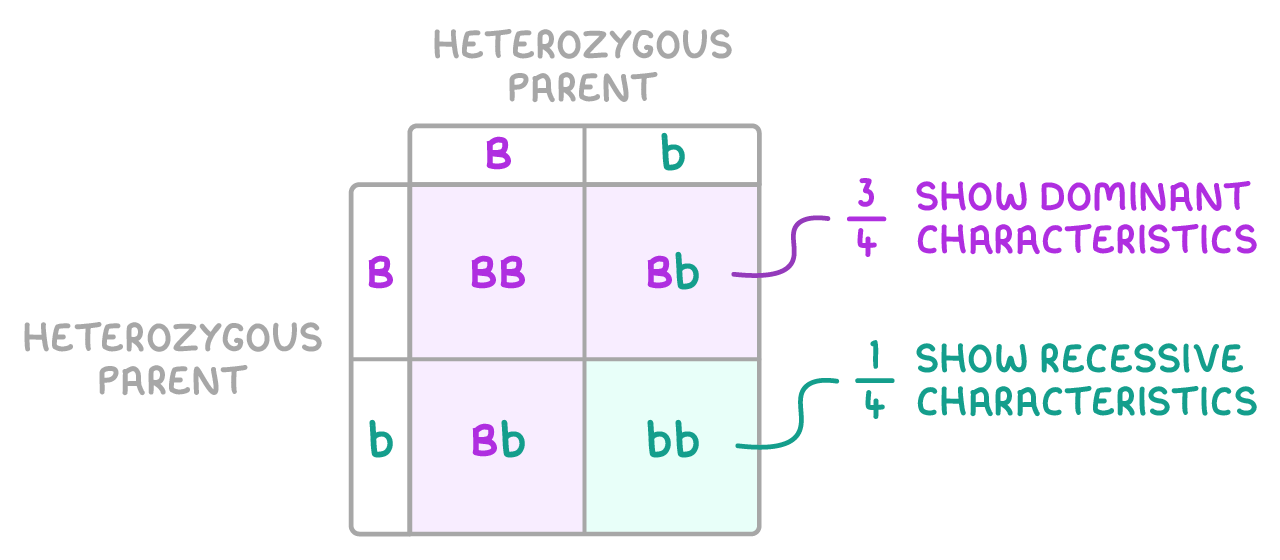
- Bb × Bb (two heterozygous parents) - gives one BB, two Bb and one bb in every four offspring. One dominant allele is enough to show the dominant characteristic, so three show the dominant and one the recessive:
- Phenotype ratio 3:1
- 3 in 4 (75%) chance of the dominant characteristic, 1 in 4 (25%) chance of the recessive one
- Out of 100 offspring you'd expect about 25 to be recessive
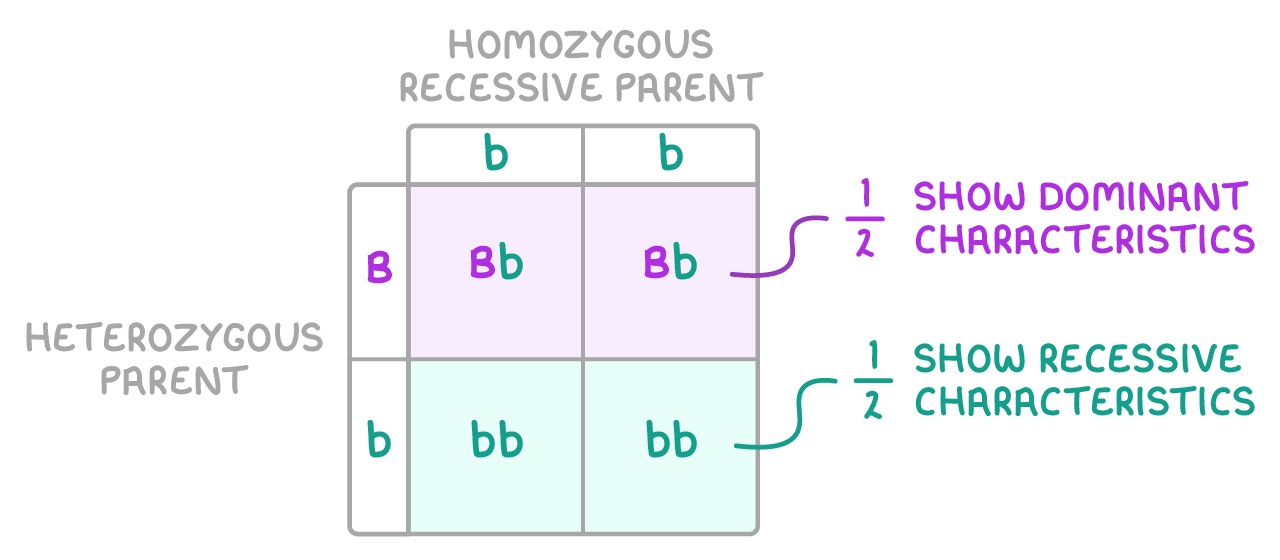
- Bb × bb (heterozygous × homozygous recessive) - gives half Bb and half bb:
- Phenotype ratio 1:1
- 1 in 2 (50%) chance of each
Reading a ratio backwards
- A 3:1 ratio in the offspring tells you both parents were heterozygous (Bb × Bb).
- A 1:1 ratio tells you one parent was heterozygous and the other homozygous recessive (Bb × bb).
TermDefinition
AlleleOne of the different forms of a gene.
Dominant alleleAn allele that is always expressed (shows its effect), even if only one copy is present.
Recessive alleleAn allele that is only expressed (shows its effect) when two copies are present.
GenotypeThe combination of alleles an organism has for a particular gene.
PhenotypeThe observable characteristics of an organism, which result from its genotype and its environment.
HomozygousHaving two identical alleles for a particular gene.
HeterozygousHaving two different alleles for a particular gene.
Key points to remember
How were these notes?