8.2 - Osmosis in Plant Tissue
The experiment
Aim
To find out how the concentration of a sugar (or salt) solution affects the mass of potato cylinders, and to use the results to estimate the concentration of the dissolved sugars and salts inside the potato cells (this is called the cell sap).
Background
- Osmosis is the movement of water across a partially permeable membrane, from where the water is more concentrated (a dilute solution) to where it is less concentrated (a concentrated solution).
- The membrane around each potato cell is partially permeable, so water moves into or out of the cells depending on the solution around them.
- You can't see the water moving, but you can measure the change in mass it causes. A cylinder gains mass as water moves in, and loses mass as water moves out.
- So in this practical you measure the change in mass of potato cylinders left in sugar solutions of different concentrations.
Variables
- Independent variable - The concentration of the sucrose solution, in mol/dm3.
- Dependent variable - The percentage change in mass of each cylinder.
- Control variables - The volume of solution, the time in the solution, the temperature, the size of the cylinders, and the type of potato.
Method
- Cut the cylinders - Use a cork borer to cut cylinders from a potato, trim off the skin, and cut them all to the same length with a scalpel and a ruler on a tile.
- Weigh each cylinder - Blot it dry with a paper towel, then measure and record its starting mass.
- Set up the solutions - Measure 10 cm3 of sucrose solution into each of a set of labelled boiling tubes, at a range of concentrations such as 0.0 (pure water), 0.2, 0.4, 0.6, 0.8, and 1.0 mol/dm3.
- Leave the cylinders in - Put one cylinder into each tube, and leave them all for the same time, at least 30 minutes.
- Reweigh each cylinder - Take it out, blot it dry in the same way as before, then measure and record its final mass.
- Repeat the experiment - If you can, and find the mean percentage change in mass at each concentration.
Safety
- Cork borer and scalpel - Use them on a tile, push the borer away from your other hand, and cut with the blade pointing away from you. Cover the blade when you're not using it.
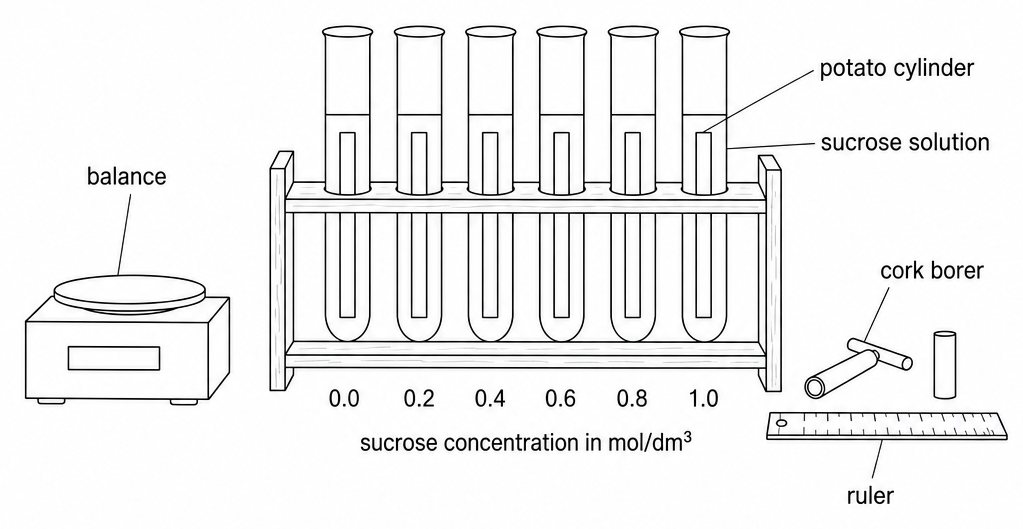
Worked example - Osmosis in potato tissue
A student cut six potato cylinders, each with a starting mass of 1.50 g. She left one in each of six sugar solutions for 30 minutes, then blotted the cylinders dry and reweighed them.
| Concentration (mol/dm3) | Initial mass (g) | Final mass (g) |
|---|---|---|
| 0.0 (pure water) | 1.50 | 1.65 |
| 0.2 | 1.50 | 1.58 |
| 0.4 | 1.50 | 1.50 |
| 0.6 | 1.50 | 1.42 |
| 0.8 | 1.50 | 1.35 |
| 1.0 | 1.50 | 1.30 |
Work out the percentage change in mass of each cylinder, use a graph to estimate the concentration of the cell sap, and describe the trend.
Step 1 - Work out the percentage change for the cylinder in pure water
Use the percentage change in mass, not the change in grams, because the cylinders may not all start at exactly the same mass. The cylinder in pure water went from 1.50 g to 1.65 g.
The answer is positive, so this cylinder gained water by osmosis.
Step 2 - Work out the percentage change for every other cylinder
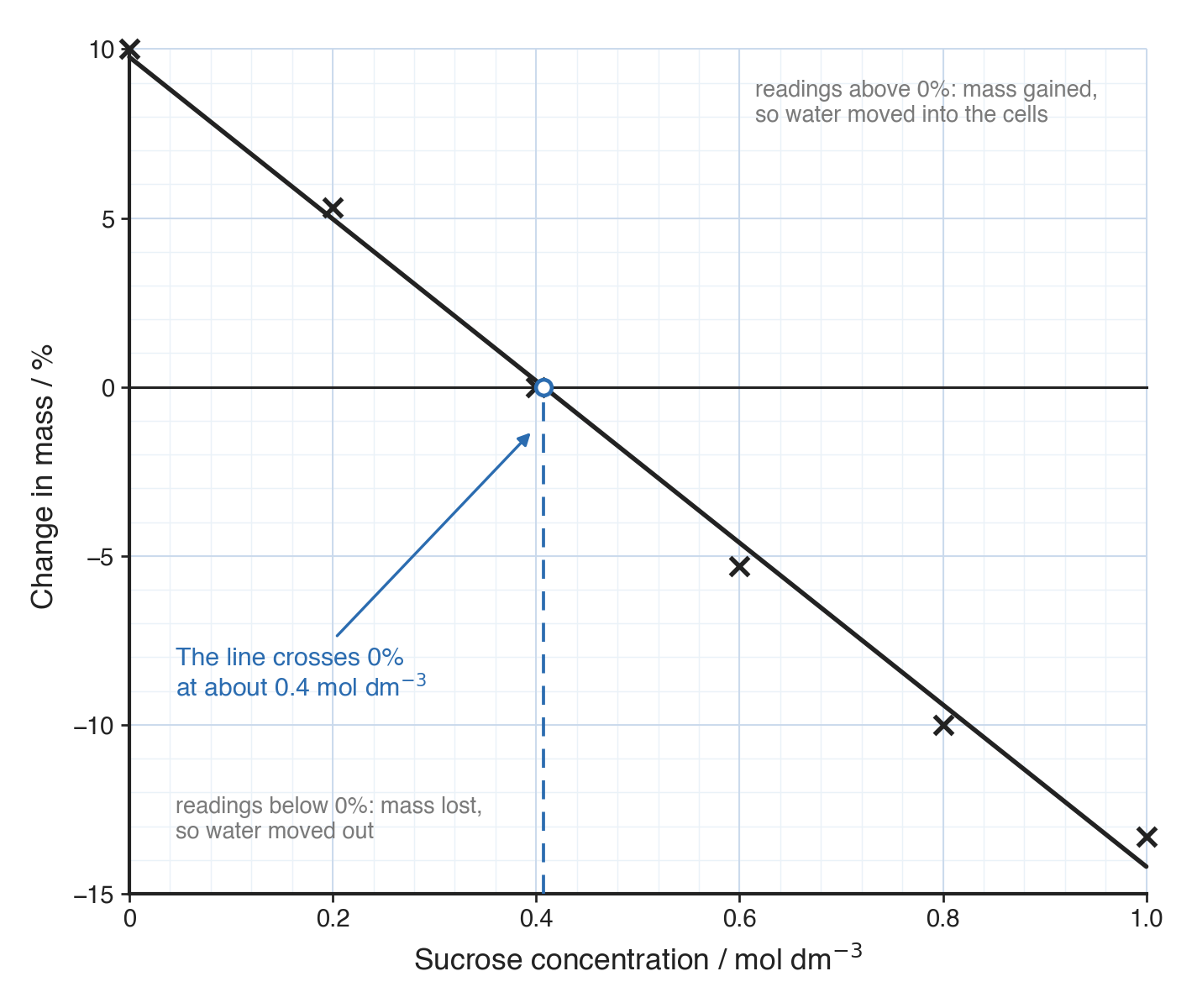
- At 0.2 mol/dm3, (1.58 − 1.50) ÷ 1.50 × 100 = +5.3%.
- At 0.4 mol/dm3, (1.50 − 1.50) ÷ 1.50 × 100 = 0.0%.
- At 0.6 mol/dm3, (1.42 − 1.50) ÷ 1.50 × 100 = −5.3%.
- At 0.8 mol/dm3, (1.35 − 1.50) ÷ 1.50 × 100 = −10.0%.
- At 1.0 mol/dm3, (1.30 − 1.50) ÷ 1.50 × 100 = −13.3%.
Step 3 - Plot the graph and find the concentration of the cell sap
Plot the percentage change in mass against the concentration, and draw a line of best fit. It crosses 0% at about 0.4 mol/dm3. At this concentration no water moves in or out overall, because the solution has the same concentration of water (the same water potential) as the cell sap. So the cell sap's concentration is about 0.4 mol/dm3.
Step 4 - Describe the trend
Below 0.4 mol/dm3 the cylinders gain mass, because the solution is more dilute than the cell sap (it has a higher water potential), so water moves into the cells. Above 0.4 mol/dm3 they lose mass, because the solution is more concentrated (it has a lower water potential), so water moves out.
Common exam questions
Question 1
Why is each cylinder blotted dry before it is weighed?
Any solution left on the surface adds to the mass, which would make a gain look bigger, or a loss smaller, than it really is.
Question 2
Why are all the cylinders cut to the same size?
So they have the same surface area. A larger surface area lets water move in or out faster, so cylinders of different sizes couldn't be compared fairly.
Question 3
A student says the cylinders change mass because sugar moves into or out of the potato cells. Explain why this is wrong.
The cell membrane is partially permeable. Sugar molecules are too large to pass through it, so only water moves, by osmosis.