6.15 - Antibiotic Resistance
How antibiotic resistance arises
- Bacteria reproduce very quickly, so they can evolve in a short time.
- Like all organisms, a bacterium can develop a random mutation in its DNA. Very occasionally this makes the bacterium less affected by a particular antibiotic - a drug that kills bacteria or stops them reproducing.
- The mutation produces a new allele (sometimes called a new variant) for antibiotic resistance.
- The mutation happens by chance - the antibiotic does not cause it. So some bacteria in a population are already resistant before any antibiotic is used.
Natural selection builds up a resistant strain
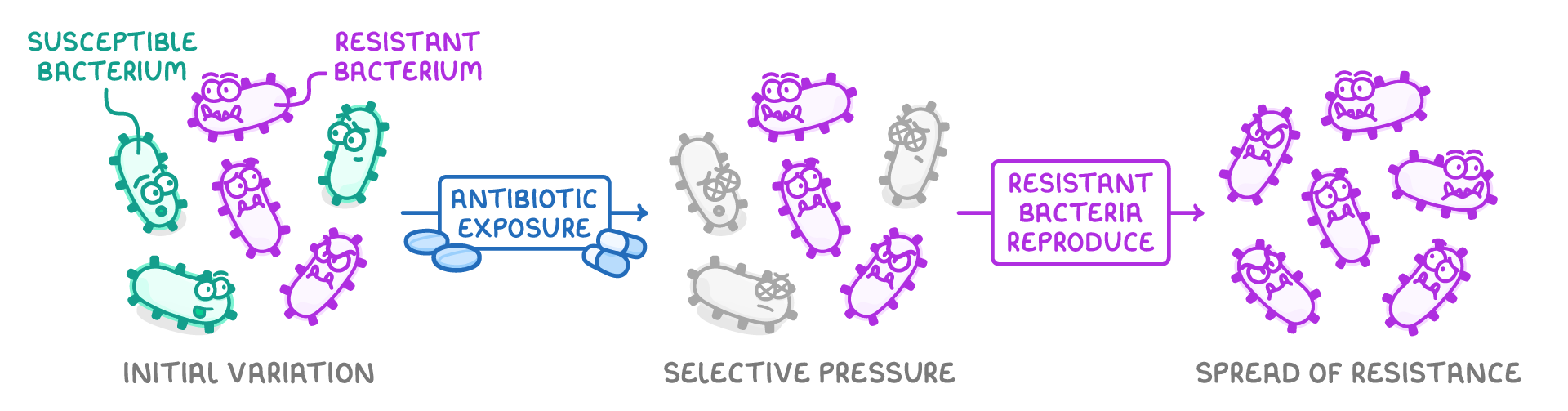
This is natural selection acting on bacteria, with the antibiotic as the selection pressure. Because bacteria reproduce so fast, it can be watched happening within a few generations:
- The antibiotic kills the bacteria that are not resistant, known as susceptible bacteria, but a resistant bacterium survives.
- Resistance is a large survival advantage - the resistant bacterium lives longer and reproduces many more times, even inside a host being treated for the infection.
- It passes the resistance allele on to all of its offspring.
- Because bacteria reproduce so rapidly, the proportion of resistant bacteria rises quickly until a whole new antibiotic-resistant strain has built up.
Why a resistant strain is a serious problem
- People have no immunity to it and the usual antibiotic no longer works, so the infection is hard to treat and spreads easily from person to person.
- Bacteria that have become resistant to many different antibiotics are called superbugs.
- An example is MRSA, and such superbugs are becoming more common.
MRSA and reducing antibiotic resistance
- MRSA (methicillin-resistant Staphylococcus aureus) is a well-known superbug - a strain of bacteria that has become resistant to most antibiotics, including powerful ones.
- It's hard to kill, so it's difficult to treat and difficult to eradicate.
- It can cause serious infections, particularly wound infections in people in hospital, where it can be fatal.
Slowing the development of resistance
The more antibiotics are used, the faster resistant strains develop - so resistance is slowed by using antibiotics carefully:
- Doctors shouldn't prescribe antibiotics when they aren't really needed - for example for non-serious complaints, or for viral infections, which antibiotics can't treat anyway.
- Patients should finish the whole course of antibiotics, even once they feel better, so all the bacteria are killed and none survive to mutate into a resistant strain.
- Use of antibiotics in farming should be restricted. Antibiotics are given to healthy livestock to stop them getting ill and to make them grow faster, which encourages resistant bacteria to develop in the animals - these can then pass to people through meat.
Reducing spread within hospitals
- Thorough cleaning of wards
- Staff washing their hands between patients
- Using alcohol-based hand gels
- Isolating infected patients
- Screening incoming patients for the bacteria
Developing new antibiotics
- New antibiotics that work against resistant strains are being developed.
- But the process is slow and costly, so it's unlikely to keep pace with the rate at which new resistant strains appear - which is why slowing the development of resistance matters so much.
TermDefinition
AntibioticA substance that kills bacteria or stops them from growing and dividing, used as a medicine to cure bacterial diseases.
SuperbugA strain of bacteria that has become resistant to many different antibiotics.
MRSAA strain of bacteria that has become resistant to most antibiotics.
Key points to remember
How were these notes?