7.9 - Global Warming
The greenhouse effect and global warming
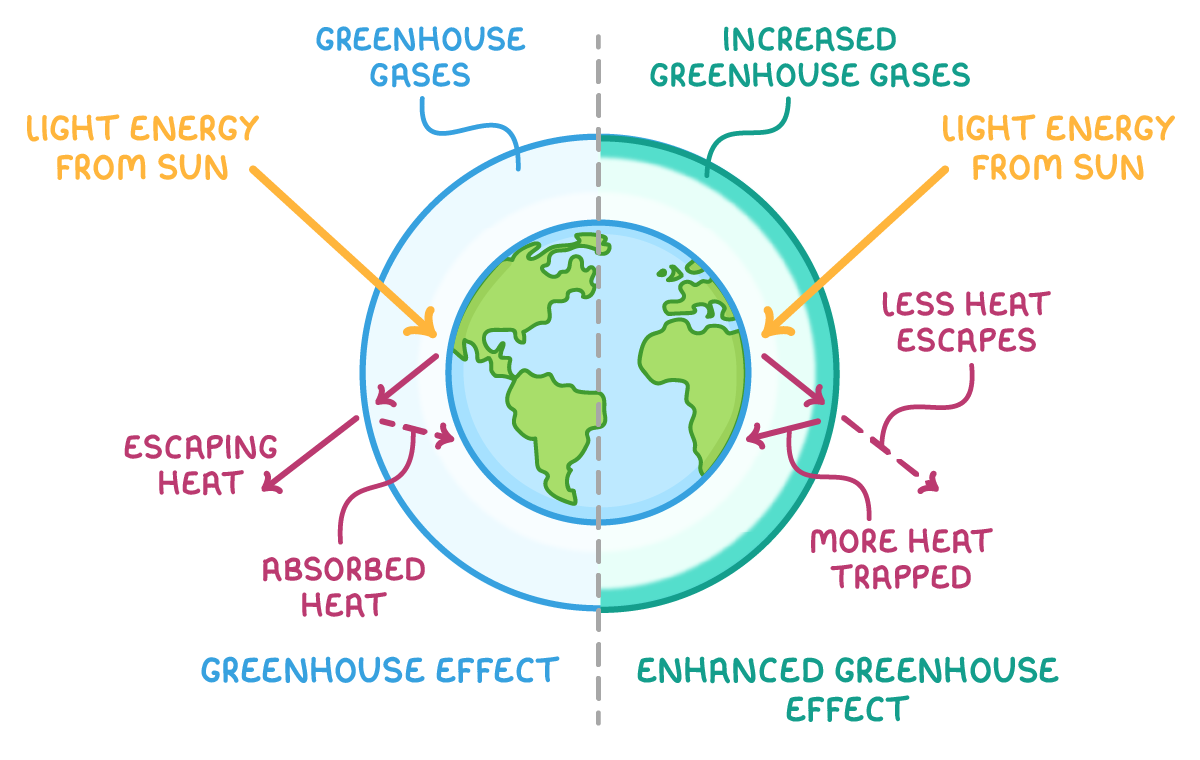
- The Earth's temperature is a balance between the energy it receives from the Sun and the energy it radiates back out into space.
- Light energy from the Sun passes through the atmosphere and warms the surface, which then radiates energy back outwards.
- Greenhouse gases in the atmosphere absorb most of this outgoing energy and re-radiate it in all directions, including back towards the Earth.
- They act like an insulating layer, so heat stays near the surface for longer and the planet is kept at a warm, stable temperature.
- This natural greenhouse effect is essential for life - without it the Earth would be far too cold.
The main greenhouse gases
- Carbon dioxide and methane are the main greenhouse gases.
- Water vapour, nitrous oxide, and CFCs (chlorofluorocarbons) also act as greenhouse gases.
The enhanced greenhouse effect and climate change
- When levels of greenhouse gases rise, the effect is strengthened: more outgoing energy is trapped, so less heat escapes and the Earth gradually heats up.
- This strengthening of the natural effect by extra greenhouse gases is called the enhanced greenhouse effect.
- The resulting rise in the Earth's temperature is called global warming.
- Global warming is one type of climate change - a long-term shift in the planet's temperature and weather patterns.
How human activity increases global warming
- Human activity is increasing the levels of greenhouse gases in the atmosphere.
- As these gases build up, the greenhouse effect is strengthened - this is the enhanced greenhouse effect - and the Earth gradually heats up.
- The faster the levels rise, the faster the planet warms, so reducing emissions from these activities is central to limiting global warming.
Human sources of greenhouse gases
- Carbon dioxide - Burning fossil fuels releases it directly through combustion. Cutting down forests (deforestation) removes trees that would otherwise take carbon dioxide out of the air by photosynthesis.
- Methane - Released by rearing cattle and by growing rice in flooded paddies.
- Nitrous oxide - Raised by the use of fertilisers, together with vehicles and industry.
- CFCs - Leak from old aerosols and fridges.
Biological consequences of global warming
- The rise in temperature is driven by rising carbon dioxide, mainly from the combustion of fossil fuels and from deforestation.
- Global warming then has several biological consequences: changes in distribution of organisms, rising sea levels, more extreme weather, and falling biodiversity.
Changes in the distribution of organisms
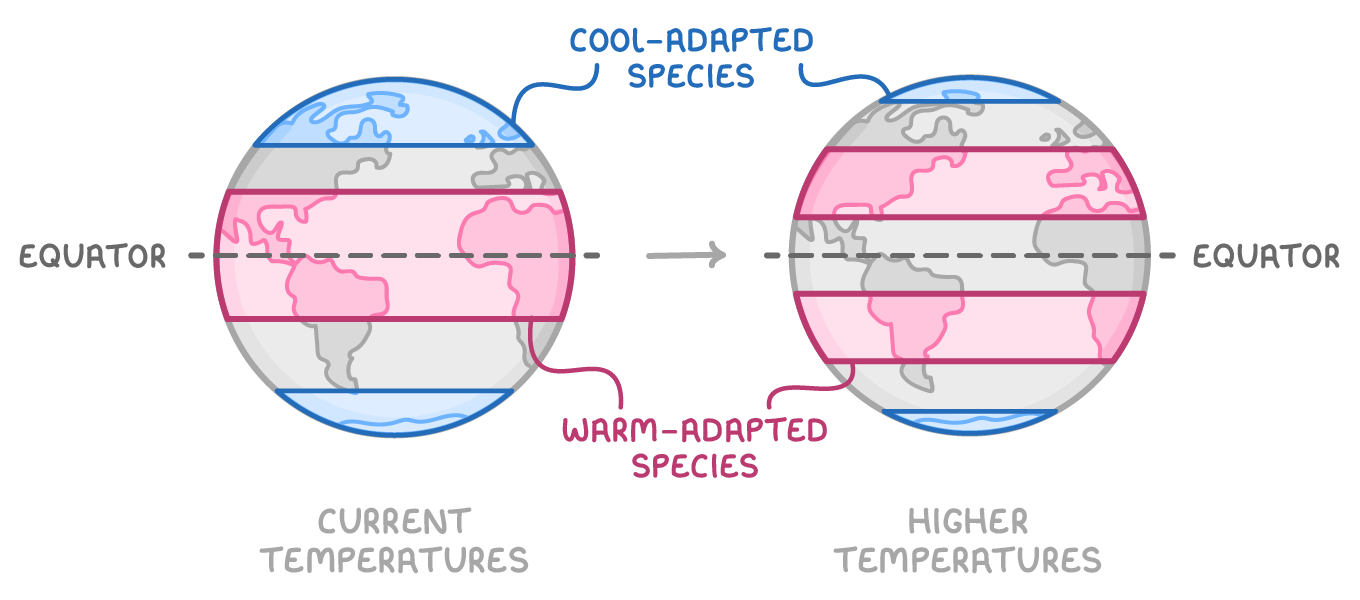
- As temperatures and rainfall patterns change, organisms shift where they can live:
- Organisms that need warmer conditions spread into new areas
- Organisms that need cooler conditions occupy smaller ranges
- Some species migrate towards the poles
- Some organisms shift to new regions, but others cannot move or adapt quickly enough, so their ranges shrink and some are lost.
- Evidence for these shifts in distribution links the environmental change to its effect on living things.
Rising sea levels and extreme weather
- Higher temperatures make seawater expand and the ice caps melt, so sea levels rise.
- This increases flooding in low-lying coastal areas and the loss of habitats.
- Extreme weather events - Droughts, storms, and floods - become more frequent and more severe.
- Habitats are lost as a result - for example, wetlands dry out or are submerged.
Falling biodiversity
- Together these changes reduce the variety of organisms an area can support, so biodiversity is likely to fall.
- This is because some species cannot adapt or migrate quickly enough and may become extinct.
TermDefinition
Greenhouse gasA gas in the atmosphere that absorbs energy given off by the Earth's surface and re-radiates it in all directions.
Enhanced greenhouse effectThe strengthening of the natural greenhouse effect by extra greenhouse gases in the atmosphere.
Global warmingThe gradual rise in the Earth's temperature caused by the enhanced greenhouse effect.
Climate changeA long-term shift in the planet's temperature and weather patterns.
Key points to remember
How were these notes?