4.5 - Social–Cognitive & Trait Theories of Personality
Social–cognitive theory of personality: an overview
Social–cognitive theory offers a perspective on personality that emphasizes the interaction between personal factors, behavior, and the environment. Unlike other theories that might focus solely on internal traits or past experiences, this approach views personality as a dynamic system influenced by ongoing interactions. It suggests that who we are is shaped not just by inherent qualities, but by how we think, act, and experience the world around us.
Key concepts in social-cognitive theory
- Personal factors - These include thoughts, emotions, and beliefs that influence how individuals perceive and respond to situations.
- Behavior - The actions individuals take, which can reinforce or alter their thoughts and environmental interactions.
- Environment - The external context, including social influences and situations, that impacts both personal factors and behavior.
This theory highlights that personality isn't static; it evolves through continuous interplay among these elements.
Reciprocal determinism: the core of social–cognitive theory
At the heart of social–cognitive theory is the concept of reciprocal determinism. This idea suggests that personality is formed through a three-way interaction among personal factors, behavior, and the environment. Each element influences the others in a constant feedback loop, meaning that a change in one can ripple through and affect the entire system.

How reciprocal determinism works:
- Personal factors influence behavior - For instance, if someone believes they are capable of succeeding (a personal belief), they are more likely to take on challenging tasks.
- Behavior impacts the environment - Taking on those tasks might lead to recognition or new opportunities in their surroundings.
- Environment shapes personal factors - Positive feedback from the environment, like praise, can strengthen the belief in one's abilities, reinforcing personal confidence.
This cycle shows how personality develops as a result of ongoing, mutual influences rather than a single cause.
Self-concept, self-efficacy, and self-esteem in personality development
A critical aspect of social–cognitive theory is the idea of self-concept, which refers to how individuals perceive themselves and their relationships with others. This self-view is influenced by two key components: self-efficacy and self-esteem. Together, these elements play a significant role in shaping personality by affecting how individuals interpret and engage with their world.
Components of self-concept:
- Self-concept - This is the overall mental image or perception individuals have of themselves, including their identity, abilities, and social roles. A positive self-concept can lead to confidence in social interactions, while a negative one might result in withdrawal or insecurity.
- Self-efficacy - This refers to the belief in one's ability to execute behaviors necessary to produce specific performance attainments. High self-efficacy means believing you can achieve goals, which often leads to greater motivation and persistence.
- Self-esteem - This is the value or worth individuals place on themselves. High self-esteem can foster resilience and a willingness to take risks, while low self-esteem might hinder personal growth and social engagement.
These elements interact within the framework of reciprocal determinism, where a strong sense of self-efficacy might encourage behaviors that improve environmental outcomes, which in turn boost self-esteem and refine self-concept.
Trait theories of personality: enduring characteristics
Trait theories take a different approach to understanding personality by focusing on stable, enduring characteristics that define how individuals typically respond to various situations. These theories suggest that personality is composed of consistent patterns of thoughts, feelings, and behaviors that remain relatively unchanged over time and across contexts.
Core ideas of trait theories:
- Traits as building blocks - Traits are specific qualities or predispositions, such as being outgoing or cautious, that form the foundation of personality.
- Consistency in responses - These traits lead to predictable reactions to stimuli. For example, a person with a high level of shyness (a trait) might consistently avoid large social gatherings.
- Focus on measurement - Trait theories emphasize identifying and quantifying these characteristics to create a detailed profile of an individual's personality.
This perspective views personality as a collection of stable attributes rather than a product of dynamic interactions, setting it apart from social-cognitive theory.
The Big Five theory of personality: a trait-based model
One of the most widely accepted frameworks within trait theories is the Big Five theory, also known as the Five-Factor Model. This model proposes that personality can be broken down into five broad traits that capture the core dimensions of human behavior and temperament. These traits provide a comprehensive way to describe and compare individual differences.
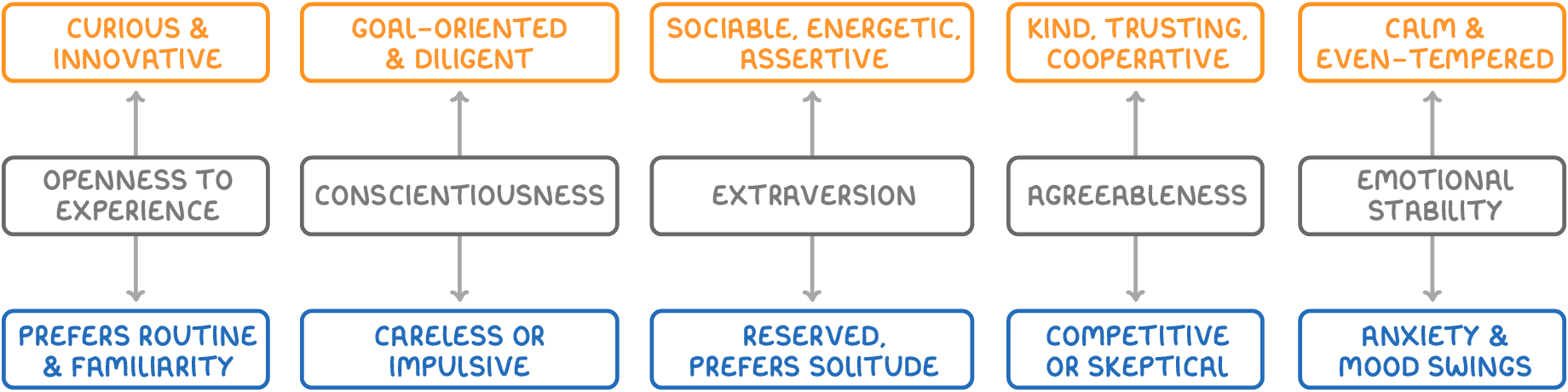
The five key traits of the Big Five model:
- Openness to experience - Reflects a person's imagination, creativity, and willingness to try new things. High scorers are often curious and innovative, while low scorers prefer routine and familiarity.
- Conscientiousness - Indicates a person's level of organization, responsibility, and dependability. Those high in this trait are goal-oriented and diligent, whereas those low in it may be more careless or impulsive.
- Extraversion - Measures sociability, energy, and assertiveness. Extraverts thrive in social settings and seek stimulation, while introverts (low extraversion) are more reserved and prefer solitude.
- Agreeableness - Captures traits like kindness, trust, and cooperation. Highly agreeable individuals are empathetic and get along well with others, while those low in agreeableness may be more competitive or skeptical.
- Emotional stability (also called Neuroticism when reversed) - Assesses emotional resilience and stability. High emotional stability means calmness and even-temperedness, while low stability (high neuroticism) is associated with anxiety and mood swings.
These traits are not just labels but are seen as dimensions along which individuals vary, providing a nuanced view of personality.
Assessing personality: methods in social-cognitive and trait theories
Both social-cognitive and trait theories have distinct approaches to assessing personality, reflecting their different focuses on dynamic processes versus stable characteristics. These assessment methods help psychologists understand individual differences and predict behavior in various contexts.
Assessment in social-cognitive theory
- Focus on self-reports - Individuals often describe their own thoughts, feelings, and behaviors through questionnaires or interviews, providing insight into their self-concept, self-efficacy, and self-esteem.
- Behavioral observations - Researchers may observe how people interact with their environment to see the effects of reciprocal determinism in real-time situations.
- Situational analysis - Assessments might include evaluating how specific contexts influence behavior, emphasizing the interaction between personal factors and environment.
Assessment in trait theories, particularly the Big Five
- Personality inventories - These are structured questionnaires designed to measure specific traits. Respondents answer a series of items, and their responses are scored to determine their standing on each trait dimension.
- Factor analysis - This statistical method is used to analyze responses to personality inventories. It identifies clusters of related items that correspond to underlying traits, helping to organize and validate the structure of personality models like the Big Five.
- Standardized testing - Tools like the NEO Personality Inventory are commonly used to assess the Big Five traits, providing reliable and comparable data across individuals.
These methods ensure that personality assessment is both systematic and tailored to the theoretical framework, whether focusing on dynamic interactions or enduring traits.