4.7 - Emotion
The nature of emotion as a psychological process
Emotion, often referred to as affect, is a complex psychological state that involves feelings, physiological changes, and behavioral responses. Unlike reasoning or factual knowledge, emotions are deeply personal and reflect both internal states (like mood or temperament) and external influences (such as social interactions or environmental events). They play a significant role in shaping how individuals think and act in various situations.
Key characteristics of emotion
- Multidimensional process - Emotions combine subjective feelings, bodily reactions (like a racing heart), and expressive behaviors (such as smiling or frowning).
- Internal and external triggers - They can arise from personal thoughts or memories as well as external events like a surprising encounter or a stressful situation.
- Impact on behavior - Emotions often guide decision-making, motivate actions, and influence interpersonal relationships.
Understanding emotions involves recognizing their complexity and the interplay between mind and body, which has been a central focus of psychological inquiry for over a century.
Theories explaining physiological and cognitive aspects of emotion
Early psychological theories from the 20th century sought to explain how emotions emerge by distinguishing between their physiological components (bodily changes) and cognitive components (mental interpretations). While specific theory names are not required for study, the core ideas about how these components interact provide valuable insight into emotional experiences.
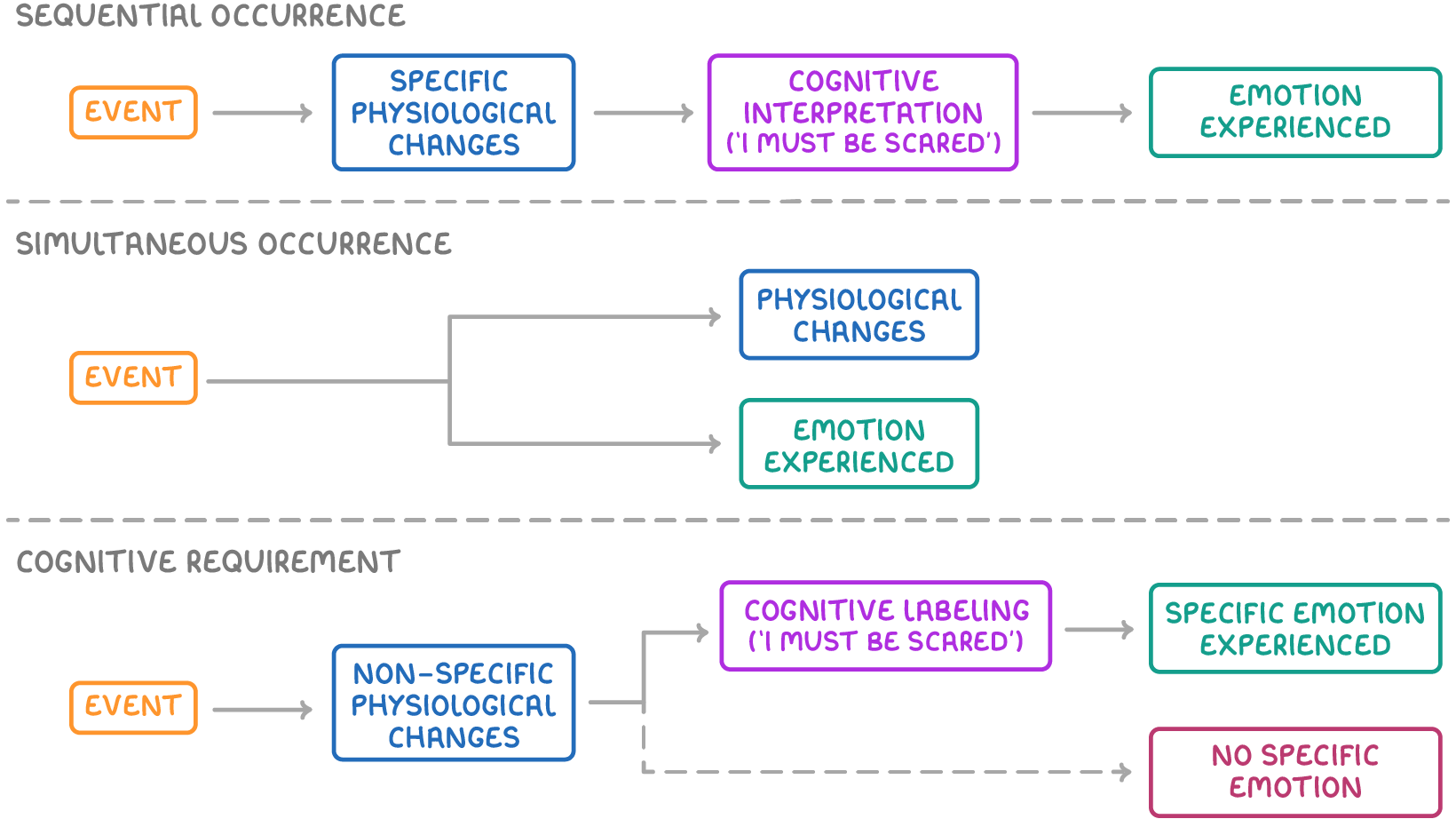
Perspectives on physiological and cognitive interaction
- Sequential occurrence - Some perspectives suggest that distinct physiological changes, such as an increased heart rate, happen first and are then followed by a specific cognitive interpretation that labels the emotion (e.g., "My heart is racing, so I must be scared").
- Simultaneous occurrence - Other views propose that physiological responses and the emotional experience occur at the same time, without requiring any cognitive interpretation.
- Cognitive requirement - Another perspective is that a cognitive label is actually required to fully experience an emotion, as physiological changes can be non-specific so the same bodily response (like increased heart rate) could correspond to different emotions. Without mentally labeling the feeling, those physiological changes alone do not lead to a specific emotion.
The facial feedback hypothesis
One intriguing concept, known as the facial feedback hypothesis, explores the idea that facial expressions can influence emotional experiences. This perspective aligns with theories suggesting that physiological responses can precede cognitive appraisal.
Key aspects of the facial feedback hypothesis:
- Mechanism - The hypothesis proposes that physically expressing an emotion, like smiling, can intensify or even trigger the corresponding feeling of happiness.
- Supporting evidence - Studies have shown that adopting specific facial expressions can lead to subtle changes in emotional state, suggesting a feedback loop between body and mind.
- Mixed research outcomes - While some experiments support this idea, results are inconsistent, indicating that facial expressions may not always directly cause or enhance emotions.
These differing views highlight the complexity of emotions and the ongoing debate about how body and mind interact to create them.
The broaden-and-build theory and its impact on behavior
The broaden-and-build theory focuses on the effects of positive and negative emotions on thought patterns and behaviors. This perspective suggests that emotions do more than just reflect internal states; they actively shape how individuals interact with the world.
Core principles of broaden-and-build theory
- Positive emotions broaden awareness - Feelings like joy, hope, or love expand a person's focus, encouraging exploration, creativity, and openness to new ideas or experiences. For example, feeling happy might prompt someone to try a new hobby or connect with new people.
- Positive emotions build resources - These broadened mindsets help build lasting psychological, social, and physical resources, such as resilience, stronger relationships, or improved problem-solving skills.
- Negative emotions narrow focus - Emotions like fear, anger, or sadness tend to limit attention to immediate concerns, often preparing individuals for specific actions like fight or flight. For instance, anxiety might focus someone solely on escaping a perceived threat.
- Behavioral implications - While negative emotions can be useful in urgent situations by narrowing focus, positive emotions foster long-term growth by promoting flexibility and innovation in thinking.
This theory underscores the adaptive value of emotions, showing how they influence mental processes and behaviors in distinct ways depending on their nature.
The influence of social norms and cultural factors on emotional expression
Emotional expression is not just a personal experience; it is heavily shaped by social norms and cultural contexts. The ways individuals display and interpret emotions often depend on societal expectations and learned behaviors rather than being purely instinctual.
Cultural differences in emotional expression
- Display rules - These are culturally specific guidelines that dictate how, when, and to whom emotions can be expressed. For example, in some cultures, openly showing sadness at a funeral is expected, while in others, maintaining composure is the norm.
- Elicitors of emotion - The stimuli or events that trigger emotions can vary across cultures. An event considered a cause for celebration in one society might evoke indifference or even negativity in another.
- Variations within cultures - Within a single culture, display rules may differ based on factors like gender, age, or socioeconomic status. For instance, men and women might face different expectations about showing anger or vulnerability.
These differences highlight how social experiences mold emotional expression, often overriding individual inclinations to align with cultural standards.
Cross-cultural research on the universality of emotions
Researchers have long investigated whether certain emotions are experienced and expressed similarly across all human cultures, or if they are largely shaped by cultural context. This area of study provides insight into the balance between biological instincts and social influences in emotional life.
Emotions potentially universal across cultures
Some emotions appear to be recognized and expressed in similar ways worldwide, suggesting a possible biological basis.

Examples of potentially universal emotions:
- Anger - Often shown through furrowed brows and a tense posture, typically in response to perceived injustice or threat.
- Disgust - Characterized by a wrinkled nose or grimace, usually triggered by something offensive or harmful.
- Sadness - Marked by downward facial expressions and withdrawal, often linked to loss or disappointment.
- Happiness - Expressed with smiles and laughter, generally associated with positive experiences or achievements.
- Surprise - Indicated by widened eyes and raised eyebrows, reflecting an unexpected event.
- Fear - Visible through wide eyes and tense muscles, often a response to danger or uncertainty.
Research findings on universality
- Mixed results - Studies yield conflicting evidence. While some research supports the idea that these basic emotions are universally recognized through facial expressions, other findings suggest that cultural context heavily influences interpretation.
- Cultural nuances - Even when emotions are similarly felt, the intensity, context, or acceptable expression can differ significantly. For instance, happiness might be universally felt, but how openly it is shown can vary widely.
This ongoing debate reflects the intricate interplay between innate human tendencies and the social environments that shape emotional experiences.