5.3 - Explaining & Classifying Psychological Disorders
Approaches to defining psychological disorders
Psychological disorders are behaviors or mental processes that deviate from what is considered typical or healthy. To identify these disorders, professionals use specific criteria to assess whether an individual's experiences or actions warrant a diagnosis.
Key criteria for identifying psychological disorders
- Level of dysfunction - This refers to the degree to which a behavior or mental process interferes with an individual's ability to carry out daily activities, such as maintaining relationships, working, or self-care.
- Perception of distress - This focuses on the individual's subjective experience of emotional pain or discomfort, which may indicate a disorder even if it isn't outwardly visible.
- Deviation from social norms - Behaviors or thoughts that significantly differ from what is culturally or socially expected can be considered disordered, though this criterion must account for cultural context to avoid misjudgment.
These factors help professionals distinguish between typical variations in behavior and conditions that require intervention. However, applying these criteria isn't always straightforward due to cultural differences and individual perceptions.
Positive and negative consequences of diagnosing disorders
Diagnosing psychological disorders can have significant impacts, both beneficial and harmful, depending on various factors. While a diagnosis can provide clarity and access to treatment, it can also carry unintended consequences.
Positive consequences of diagnosis
- Access to treatment - A formal diagnosis often opens doors to therapy, medication, or support services that can improve quality of life.
- Validation and understanding - For many individuals, a diagnosis helps explain their struggles, reducing self-blame and fostering a sense of relief.
- Guided interventions - It allows professionals to tailor specific treatments based on the identified disorder.
Negative consequences of diagnosis
- Stigma and labeling - A diagnosis can lead to societal judgment or stereotyping, causing individuals to feel isolated or misunderstood.
- Discrimination risks - Factors like racism, sexism, ageism, or cultural biases can influence how a diagnosis is perceived or applied, sometimes leading to unfair treatment in workplaces or communities.
- Misdiagnosis potential - Incorrect diagnoses due to cultural misunderstandings or insufficient information can result in inappropriate treatment and prolonged distress.
These consequences highlight the importance of approaching diagnosis with sensitivity and awareness of individual and societal contexts.
Tools for classifying psychological disorders
Classifying psychological disorders requires specialized training and the use of standardized tools to ensure accuracy and consistency. Two primary systems are widely used globally to categorize and diagnose mental health conditions.
Major classification systems
- Diagnostic and Statistical Manual of Mental Disorders (DSM) - Developed by the American Psychiatric Association, this manual provides detailed criteria for diagnosing mental disorders. It is regularly updated to reflect new research and clinical insights, ensuring its relevance in practice.
- International Classification of Diseases (ICD) - Created by the World Health Organization, this system classifies both mental and physical disorders. Like the DSM, it undergoes periodic revisions to incorporate advances in understanding and treatment approaches.
These tools are essential for professionals as they provide a common language and framework for diagnosis. This consistency helps in research, treatment planning, and communication across different regions and cultures.
Psychological perspectives on the causes of disorders
Psychologists often use multiple perspectives to understand and treat psychological disorders, adopting an eclectic approach that combines insights from various theories. Each perspective offers a unique lens on why disorders develop, focusing on different aspects of human experience.
Different perspectives and their explanations
- Behavioral perspective - Suggests that disorders arise from maladaptive learned associations. For example, a phobia might develop from a negative experience being paired with a specific stimulus, leading to fear responses over time.
- Psychodynamic perspective - Focuses on unconscious thoughts and childhood experiences as the root of disorders. This view posits that unresolved conflicts or repressed emotions can manifest as mental health issues later in life.
- Humanistic perspective - Emphasizes a lack of social support and barriers to self-fulfillment. Disorders may emerge when individuals feel disconnected or unable to achieve their potential due to external or internal obstacles.
- Cognitive perspective - Highlights maladaptive thoughts, beliefs, attitudes, or emotions as causes. For instance, persistent negative thinking patterns might contribute to disorders like depression or anxiety.
- Evolutionary perspective - Considers behaviors or mental processes that reduce survival chances. This view might explain anxiety as an overactive survival mechanism that becomes detrimental in modern contexts.
- Sociocultural perspective - Points to maladaptive social and cultural relationships. Disorders can stem from societal pressures, discrimination, or dysfunctional family dynamics that shape behavior negatively.
- Biological perspective - Focuses on physiological or genetic factors. This includes brain chemistry imbalances, genetic predispositions, or physical health issues that influence mental well-being.
By integrating these perspectives, psychologists can form a more comprehensive understanding of a disorder's origins, tailoring treatments to address multiple contributing factors.
Interaction models for understanding psychological disorders
Beyond individual perspectives, interaction models consider how different factors combine to contribute to psychological disorders. These models recognize the complexity of mental health and the interplay of various influences.
Biopsychosocial model
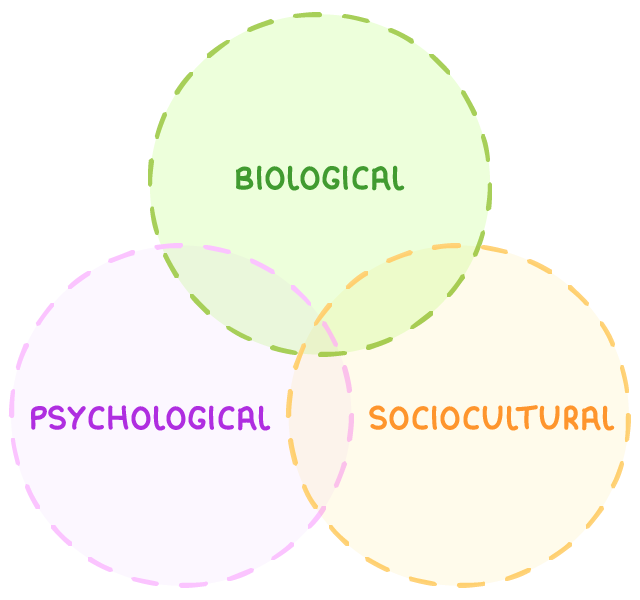
This model assumes that psychological disorders result from a combination of three main factors:
- Biological factors - Genetic predispositions, brain chemistry, or physical health conditions.
- Psychological factors - Thoughts, emotions, and behaviors that influence mental state.
- Sociocultural factors - Social environment, cultural norms, and interpersonal relationships.
By considering all these elements, the model provides a holistic view, suggesting that no single factor alone is sufficient to explain a disorder. For example, depression might involve a genetic tendency, negative thought patterns, and a lack of social support.
Diathesis-stress model
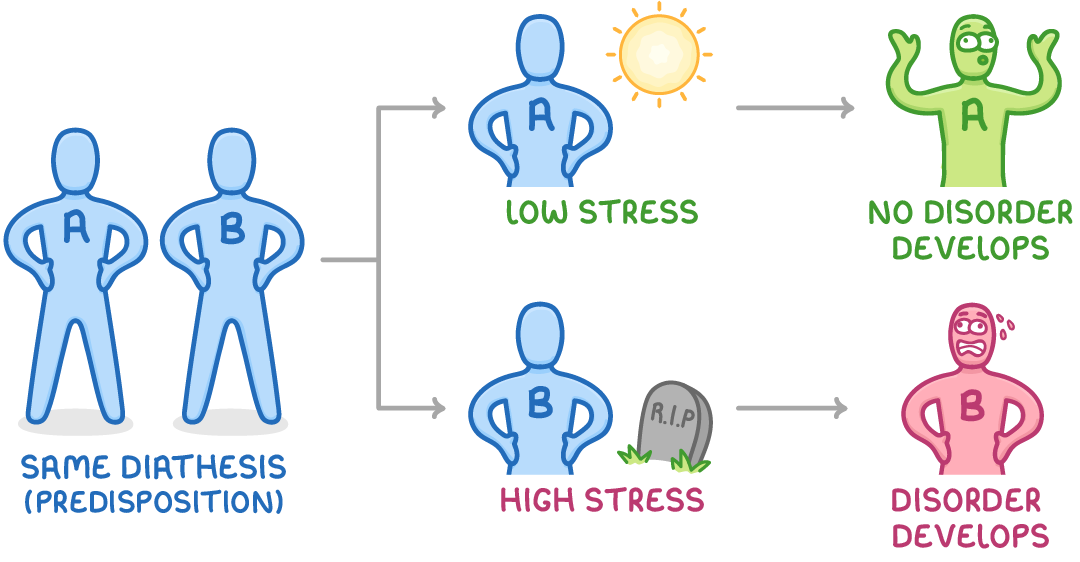
This model proposes that disorders develop from a predisposition or vulnerability, known as diathesis, interacting with stressful life experiences, referred to as stress.
Key components:
- Diathesis - A predisposition or inherent risk for a disorder, such as a family history of anxiety.
- Stress - Environmental triggers like trauma, loss, or chronic pressure that activate the vulnerability.
The combination of these elements can lead to the onset of a disorder, even if neither factor alone would be sufficient. For instance, someone with a genetic risk for schizophrenia might not develop the condition unless exposed to significant stressors.
These interaction models underscore the importance of looking at mental health through a multifaceted lens, acknowledging that biological, psychological, and environmental components often work together to shape outcomes.