1.7 - Proteins
What proteins are and why they matter
Proteins are large, complex molecules that play critical roles in nearly every biological process within living organisms. They are essential for structure, function, and regulation of the body's tissues and organs. From building muscle to catalyzing chemical reactions as enzymes, proteins are vital to life.
Key roles of proteins in living systems
- Structural support - Proteins like collagen provide strength and support to tissues such as skin and bones.
- Enzymatic activity - Many proteins act as enzymes, speeding up biochemical reactions necessary for metabolism and other processes.
- Transport and storage - Proteins like hemoglobin transport oxygen in the blood, while others store essential molecules.
- Signaling and regulation - Proteins are involved in cell communication, immune responses, and controlling gene expression.
Understanding proteins begins with their basic components and how these components come together to create functional molecules.
Building blocks of proteins: Amino acids
Proteins are made up of smaller units called amino acids, which are organic molecules that link together to form long chains. While the detailed molecular structure of amino acids is not required for this course, knowing their general composition and properties is crucial for understanding protein formation.
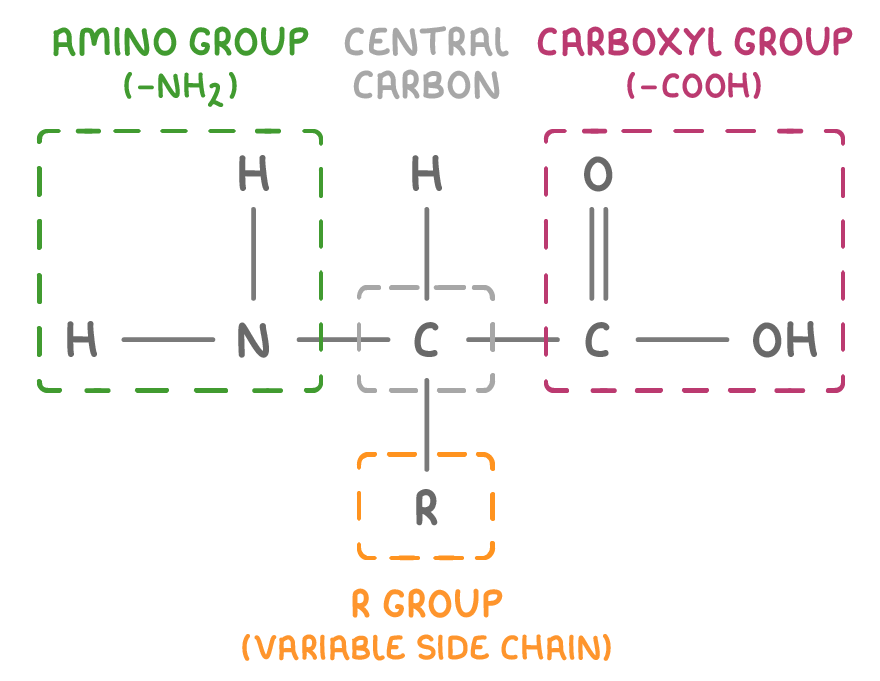
Components of amino acids
- Central carbon atom - The core of an amino acid, to which other groups are attached.
- Hydrogen atom - Bonded to the central carbon, contributing to the molecule's structure.
- Carboxyl group (-COOH) - A functional group that can release a hydrogen ion, playing a role in linking amino acids together.
- Amino group (-NH2) - A functional group that can accept a hydrogen ion, also critical for linking amino acids.
- R group (variable side chain) - A unique group that varies between different amino acids, determining their chemical properties and interactions.
Categories of R groups and their properties
- Hydrophobic/nonpolar - These R groups repel water and tend to cluster together in the interior of proteins, away from aqueous environments.
- Hydrophilic/polar - These R groups attract water and are often found on the protein's surface, interacting with the surrounding environment.
- Ionic (charged) - These R groups carry a positive or negative charge, forming ionic bonds with oppositely charged groups, which can stabilize protein structure.
The specific R group on each amino acid influences how it interacts with other amino acids, ultimately shaping the protein's structure and function.
Formation of polypeptide chains
Amino acids link together in a specific order to form polypeptide chains, which are the foundation of proteins. This process involves a chemical reaction that creates strong bonds between amino acids.
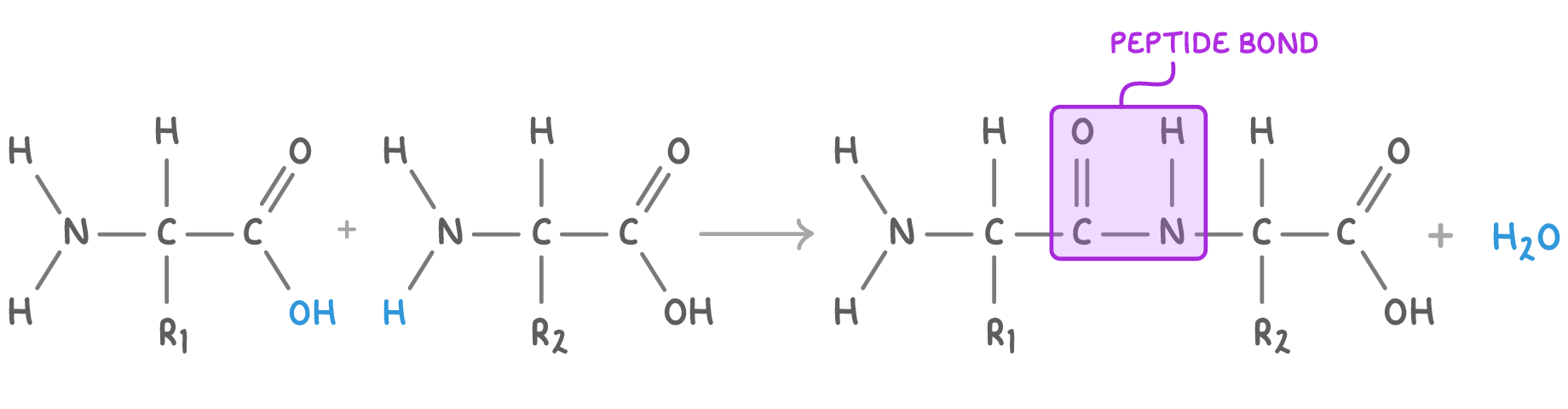
How amino acids connect
- Peptide bond formation - A covalent bond forms between the carboxyl group of one amino acid and the amino group of the next amino acid. This reaction releases a water molecule in a process known as dehydration synthesis.
- Chain growth - As more amino acids are added through peptide bonds, a linear chain called a polypeptide is formed. A single protein may consist of one or more polypeptide chains.
This linear sequence of amino acids is just the starting point. The way this chain folds and interacts determines the protein's final shape and function.
Levels of protein structure
Proteins are not just simple chains; they fold into intricate three-dimensional shapes that are critical to their function. There are four levels of protein structure, each building on the previous one, determined by various interactions between amino acids.
Primary structure: Sequence of amino acids
Primary structure is the linear sequence of amino acids in a polypeptide chain, linked by peptide bonds. This sequence acts as the blueprint for the protein. Even a single change in the order of amino acids can alter the protein's overall shape and function. The specific order is dictated by the genetic code, ensuring each protein has a unique primary structure.
Secondary structure: Local folding patterns
Secondary structure refers to the local folding of the polypeptide chain into specific shapes due to interactions between atoms in the backbone of the chain. Hydrogen bonds form between the carbonyl oxygen of one amino acid and the hydrogen of another, stabilizing these structures.
Common secondary structure shapes:
- Alpha-helix - A coiled, spiral shape resembling a spring, held together by hydrogen bonds along the backbone.
- Beta-pleated sheet - A flat, folded structure where segments of the chain lie parallel or antiparallel to each other, connected by hydrogen bonds.
These folded patterns provide the initial framework for the protein's final shape.
Tertiary structure: Three-dimensional folding
Tertiary structure is the overall three-dimensional shape of a single polypeptide chain, resulting from interactions between the R groups of amino acids.
Key interactions in tertiary structure:
- Hydrogen bonds - Form between polar R groups, adding stability.
- Hydrophobic interactions - Nonpolar R groups cluster together away from water, often in the protein's core.
- Ionic bonds - Form between oppositely charged R groups, locking parts of the structure in place.
- Disulfide bridges - Strong covalent bonds between sulfur atoms in amino acids like cysteine, providing significant stability.
This level determines the protein's unique shape, which is crucial for its specific function, such as an enzyme's active site fitting a particular substrate.
Quaternary structure: Multi-subunit assembly
Quaternary structure occurs when two or more polypeptide chains (subunits) come together to form a functional protein. The same forces that stabilize tertiary structure (hydrogen bonds, hydrophobic interactions, ionic bonds, and disulfide bridges) hold the subunits together.
Not all proteins have quaternary structure, but for those that do, the arrangement of subunits is essential for their biological activity. For example, hemoglobin, which is a protein that carries oxygen in blood, consists of four polypeptide subunits that can each carry an oxygen molecule, working as a single unit.
Each level of structure builds upon the previous one, and together, they define how a protein will function in the body.
Relationship between protein structure and function
The specific shape of a protein, determined by its structure at all four levels, is directly linked to its biological role. This precise configuration allows proteins to interact with other molecules in highly specific ways.
How structure determines function
- Shape specificity - The three-dimensional shape of a protein creates specific binding sites or active sites that match particular molecules, like a lock fitting a key.
- Functional diversity - Different structures enable proteins to perform a wide range of functions, from catalyzing reactions (enzymes) to providing structural support (keratin in hair and nails).
- Interaction precision - The arrangement of R groups on the protein's surface dictates how it interacts with other molecules, ensuring accurate biological responses.
This close relationship means that any alteration in structure can profoundly affect a protein's ability to perform its role.
Impact of disruptions to protein structure
Changes or disruptions to a protein's structure can lead to loss of function, often with significant consequences for the organism. These disruptions can occur due to environmental factors, genetic mutations, or chemical interference.
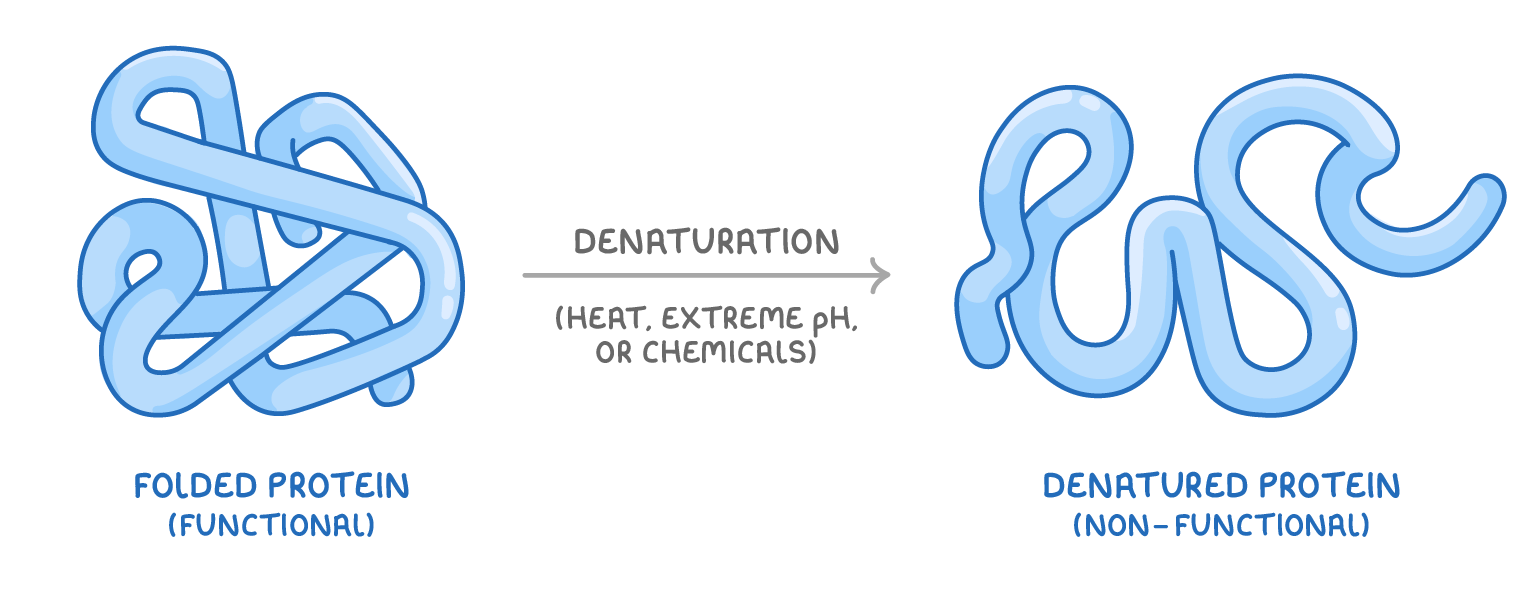
Causes and effects of structural disruption
- Denaturation - A process where a protein loses its natural shape due to high temperatures, extreme pH, or exposure to certain chemicals. This breaks the weak bonds (like hydrogen bonds) holding the tertiary and secondary structures together, causing the protein to unfold.
- Loss of function - When a protein's shape is altered, it can no longer bind to its target molecules or perform its role. For example, a denatured enzyme loses its ability to catalyze reactions.
- Biological impact - Structural disruptions can lead to diseases. For instance, in sickle cell anemia, a single amino acid change in hemoglobin's primary structure alters its shape, reducing its ability to carry oxygen effectively.
- Aggregation - Misfolded proteins can clump together, forming aggregates that interfere with cellular processes. This is seen in neurodegenerative diseases like Alzheimer's, where protein aggregates contribute to neuron damage.
These examples highlight how critical the precise structure of proteins is to maintaining life processes.