8.7 - Disruptions in Ecosystems
The role of adaptations and genetic variations in environmental response
Ecosystems are dynamic environments where organisms constantly interact with their surroundings. Genetic variations within populations play a critical role in how species respond to environmental changes, often determining their survival and reproductive success.
Adaptations
An adaptation is a genetic variation favored by natural selection, resulting in a trait that gives an organism an advantage in a specific environment. Adaptations enhance an organism's ability to survive and reproduce under particular conditions, such as camouflage in predators or drought resistance in plants. Over time, individuals with advantageous traits are more likely to pass on their genes, increasing the frequency of these traits in the population.
Heterozygote advantage in populations
Heterozygote advantage occurs when individuals with a heterozygous genotype (having two different alleles for a gene) have higher relative fitness compared to those with homozygous dominant or homozygous recessive genotypes.
Example of heterozygote advantage:
- In humans, the sickle cell trait (heterozygous condition) provides resistance to malaria, a deadly disease in certain regions.
- Homozygous recessive individuals suffer from sickle cell anemia.
- Homozygous dominant individuals lack malaria resistance.
- This advantage helps maintain genetic diversity by ensuring that multiple alleles remain in the population, even under selective pressure.
Mutations and environmental pressures
- Random nature of mutations - Mutations, which are changes in the DNA sequence, occur randomly and are not directed by specific environmental needs or pressures.
- Role in variation - These random changes provide the raw material for evolution, as some mutations may become beneficial if environmental conditions change.
- Interaction with environment - While mutations are not targeted, those that confer an advantage in a given environment are more likely to be selected for, driving evolutionary change over generations.
The impact of invasive species on ecosystem dynamics
Invasive species are organisms introduced, either intentionally or unintentionally, into a new environment where they are not native. Their presence often disrupts the balance of ecosystems by altering resource availability and species interactions.
How invasive species affect ecosystems
- Exploitation of new niches - Invasive species can exploit ecological niches free of natural predators or competitors, allowing rapid population growth.
- Outcompeting native species - They often outcompete native organisms for resources like food, water, or habitat space, leading to declines in native populations.
- Disruption of food webs - By altering predator-prey relationships or resource distribution, invasive species can destabilize entire food webs.
Examples of invasive species
- Kudzu - A fast-growing vine introduced to the United States from Asia, kudzu smothers native plants by blocking sunlight, drastically altering habitats in the southeastern US.
- Zebra mussels - Introduced into North American waterways, these mussels outcompete native species for food and clog water intake systems, affecting both ecosystems and human infrastructure.
Human activities disrupting ecosystem structure and dynamics
Human actions often accelerate changes in ecosystems, leading to shifts in structure and dynamics at both local and global scales. These activities can drive species extinctions and alter biodiversity.
Biomagnification
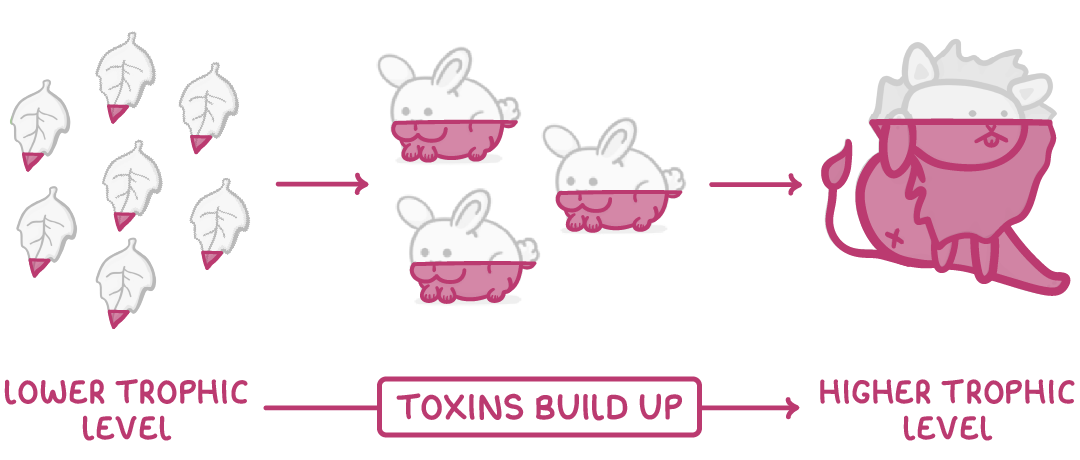
This process involves the increasing concentration of toxic substances, like pesticides or heavy metals, in organisms at higher trophic levels of the food chain. As predators consume contaminated prey, toxins accumulate in their tissues, often causing reproductive failure or death in top predators like lions.
Eutrophication
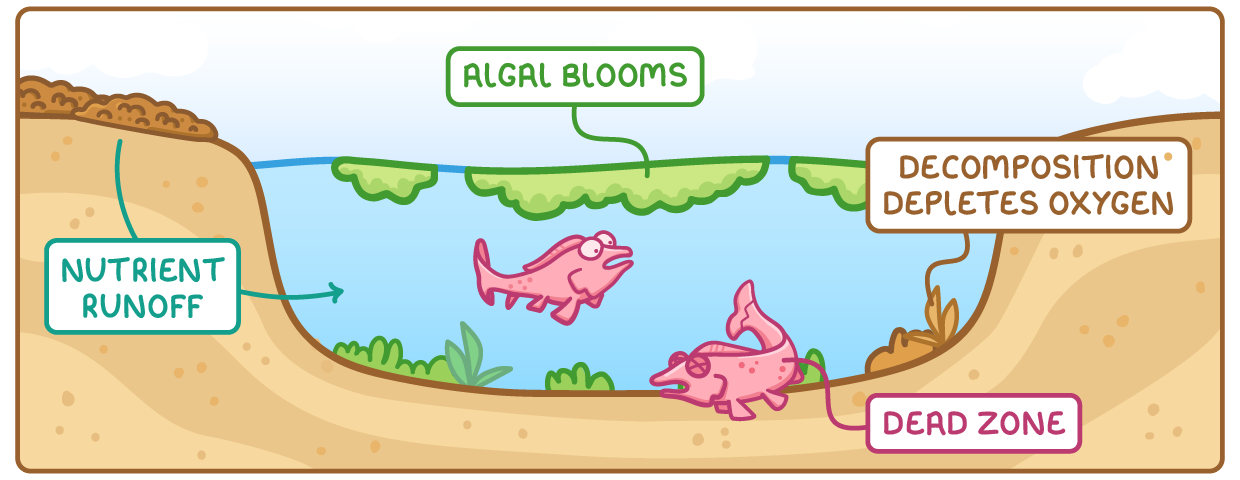
This happens when excessive nutrient input, often from agricultural runoff containing fertilizers, leads to algal blooms in water bodies. These blooms deplete oxygen levels as they decompose, creating "dead zones" where aquatic life cannot survive.
Consequences of human impact
- Accelerated extinction rates - Human-driven changes often occur faster than species can adapt, leading to loss of biodiversity.
- Habitat alteration - Activities like deforestation and urbanization fragment or destroy habitats, reducing the space and resources available for native species.
- Global scale effects - Actions in one region, such as industrial pollution, can contribute to worldwide issues like climate change, affecting ecosystems far beyond their origin.
Geological and meteorological events as drivers of ecosystem change
Natural events driven by geological and meteorological forces also play a significant role in reshaping ecosystems. These events can alter habitats and influence the distribution of species over time.
Types of geological and meteorological disruptions
- Geological events - Processes like continental drift, where tectonic plates shift over millions of years, have historically separated or merged ecosystems, leading to speciation or extinction. Meteor impacts, such as the one believed to have caused the extinction of dinosaurs 66 million years ago, can trigger mass extinctions by altering climate and habitats.
- Meteorological events - Phenomena like El Niño, a periodic warming of Pacific Ocean waters, disrupt weather patterns globally, affecting precipitation and temperature, which in turn impact ecosystems such as coral reefs and rainforests.
- Climate change - Global climate change, driven by both natural and human factors, shifts temperature and precipitation patterns, forcing species to migrate, adapt, or face extinction.
Human-influenced geological and meteorological changes
- Logging - Large-scale removal of trees alters soil stability and local climates, leading to erosion and habitat loss for forest-dependent species.
- Urbanization - The expansion of cities replaces natural habitats with impervious surfaces, disrupting water cycles and reducing biodiversity.
- Monocropping - Planting a single crop over large areas reduces soil health and biodiversity, making ecosystems more vulnerable to pests and climate shifts.
Biogeographical studies and ecosystem distribution
- Tracking changes - Biogeography, the study of the distribution of species and ecosystems across geographic space and time, helps scientists understand how geological and meteorological events shape biodiversity.
- Evidence from history - Fossil records and current species distributions show how past events like continental drift have isolated populations, leading to divergent evolution, while modern climate shifts are causing species to move toward poles or higher elevations.
Data analysis in evaluating ecological hypotheses
In ecology, data analysis and statistical tests are critical for evaluating hypotheses about ecosystem disruptions and species interactions. These methods help determine whether observed changes support or refute predictions about environmental impacts.
Importance of statistical tests
- Hypothesis testing - Statistical tests allow ecologists to assess whether data supports a hypothesis, such as the impact of an invasive species on native populations, or fails to reject the null hypothesis (no effect).
- Quantifying change - Data on population sizes, species diversity, or pollutant levels can be analyzed to measure the extent of disruptions like eutrophication or biomagnification.
- Predictive models - Statistical tools help predict future ecosystem changes based on current trends, aiding in conservation planning and policy-making.
Application in ecosystem studies
- Field data collection - Observations of species abundance before and after an event, like the introduction of zebra mussels, provide raw data for analysis.
- Evaluating significance - Tests determine if changes in ecosystem dynamics are statistically significant or due to random variation, ensuring conclusions are reliable.
- Informing management - Data-driven insights guide actions to mitigate disruptions, such as controlling invasive species or reducing nutrient runoff to prevent eutrophication.