2.2 - Cell Size
The importance of surface area-to-volume ratios in cells
Cells, as the fundamental units of life, must exchange materials like nutrients, waste, and gases with their environment to survive and function.
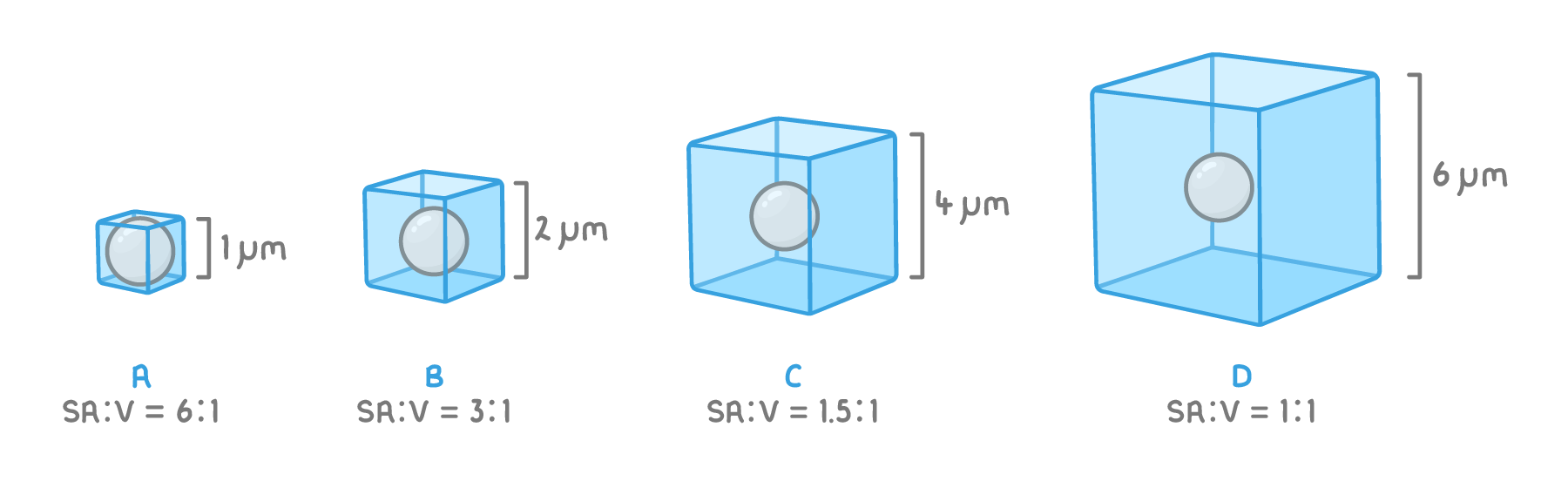
The surface area-to-volume (SA:V) ratio is a critical factor that determines how efficiently a cell can perform these exchanges. This ratio compares the area available for exchange (surface area) to the amount of material that needs to be supported (volume), directly influencing a cell's ability to obtain resources and eliminate waste. Generally, as size increases, the SA:V ratio decreases.
Why surface area-to-volume ratios matter
- Material exchange - The surface area of a cell's plasma membrane must be large enough to allow sufficient exchange of chemicals and energy with the environment.
- Resource acquisition - Nutrients and oxygen must enter the cell, while waste products and excess heat must exit, all through the surface.
- Efficiency determinant - A higher SA:V ratio means a larger surface relative to the cell's volume, allowing more efficient exchange compared to a lower ratio.
This concept is not just limited to cells but extends to whole organisms, affecting how they interact with their surroundings.
How surface area-to-volume ratios affect material exchange
As cells grow larger, their volume increases much faster than their surface area, leading to a decrease in the SA:V ratio. This relationship has profound implications for how effectively a cell can exchange materials with its environment.
Key effects of SA:V ratios on exchange
- Smaller cells, higher efficiency - Smaller cells have a higher SA:V ratio, meaning they can exchange materials more efficiently because a larger proportion of their volume is close to the surface.
- Larger cells, reduced efficiency - As a cell's volume increases, the SA:V ratio decreases, reducing the surface area available for exchange relative to the cell's needs. This makes it harder to supply internal resources or remove waste.
- Demand for resources - Larger cells have a greater internal volume, increasing the demand for nutrients and oxygen while producing more waste, which exacerbates the challenge of maintaining efficient exchange.
This principle explains why cells cannot grow indefinitely large and why specific adaptations are necessary to overcome limitations imposed by size.
The impact of cell size and shape on efficiency
Cell size and shape are not arbitrary; they are constrained by the need to maintain an adequate SA:V ratio for survival. These physical characteristics play a significant role in determining how well a cell can function.
Constraints imposed by size and shape
- Size restriction - Most cells remain small to keep a high SA:V ratio, ensuring efficient material exchange. If a cell becomes too large, the distance from the surface to the center increases, slowing down diffusion and transport processes.
- Shape influence - Cells often adopt shapes that maximize surface area relative to volume. For example, flattened or elongated shapes provide more surface for exchange compared to a perfect sphere of the same volume.
This balance between size and shape is a fundamental reason why cells in multicellular organisms are specialized and vary in structure depending on their function.
Adaptations for increasing surface area in cells and organisms
To overcome the limitations of a decreasing SA:V ratio as size increases, cells and organisms have evolved structural adaptations that enhance surface area for more effective exchange with the environment.
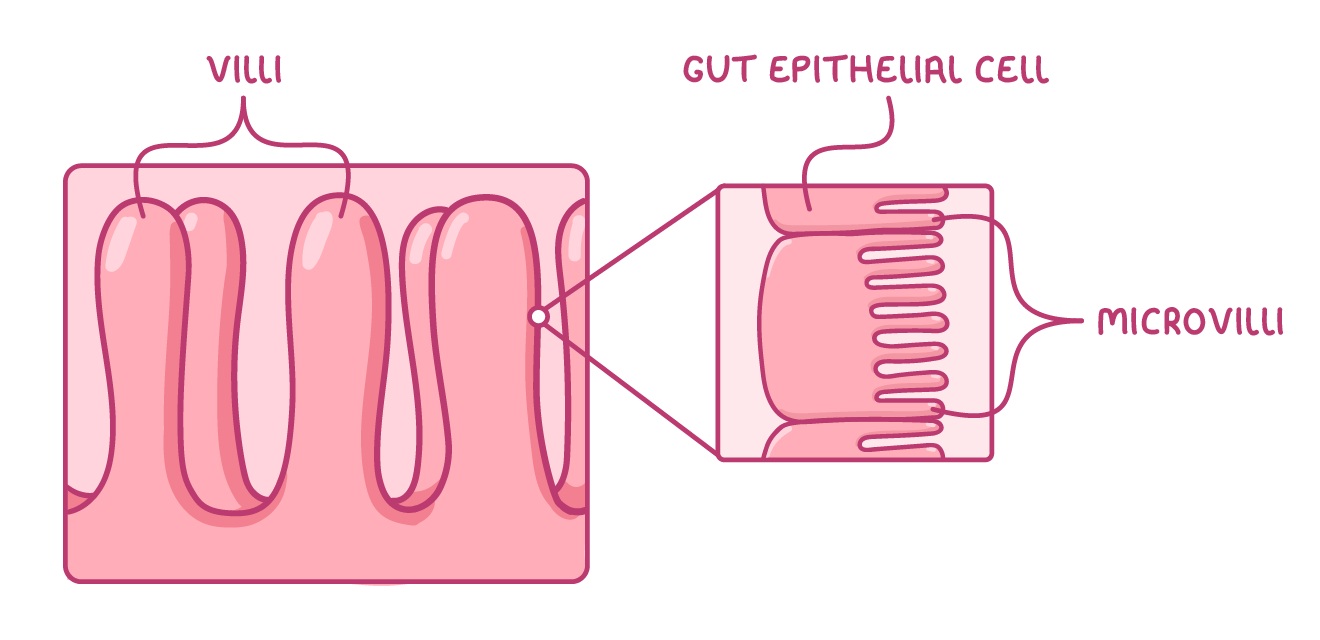
Cellular adaptations for material exchange
- Membrane folds - Some cells develop folds or projections in their plasma membrane to increase surface area. For example, microvilli in gut epithelial cells (specialized cells lining the intestine) dramatically boost the area available for nutrient absorption.
- Root hairs - In plants, root hair cells extend as thin projections from the root surface, increasing the surface area for water and mineral uptake from the soil.
- Cilia - Tiny hair-like structures on cell surfaces, such as in respiratory cells, increase surface area and aid in moving substances across the cell surface.
Organism-level adaptations for exchange
- Guard cells and stomata - In plants, guard cells control the opening and closing of stomata (small pores on leaves), maximizing surface area for gas exchange while minimizing water loss.
- Gut epithelial cells - In animals, the lining of the digestive tract is folded into villi and microvilli, vastly increasing the surface area for nutrient absorption.
These adaptations illustrate how biological systems counteract the challenges posed by SA:V ratios to maintain efficient exchange with their environment.
The relationship between organism size, metabolic rate, and heat exchange
The SA:V ratio doesn't just apply to cells; it also affects whole organisms, particularly in terms of metabolic rate and heat exchange with the environment. As organisms increase in size, their SA:V ratio decreases, influencing key physiological processes.
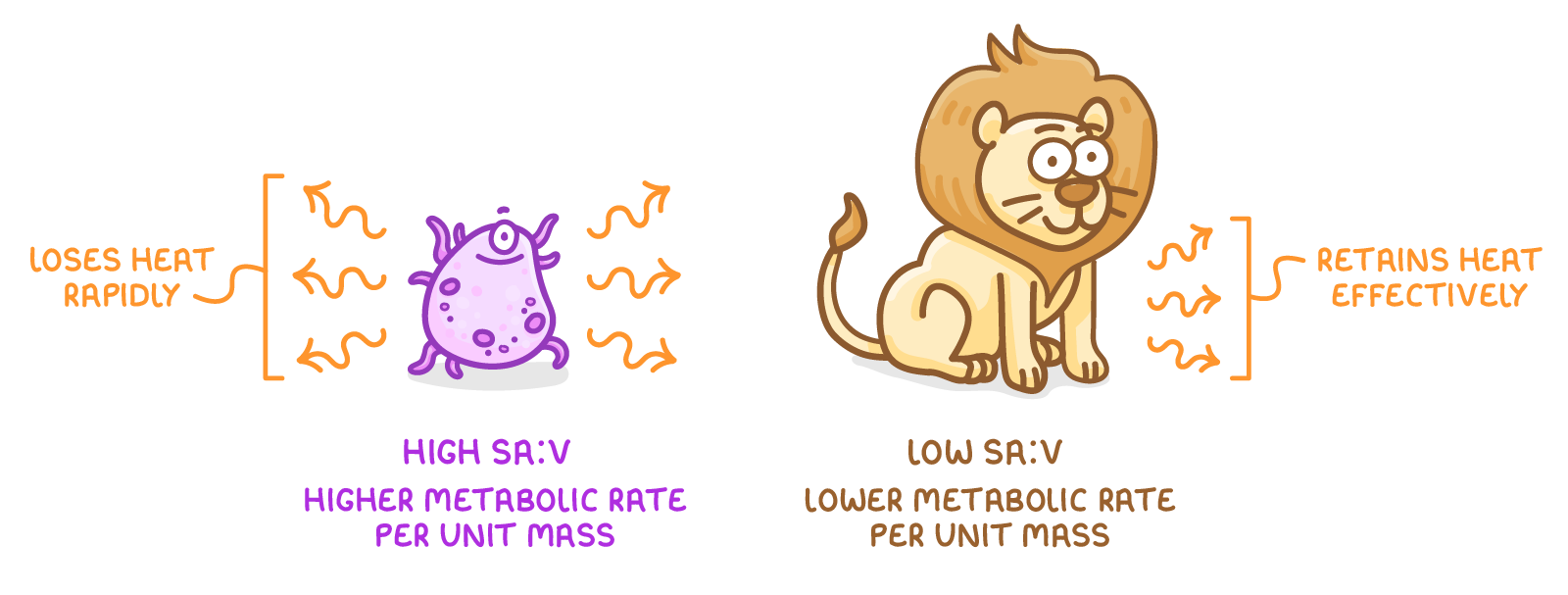
Effects of size on metabolic rate and heat exchange
- Metabolic rate per unit mass - Smaller organisms typically have a higher metabolic rate per unit body mass compared to larger organisms. This is because a higher SA:V ratio in smaller organisms allows for faster exchange of energy and materials to support metabolism.
- Heat exchange with the environment - Smaller organisms lose heat more rapidly due to their higher SA:V ratio, as a larger proportion of their body mass is exposed to the environment. Conversely, larger organisms retain heat more effectively because their lower SA:V ratio means less surface area relative to volume for heat loss.
- Proportional impact - As mass increases, both the SA:V ratio and the rate of heat exchange decrease, meaning larger organisms exchange less heat proportionally compared to smaller ones.
This relationship explains why small animals, like mice, have high energy demands and need to eat frequently, while larger animals, like elephants, can sustain themselves with less frequent feeding relative to their body mass.
Mathematical calculations for surface area and volume
Understanding SA:V ratios often involves mathematical calculations to quantify how surface area and volume change with size. These calculations are essential for comparing the efficiency of different cell or organism shapes and sizes.
Formulas for surface area and volume
Below are the key equations used to calculate surface area and volume for common geometric shapes relevant to biological systems.
Formula for a sphere:
- Volume (V):
- Surface Area (SA):
Where:
- r = Radius
Formula for a cube:
- Volume (V):
- Surface Area (SA):
Where:
- s = Length of one side of the cube
Formula for a rectangular solid:
- Volume (V):
- Surface Area (SA):
Where:
- l = Length
- w = Width
- h = Height
Formula for a cylinder:
- Volume (V):
- Surface Area (SA):
Where:
- r = Radius
- h = Height
These formulas allow for precise calculations of SA:V ratios by dividing the surface area by the volume for any given shape.
Worked example - Calculating surface area-to-volume ratio for a cube
Calculate the surface area-to-volume ratio for a cube with a side length of 2 cm.
Step 1: Identify the formulas
- Volume:
- Surface Area:
Step 2: Calculate volume
Step 3: Calculate surface area
Step 4: Calculate SA:V ratio
This result means there are 3 square centimeters of surface area for every cubic centimeter of volume, indicating the efficiency of material exchange for this cube.
Worked example - Comparing SA:V ratios for different-sized spheres
Compare the surface area-to-volume ratios of two spherical cells, one with a radius of 1 µm and another with a radius of 2 µm.
Step 1: Identify the formulas
- Volume:
- Surface Area:
Step 2: Calculate for radius = 1 µm
- Volume:
- Surface Area:
- SA:V ratio:
Step 3: Calculate for radius = 2 µm
- Volume:
- Surface Area:
- SA:V ratio:
Step 4: Interpretation
The smaller sphere (radius 1 µm) has a higher SA:V ratio of approximately 3.00 µm-1 compared to the larger sphere (radius 2 µm) with a ratio of approximately 1.50 µm-1. This demonstrates that as size increases, the SA:V ratio decreases, reducing the efficiency of material exchange.