3.2 - Environmental Impacts on Enzyme Function
The role of enzyme structure in catalytic function
Enzymes are specialized proteins that act as biological catalysts, speeding up chemical reactions in living organisms by lowering the activation energy required for the reaction to proceed. Their ability to function effectively depends heavily on their unique three-dimensional structure, which is critical for binding to specific substrates - the molecules upon which enzymes act.
Key features of enzyme structure
- Active site - A specific region on the enzyme where the substrate binds, forming an enzyme-substrate complex. This site is shaped to fit the substrate like a lock and key.
- Hydrogen bonds and interactions - The enzyme's structure is stabilized by hydrogen bonds, ionic bonds, and other interactions that maintain its precise shape.
- Specificity - Due to their structural precision, enzymes are highly specific, catalyzing only particular reactions with specific substrates.
This structural integrity allows enzymes to facilitate reactions essential for processes like digestion, energy production, and DNA replication. Any alteration to this structure can impact the enzyme's ability to bind to its substrate and catalyze the reaction.
How environmental factors like temperature and pH affect enzyme activity
Enzymes operate most efficiently within specific environmental conditions. Factors such as temperature and pH can significantly influence their activity by altering their structural integrity or the dynamics of molecular interactions.
Temperature effects on enzyme activity
- Molecular movement - Higher temperatures increase the average speed of molecules in a solution, leading to more frequent collisions between enzymes and substrates. This generally increases the reaction rate up to a certain point.
- Optimal temperature - Each enzyme has an optimal temperature at which it functions most efficiently. For many human enzymes, this is around 37°C, the normal body temperature.
- Beyond optimal temperature - Excessive heat disrupts hydrogen bonds and other interactions holding the enzyme's structure together, reducing its catalytic efficiency or stopping activity altogether.
pH effects on enzyme activity
- Optimal pH range - Enzymes have a specific pH range where they work best, as pH affects the charge and shape of the active site. For example, pepsin, an enzyme in the stomach, works best at a highly acidic pH of about 2, while trypsin in the small intestine functions optimally at a pH of about 8.
- Deviation from optimal pH - pH levels outside the optimal range can disrupt the enzyme's structure by altering hydrogen bonds, changing the shape of the active site, and reducing the enzyme's ability to bind to its substrate.
These environmental factors demonstrate how sensitive enzymes are to their surroundings, as even small changes can alter their efficiency in catalyzing vital biological reactions.
The concept of enzyme denaturation and its reversibility
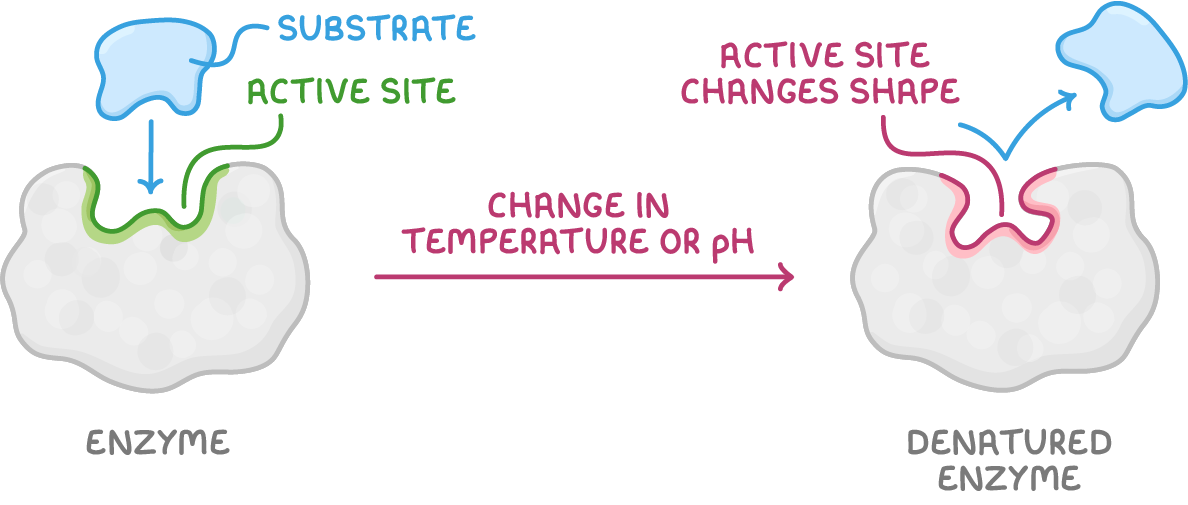
Denaturation is a process where an enzyme loses its three-dimensional structure due to environmental stressors, rendering it unable to function. This structural disruption directly impacts the enzyme's ability to bind to substrates and catalyze reactions.
Causes of denaturation
- Temperature extremes - High temperatures can break the weak bonds (like hydrogen bonds) that maintain the enzyme's shape, causing it to unfold.
- pH extremes - Significant deviations from the optimal pH can alter the charge properties of the enzyme, disrupting its structural integrity.
- Chemical environment - Exposure to certain chemicals, like heavy metals or detergents, can interfere with the bonds stabilizing the enzyme's structure.
Effects of denaturation
- Loss of function - A denatured enzyme can no longer bind to its substrate effectively, halting the catalytic process.
- Biological impact - Denaturation can disrupt critical metabolic pathways, affecting cellular function and organismal health.
Reversibility of denaturation
- Reversible denaturation - In some cases, if the denaturing condition is removed, the enzyme can refold into its original shape and regain activity. This often happens if the temperature or pH is returned to the optimal range before permanent damage occurs.
- Irreversible denaturation - If the stress is too severe or prolonged, the enzyme may be permanently altered, unable to return to its functional form. For instance, cooking an egg denatures the proteins irreversibly, as seen in the change from a liquid to a solid state.
Understanding denaturation helps explain why maintaining stable cellular environments is crucial for enzyme function and overall biological processes.
The influence of substrate and product concentrations on reaction rates
The efficiency of enzymatic reactions is not only influenced by environmental conditions but also by the relative concentrations of substrates and products present in the cellular environment. These concentrations play a key role in determining how quickly a reaction proceeds.
Substrate concentration effects
- Low substrate concentration - When substrate levels are low, many enzyme active sites remain unoccupied, leading to a slower reaction rate as there are fewer enzyme-substrate collisions.
- Increasing substrate concentration - As substrate concentration rises, more active sites are occupied, increasing the reaction rate until all enzyme molecules are bound to substrates.
- Saturation point - Beyond a certain substrate concentration, the reaction rate levels off because all enzyme active sites are occupied. This maximum rate is known as Vmax, where the enzyme is working at full capacity.
Product concentration effects
- Accumulation of products - High levels of reaction products can slow down the forward reaction, as some enzymes can catalyze reactions in reverse, converting products back to substrates.
- Equilibrium dynamics - The balance between substrates and products influences the net direction of the reaction, impacting overall efficiency.
This relationship highlights how cellular environments must regulate substrate and product levels to maintain optimal enzymatic activity for metabolic needs.
The effects of inhibitors on enzyme activity
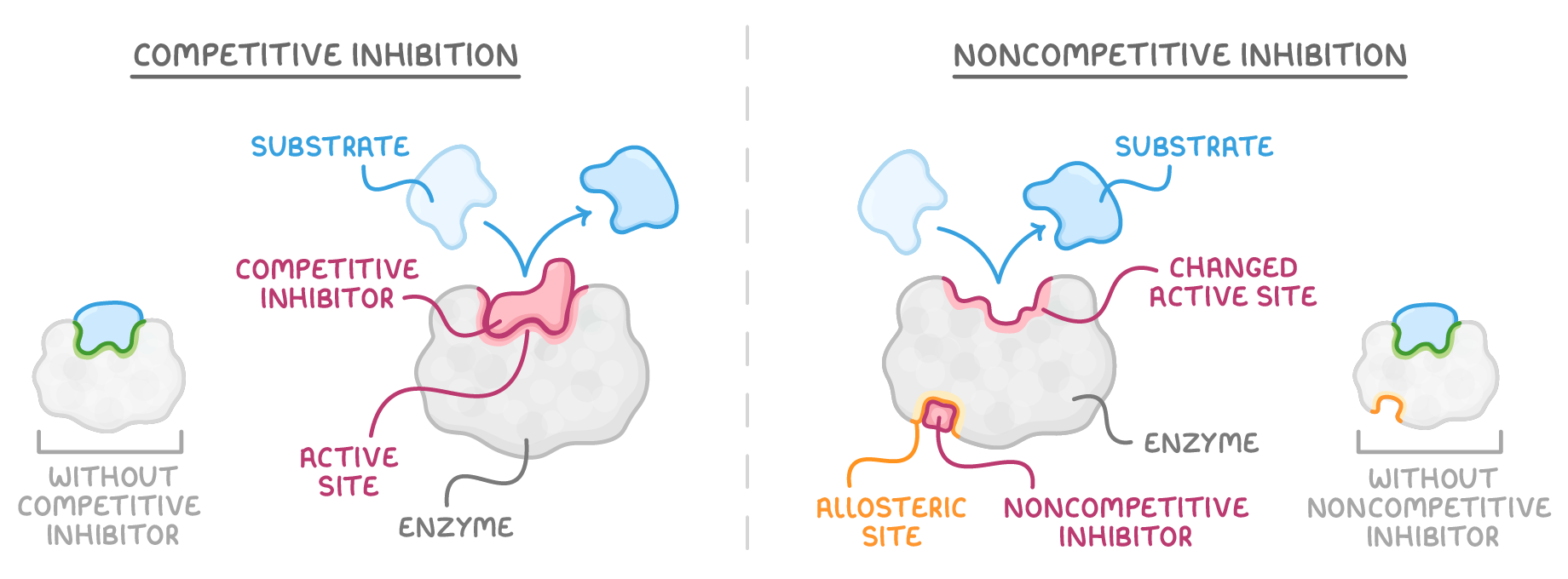
Enzyme inhibitors are molecules that decrease enzyme activity by interfering with their ability to bind to substrates or catalyze reactions. Inhibitors can be naturally occurring or synthetic and play a significant role in regulating metabolic pathways or serving as therapeutic agents.
Competitive inhibitors
Competitive inhibitors bind reversibly to the enzyme's active site, competing with the substrate for binding. This reduces the number of available active sites, slowing the reaction rate. The effect can often be overcome by increasing substrate concentration.
For example, malonate competes with succinate for the active site of succinate dehydrogenase, an enzyme involved in cellular respiration.
Noncompetitive inhibitors
Noncompetitive inhibitors bind to a different site on the enzyme, known as an allosteric site (a region other than the active site), altering the enzyme's shape and reducing its activity. This type of inhibition cannot be reversed by increasing substrate concentration.
Biological significance of inhibitors
- Regulation of metabolism - Inhibitors help control enzymatic activity to prevent overproduction of certain products, maintaining homeostasis.
- Therapeutic applications - Many drugs act as enzyme inhibitors to treat diseases. For instance, statins inhibit an enzyme involved in cholesterol synthesis, helping to lower blood cholesterol levels.
Understanding how inhibitors affect enzyme activity provides insight into controlling biochemical pathways and developing medical treatments.
Predicting outcomes of disruptions in enzymatic systems
Changes or disruptions in enzymatic systems can have cascading effects on biological processes. Predicting these outcomes is a critical skill for understanding how environmental or chemical factors impact cellular function.
Examples of disruptions and their effects
- Temperature increase beyond optimal range - This could lead to denaturation of key enzymes in a metabolic pathway, halting reactions and potentially causing cell damage or death. For instance, a fever above 40°C can denature enzymes critical for brain function, leading to neurological issues.
- pH imbalance - A significant shift in cellular pH, such as acidosis (low pH) in blood, can disrupt enzyme activity in metabolic processes, affecting energy production and leading to fatigue or organ dysfunction.
- Presence of inhibitors - Introduction of a competitive inhibitor could slow down a reaction, like in the case of certain poisons that block metabolic enzymes, leading to toxic buildup of substrates or insufficient product formation.
- Substrate scarcity - If substrate concentrations drop too low due to nutrient deficiency, enzymatic reactions may not proceed fast enough to meet cellular demands, impacting growth or repair processes.
By analyzing these scenarios, it becomes possible to anticipate how changes in one component of an enzymatic system can ripple through a biological system, affecting overall homeostasis and function.