6.2 - DNA Replication
The importance of DNA replication for genetic continuity
DNA replication is a fundamental biological process that ensures the continuity of hereditary information across generations. It occurs in all living organisms and is critical for cell division, allowing each new cell to inherit an identical copy of the genetic material from the parent cell. This process is essential for growth, repair, and reproduction in multicellular organisms, as well as for the survival and proliferation of single-celled organisms.
Why DNA replication matters
- Genetic fidelity - By copying DNA accurately, replication ensures that genetic information is preserved and passed on without alteration, maintaining the traits and functions of an organism.
- Cell division - Before a cell divides, DNA replication guarantees that each daughter cell receives a complete set of genetic instructions.
- Foundation for inheritance - Replication enables the transmission of genetic information from parents to offspring during reproduction, ensuring species continuity.
Without DNA replication, cells would not be able to divide properly, leading to the loss of critical genetic information and the inability to sustain life processes.
The semiconservative nature of DNA replication
DNA replication is described as a semiconservative process, which means that each new DNA molecule consists of one original (parent) strand and one newly synthesized strand. This mechanism ensures that the genetic code is faithfully copied while allowing for the creation of new DNA molecules.
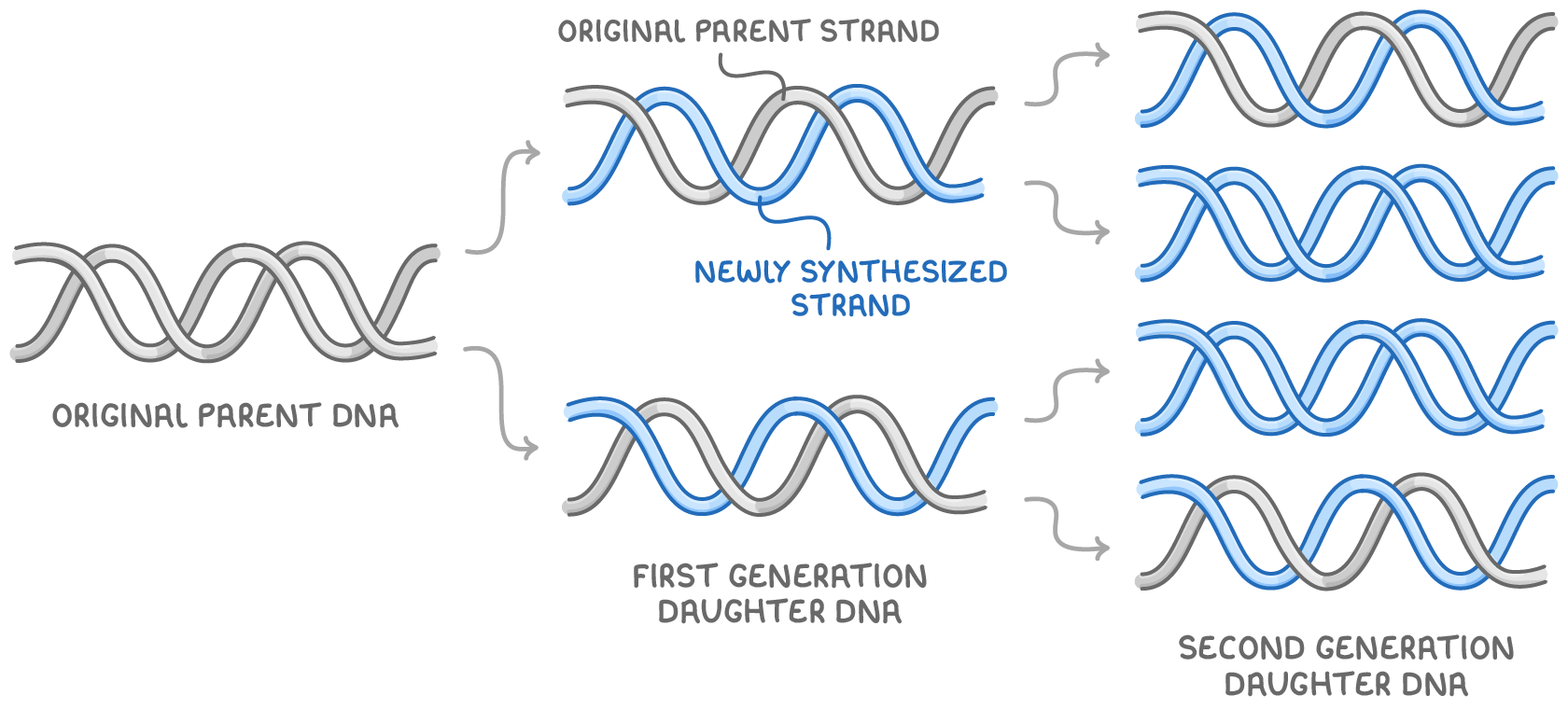
How semiconservative replication works
- Template strands - Each of the two strands in the original DNA double helix serves as a template for the synthesis of a new complementary strand.
- Resulting molecules - After replication, each daughter DNA molecule contains one strand from the parent molecule and one newly formed strand.
- Preservation of information - This process maintains the integrity of the genetic code, as the original strands act as accurate guides for building the new strands.
This semiconservative approach was first demonstrated through experiments showing that replicated DNA retains half of the original material, ensuring consistency in the genetic blueprint.
The key steps and enzymes involved in DNA replication
DNA replication is a highly coordinated process that involves several key steps and specialized enzymes. It begins with the unwinding of the DNA double helix and proceeds with the synthesis of new strands in a specific direction. The process is carefully regulated to ensure accuracy and efficiency.
Overview of the replication process
- Unwinding the DNA - The double helix structure of DNA must be separated to expose the individual strands that will serve as templates for replication.
- Initiating synthesis - Special structures are needed to start the process of building new DNA strands.
- Building new strands - New DNA is synthesized by adding nucleotides to the growing chain in a specific direction.
- Joining fragments - On one of the strands, small segments of DNA are connected to form a continuous molecule.
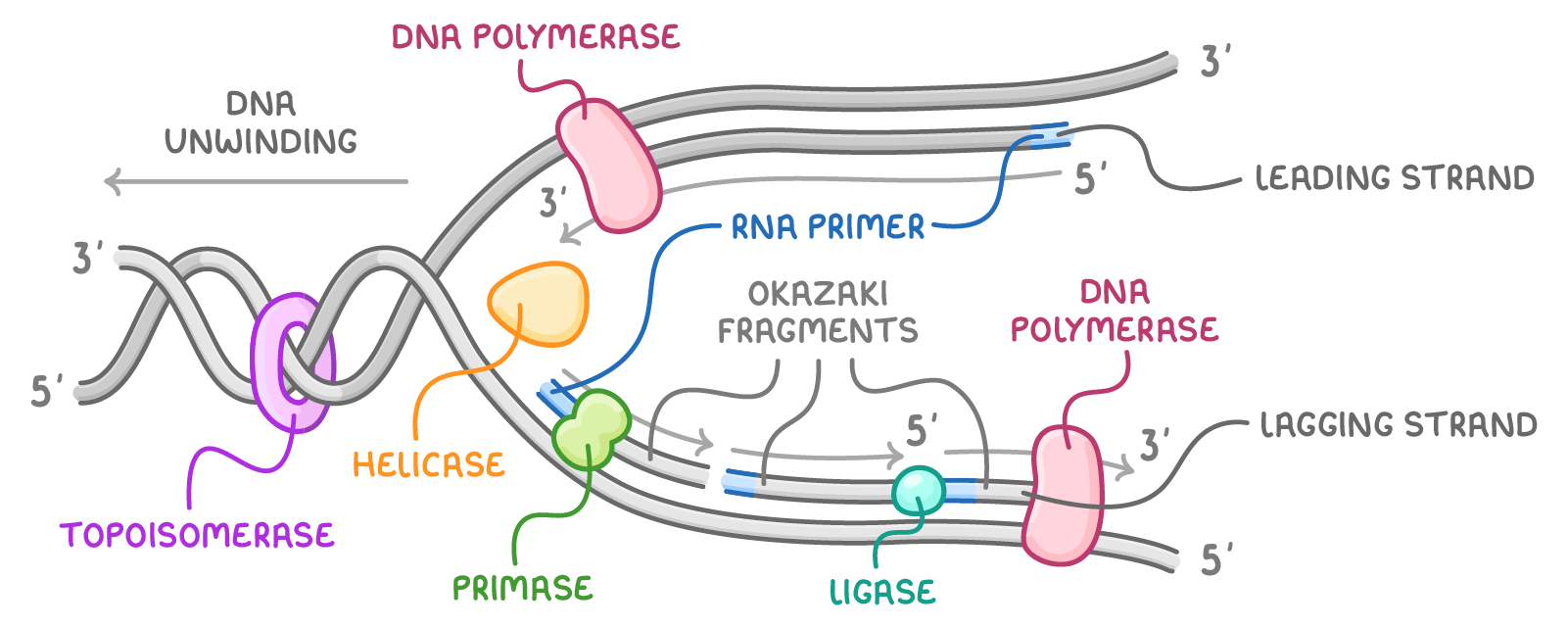
Key enzymes and their roles
- Helicase - This enzyme unwinds the DNA double helix by breaking the hydrogen bonds between the base pairs, creating two single strands that can act as templates.
- Topoisomerase - As helicase unwinds the DNA, it creates tension and supercoiling ahead of the replication fork (the point where the DNA is being split). Topoisomerase relieves this tension by cutting and rejoining the DNA strands, preventing damage.
- DNA polymerase - This enzyme is responsible for synthesizing new DNA strands by adding nucleotides to the 3' end of the growing chain. It can only build DNA in the 5' to 3' direction, which influences how replication proceeds on each strand.
- Primase - DNA polymerase cannot start a new strand from scratch; it requires a short sequence of RNA, called an RNA primer, to begin synthesis. Primase synthesizes these primers to provide a starting point for DNA polymerase.
- Ligase - This enzyme seals gaps between DNA fragments, ensuring that the newly synthesized strand becomes a continuous molecule.
These enzymes work together at the replication fork to ensure that DNA is copied accurately and efficiently, maintaining the integrity of the genetic code during cell division.
The differences between leading and lagging strand synthesis
During DNA replication, the two strands of the double helix are synthesized differently due to the directional nature of DNA polymerase, which can only build new strands in the 5' to 3' direction. This results in distinct processes for the leading strand and the lagging strand, reflecting the antiparallel structure of DNA (where the two strands run in opposite directions).
Leading strand synthesis
- Continuous process - The leading strand is synthesized continuously in the 5' to 3' direction as the replication fork opens.
- Single RNA primer - Only one RNA primer is needed at the start of replication, after which DNA polymerase adds nucleotides without interruption.
- Efficiency - This strand is copied smoothly and quickly because it aligns with the direction of fork movement.
Lagging strand synthesis
- Discontinuous process - The lagging strand is synthesized in short fragments, called Okazaki fragments, because its template strand runs in the opposite direction to the replication fork movement.
- Multiple RNA primers - Each Okazaki fragment requires its own RNA primer to initiate synthesis, as DNA polymerase must repeatedly start and stop.
- Fragment joining - After the fragments are synthesized, the enzyme ligase connects them by forming phosphodiester bonds, creating a continuous strand.
- Complexity - This process is slower and more complex due to the need for multiple initiation points and subsequent joining of fragments.
Why the difference exists
The antiparallel nature of DNA strands means that while one strand can be copied continuously in the direction of the replication fork, the other must be copied in the opposite direction. As a result, the lagging strand synthesis involves frequent stops and starts to accommodate the 5' to 3' synthesis rule of DNA polymerase. This ensures that both strands are replicated accurately despite their structural differences.