6.5 - Regulation of Gene Expression
The role of regulatory sequences in controlling gene expression
Gene expression is the process by which the information encoded in a gene is used to produce a functional product, such as a protein. This process must be tightly controlled to ensure that genes are expressed at the right time, in the right cells, and at the appropriate levels. Regulatory sequences play a crucial role in this control by interacting with specific proteins to manage the transcription of DNA into RNA, the first step of gene expression.
Regulatory sequences
Regulatory sequences are specific stretches of DNA that do not code for proteins but instead serve as binding sites for regulatory proteins that control transcription. These sequences interact with regulatory proteins, such as transcription factors, which can either promote or inhibit the binding of RNA polymerase, the enzyme responsible for transcription.
Types of gene expression:
- Constitutive expression - Some genes are always active and transcribed at a constant rate (e.g., genes for essential cellular functions).
- Inducible expression - Other genes have their transcription turned on or off in response to specific signals or environmental changes.
This precise control ensures that cells can respond to their environment and maintain proper function by producing only the necessary proteins at the right time.
Types of gene regulation in prokaryotes and eukaryotes
Gene regulation differs between prokaryotes (single-celled organisms like bacteria) and eukaryotes (organisms with complex cells, like plants and animals). Both types of organisms have mechanisms to coordinate the expression of groups of genes, but the systems and structures involved vary significantly.
Gene regulation in prokaryotes: operons
An operon is a cluster of genes in prokaryotes that are transcribed together under the control of a single promoter, a DNA sequence where RNA polymerase binds to start transcription.
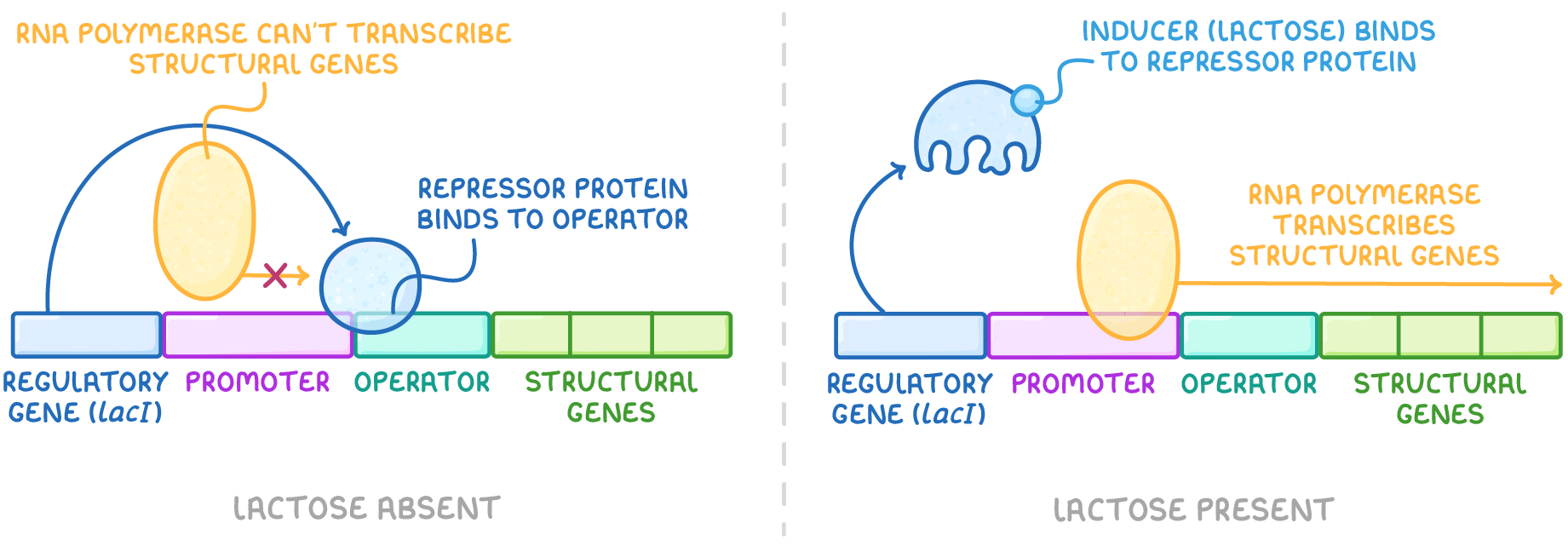
Types of operons:
- Inducible systems - In an inducible operon, transcription is normally off but can be turned on by a specific molecule called an inducer. For example, the lac operon in bacteria is induced by lactose, allowing the bacteria to metabolize this sugar when it is present.
- Repressible systems - In a repressible operon, transcription is normally on but can be turned off by a repressor molecule. For instance, the trp operon is repressed when tryptophan is abundant, preventing unnecessary production of this amino acid.
- Coordinated regulation - Operons allow prokaryotes to efficiently coordinate the expression of related genes in response to environmental changes, conserving energy and resources.
Gene regulation in eukaryotes: transcription factors
Unlike prokaryotes, eukaryotic genes are not organized into operons. Instead, groups of genes can be coordinately regulated by the same transcription factors, proteins that bind to specific regulatory sequences to control transcription.
Features of eukaryotic gene regulation:
- Shared control mechanisms - Multiple genes involved in a common process (e.g., muscle development) may be influenced by the same transcription factor, ensuring they are expressed together at the appropriate time.
- Spatial and temporal control - Eukaryotic regulation is often more complex due to the need for precise control across different tissues and developmental stages, requiring multiple layers of regulatory mechanisms.
These differences highlight how evolutionary adaptations have shaped gene regulation to meet the needs of organisms with varying levels of complexity.
The impact of epigenetic changes on gene expression
Gene expression is not solely determined by the DNA sequence itself. Epigenetic changes, which are modifications to DNA or associated proteins without altering the genetic code, can profoundly influence whether and how genes are expressed.
Epigenetic changes
Epigenetics refers to reversible modifications to DNA or histones (proteins around which DNA is wrapped) that affect gene expression without changing the underlying DNA sequence.
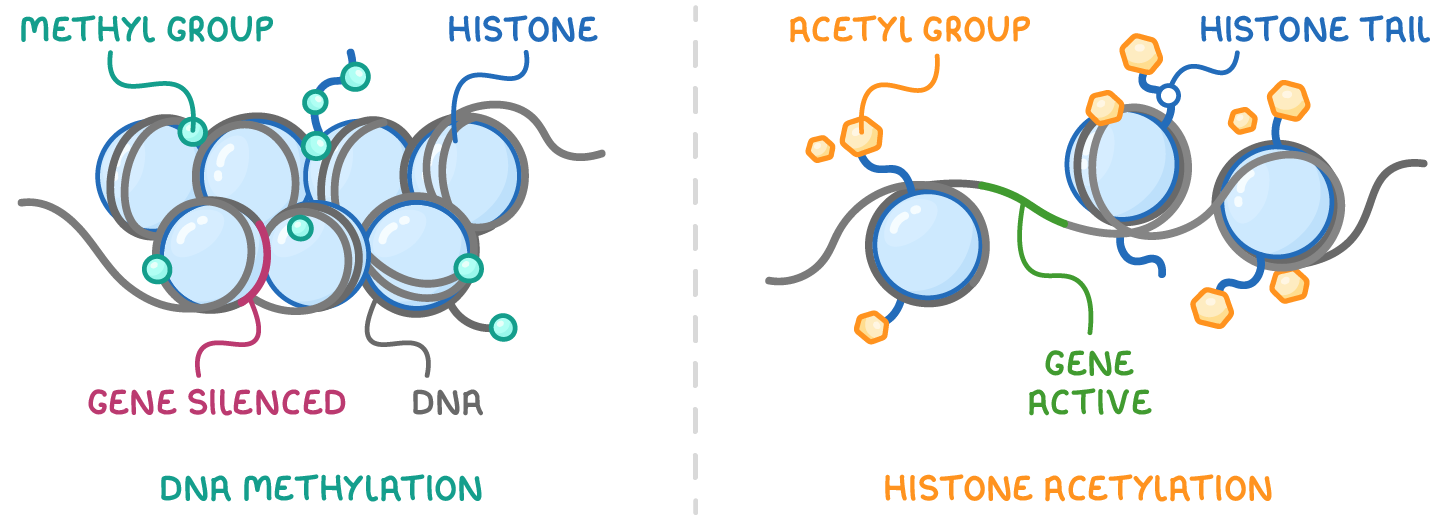
Types of epigenetic modifications:
- DNA methylation - Methyl groups are added to DNA, often silencing gene expression.
- Histone modification - Such as acetylation or methylation, which can either activate or repress transcription by altering how tightly DNA is packaged.
- Reversibility - Unlike genetic mutations, epigenetic changes can be reversed by environmental factors, diet, or lifestyle, allowing cells to adapt gene expression to changing conditions.
Effects on gene expression
- Gene silencing or activation - Epigenetic modifications can turn genes off by making DNA less accessible to transcription machinery or turn them on by loosening DNA packaging.
- Long-term impact - These changes can persist through cell divisions and, in some cases, be passed on to future generations, influencing traits and disease susceptibility.
- Examples in development - Epigenetic changes are critical during development, ensuring that specific genes are expressed in certain cell types while others remain silent, guiding cell differentiation.
Understanding epigenetics provides insight into how environmental factors can shape gene expression and impact health and disease.
How gene expression determines cell phenotype and differentiation
The phenotype of a cell or organism - its observable characteristics - results from which genes are expressed and the levels at which they are expressed. This selective expression drives cell differentiation, the process by which cells become specialized for specific functions.
Gene expression and phenotype
Phenotype refers to the physical and biochemical traits of a cell or organism, determined by the combination of expressed genes and the quantity of gene products (like proteins) produced.
How gene expression shapes phenotype:
- Role of gene products - The type and amount of proteins or other molecules produced from gene expression directly shape cellular functions and, consequently, the organism's traits. For example, high expression of pigment-producing genes results in darker skin or fur.
- Variation in expression levels - Even small differences in the amount of a gene product can lead to significant phenotypic variation, such as differing enzyme activity levels affecting metabolic rates.
Cell differentiation through gene expression
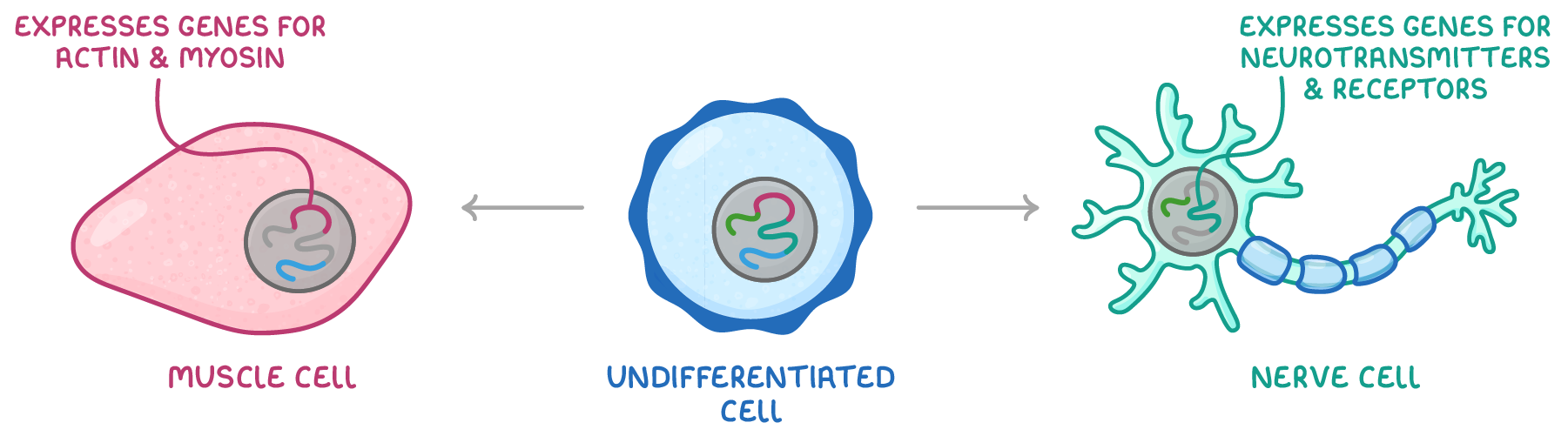
Observable cell differentiation occurs when genes for tissue-specific proteins are expressed. For instance, muscle cells express genes for contractile proteins like actin and myosin, while nerve cells express genes for neurotransmitters and receptors.
The process of differentiation:
- Sequential gene expression - During development, the induction of transcription factors triggers a cascade of gene expression. Each transcription factor activates the next set of genes in a sequence, guiding cells through stages of specialization.
- Developmental outcomes - This sequential process ensures that cells in different tissues express only the genes necessary for their specific roles, leading to the diversity of cell types in a multicellular organism.
This intricate regulation of gene expression underlies the complexity and functionality of living organisms, ensuring each cell contributes appropriately to the whole.
The relationship between regulatory sequence location and function
The position of regulatory sequences in the genome is closely tied to their role in controlling gene expression. Their location determines how they interact with regulatory proteins and influence transcription.
Location of regulatory sequences in prokaryotes
- Promoter proximity - In prokaryotes, regulatory sequences like promoters and operators (part of operons) are typically located immediately upstream of the genes they control. This close proximity allows for direct interaction with RNA polymerase and regulatory proteins.
- Efficient control - The operator, a regulatory sequence in operons, is positioned between the promoter and the structural genes, enabling repressors or activators to block or enhance transcription efficiently.
Location of regulatory sequences in eukaryotes
In eukaryotes, regulatory sequences can be located near the gene (as promoters), within the gene (as introns), or even far away (as enhancers or silencers). Enhancers can be thousands of base pairs away from the gene they regulate but still influence transcription by looping the DNA to interact with the promoter.
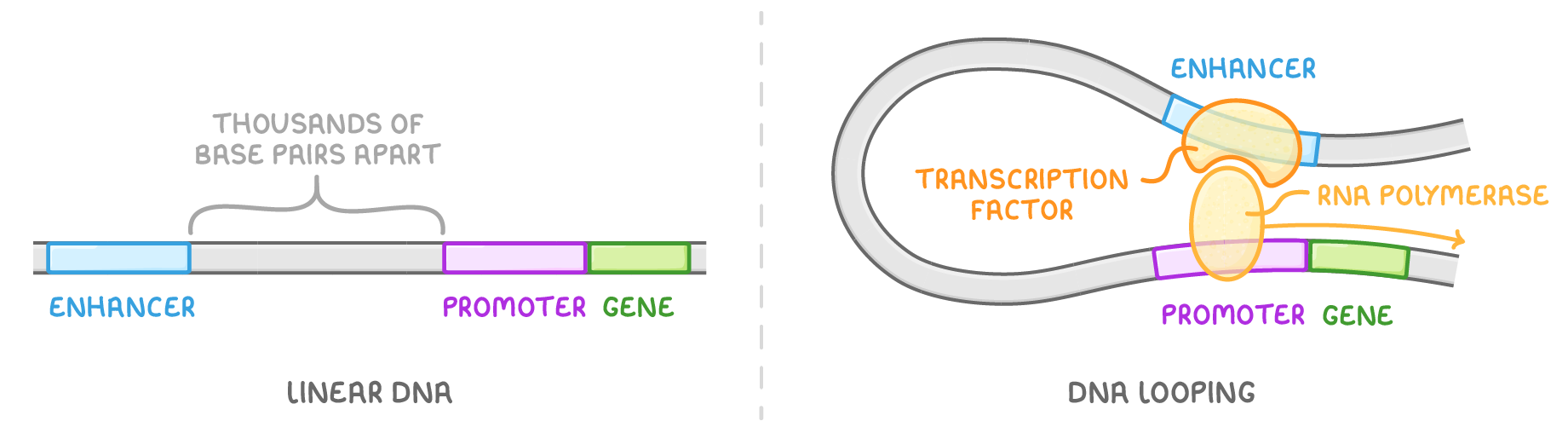
Functional significance of location:
- Accessibility - The location affects how transcription factors access these sequences and coordinate gene expression. For example, enhancers increase transcription rates when bound by activators, regardless of their distance from the gene, due to DNA looping.
- Complexity in regulation - The varied positioning allows for intricate control, enabling multiple regulatory inputs to fine-tune gene expression across different cell types and conditions.
The strategic placement of regulatory sequences ensures precise and adaptable control of gene expression, tailored to the needs of prokaryotic efficiency or eukaryotic complexity.