7.5 - Hardy–Weinberg Equilibrium
The concept of Hardy-Weinberg equilibrium and its importance in population genetics
Hardy-Weinberg equilibrium is a fundamental model in population genetics that describes a theoretical state where allele and genotype frequencies in a population remain constant from generation to generation. This means the population is not evolving with respect to the gene in question. By providing a baseline for comparison, this model helps scientists understand whether evolutionary forces are acting on a population, driving changes in genetic diversity.
This equilibrium is crucial because it allows researchers to predict genetic variation under ideal conditions and detect when real-world populations deviate due to evolutionary processes. Let's explore the specific conditions and mathematical framework that define this model.
The conditions required for Hardy-Weinberg equilibrium
For a population to be in Hardy-Weinberg equilibrium, certain conditions must be met. These conditions ensure that no evolutionary forces are altering the allele frequencies over time. Although these conditions are rarely, if ever, fully met in natural populations, they establish a critical starting point for studying genetic change.
Conditions for Hardy-Weinberg equilibrium
- Large population size - A large population minimizes the impact of random genetic drift, which is the random fluctuation in allele frequencies due to chance events. Smaller populations are more susceptible to such changes.
- No migration - There must be no movement of individuals into or out of the population, as migration can introduce or remove alleles, altering frequencies.
- No new mutations - Mutations, which are changes in the DNA sequence, must not occur, as they can introduce new alleles or alter existing ones.
- Random mating - Individuals must mate randomly with respect to the gene in question, ensuring that allele combinations are not influenced by mate choice or other biases.
- No natural selection - All genotypes must have equal chances of survival and reproduction. Natural selection, which favors certain traits over others, must not act on the population.
These idealized conditions provide a framework to compare against real populations, where deviations indicate the presence of evolutionary forces.
The Hardy-Weinberg equations for predicting allele and genotype frequencies
The Hardy-Weinberg model uses mathematical equations to relate allele frequencies to genotype frequencies in a non-evolving population. Allele frequency refers to how common a particular allele, or variant of a gene, is within the population. Genotype frequency, on the other hand, describes the proportion of individuals with a specific combination of alleles.
Key Hardy-Weinberg equations
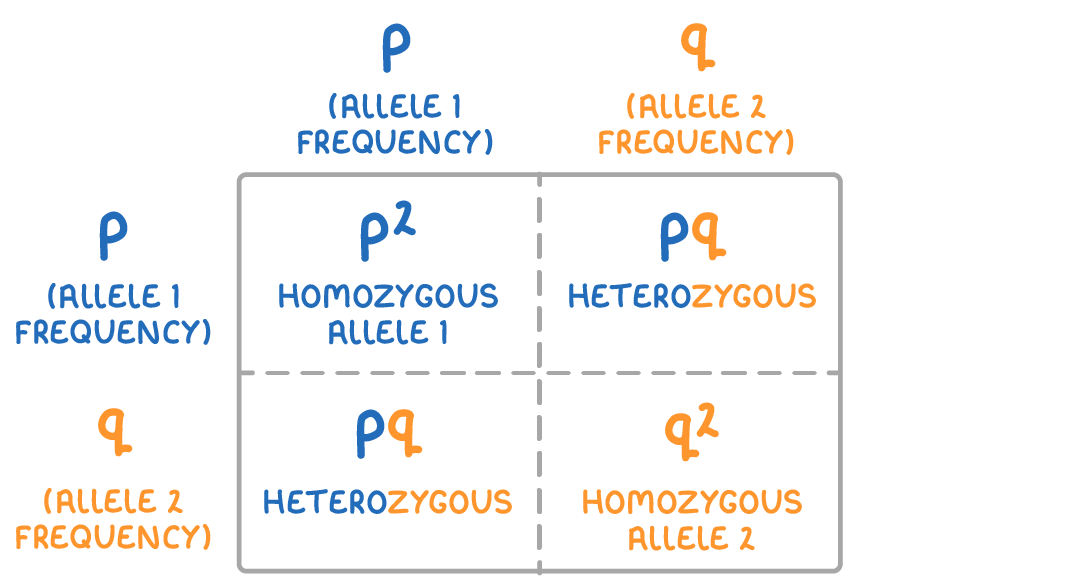
The equations are based on a simple genetic system with two alleles for a gene, often denoted as allele 1 and allele 2.
Formula for allele frequencies:
Where:
- p = Frequency of allele 1 in the population
- q = Frequency of allele 2 in the population
This equation shows that the sum of the frequencies of the two alleles equals 1, representing the entire population.
Formula for genotype frequencies:
Where:
- p2 = Frequency of homozygous genotype for allele 1 (both alleles are allele 1)
- 2pq = Frequency of heterozygous genotype (one allele 1 and one allele 2)
- q2 = Frequency of homozygous genotype for allele 2 (both alleles are allele 2)
This equation demonstrates how allele frequencies determine the proportions of each genotype in the population under equilibrium conditions. The term "homozygous" refers to having two identical alleles for a gene, while "heterozygous" means having two different alleles.
Calculating allele and genotype frequencies using the Hardy-Weinberg model
The Hardy-Weinberg equations allow us to calculate allele frequencies from genotype frequencies or vice versa. This predictive power is essential for understanding genetic structure in a population and for detecting deviations that suggest evolution is occurring.
When genotype frequencies are known, allele frequencies can be derived by counting the alleles contributed by each genotype. Conversely, if allele frequencies are known, genotype frequencies can be predicted using the equations above. Let's see this in action with a worked example.
Worked example - Calculating allele and genotype frequencies
In a population of 1,000 individuals, 360 are homozygous for allele A (AA), 480 are heterozygous (Aa), and 160 are homozygous for allele a (aa). Calculate the frequencies of alleles A and a, and verify if the population is in Hardy-Weinberg equilibrium.
Step 1: Calculate genotype frequencies
-
Total individuals = 1,000
-
Frequency of AA = 360 / 1,000 = 0.36
-
Frequency of Aa = 480 / 1,000 = 0.48
-
Frequency of aa = 160 / 1,000 = 0.16
Step 2: Calculate allele frequencies
-
Frequency of allele A (p) = (number of A alleles) / (total alleles)
- Each AA individual contributes 2 A alleles: 360 × 2 = 720
- Each Aa individual contributes 1 A allele: 480 × 1 = 480
- Total A alleles = 720 + 480 = 1,200
- Total alleles = 1,000 individuals × 2 = 2,000
- p = 1,200 / 2,000 = 0.6
-
Frequency of allele a (q) = (number of a alleles) / (total alleles)
- Each aa individual contributes 2 a alleles: 160 × 2 = 320
- Each Aa individual contributes 1 a allele: 480 × 1 = 480
- Total a alleles = 320 + 480 = 800
- q = 800 / 2,000 = 0.4
-
Check: p + q = 0.6 + 0.4 = 1.0 (correct)
Step 3: Verify Hardy-Weinberg equilibrium
-
Expected genotype frequencies if in equilibrium:
- Frequency of AA = p2 = (0.6)2 = 0.36
- Frequency of Aa = 2pq = 2 × 0.6 × 0.4 = 0.48
- Frequency of aa = q2 = (0.4)2 = 0.16
-
Compare to observed frequencies (0.36, 0.48, 0.16): They match exactly.
Step 4: Interpretation
The population is in Hardy-Weinberg equilibrium for this gene, as the observed genotype frequencies match the expected frequencies based on the allele frequencies.
The significance of Hardy-Weinberg equilibrium as a null hypothesis
While the conditions for Hardy-Weinberg equilibrium are rarely met in nature, the model serves as a valuable null hypothesis in population genetics. A null hypothesis is a baseline assumption that no change or effect is occurring. By comparing real population data to the expectations of Hardy-Weinberg equilibrium, scientists can identify when evolutionary forces such as natural selection, genetic drift, or migration are influencing allele frequencies.
Why Hardy-Weinberg equilibrium matters
- Baseline for comparison - It provides a standard against which to measure real-world deviations, helping to pinpoint the action of evolutionary mechanisms.
- Detecting evolutionary change - Deviations from equilibrium indicate that one or more conditions (like no natural selection or no migration) are not met, signaling evolution is occurring.
- Predictive tool - Even in non-equilibrium populations, the model can estimate expected frequencies under ideal conditions, offering insights into genetic dynamics.
Understanding Hardy-Weinberg equilibrium equips us to analyze how populations evolve and adapt over time, linking genetic variation to the broader process of natural selection and evolutionary biology.