13.1 - Theories of Stratification
Stratification and differentiation
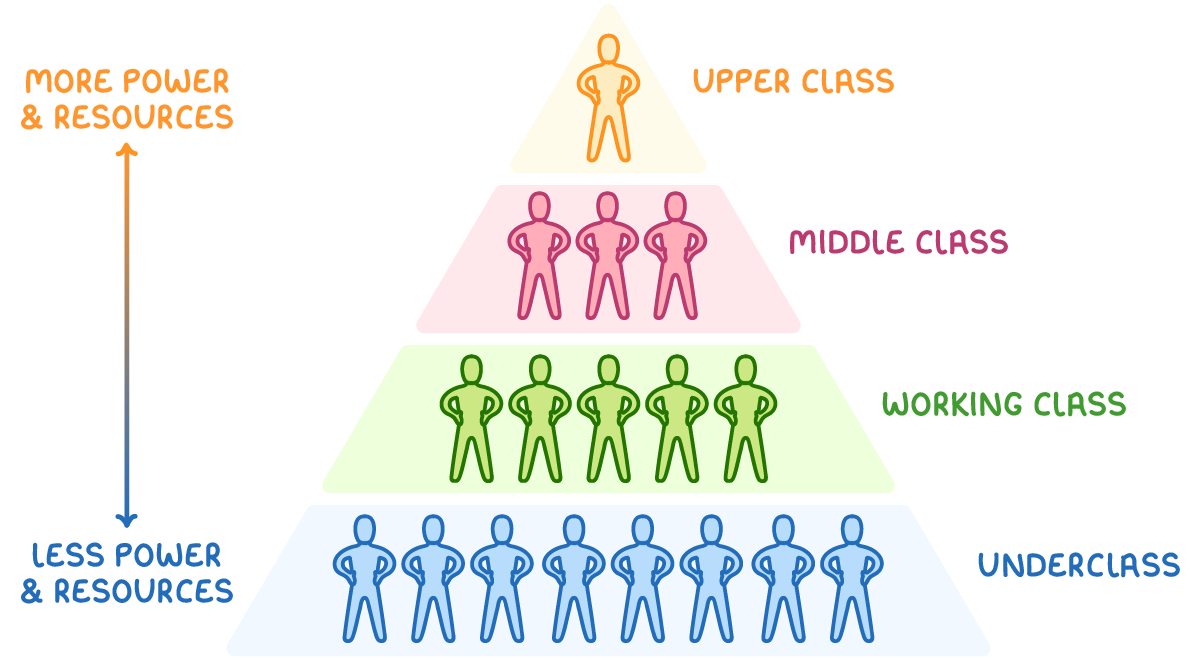
Stratification refers to the hierarchical division of society into layers, where the most powerful individuals or groups occupy the top tiers and the least powerful are at the bottom.
Key aspects of stratification
- Hierarchical layers - Societies are organised into strata, similar to layers in geological formations, with power and influence concentrated at the top.
- Bases of division - Stratification can occur due to factors like social status, class, ethnicity, gender, and age.
- Impact on life chances - Individuals in higher strata often have better access to resources, opportunities, and privileges compared to those in lower tiers.
Differentiation describes how society is split into various groups based on characteristics such as age, gender, ethnicity, or religion. Together with stratification, these concepts illustrate the complex structure of social inequality.
Social class as a stratification system
In modern Western capitalist societies like the UK, social class is the primary system of stratification. It is largely determined by economic factors but also encompasses elements of power and prestige.
Categories of social class in the UK
- Upper class - Characterised by significant wealth and influence, often inherited across generations. This group may include both traditional aristocracy and newly wealthy individuals from sectors like business or entertainment.
- Middle class - Comprises individuals engaged in non-manual professions such as teaching, medicine, or management. This class has been expanding in recent times.
- Working class - Made up of individuals in manual occupations, such as factory workers or farm labourers. They generally have fewer life chances compared to the middle class.
- Underclass - Includes those reliant on state benefits, such as the long-term unemployed or homeless, facing the most restricted life chances.
Focus of sociological study
Sociological research often concentrates on the distinctions between the middle and working classes, as these groups represent significant divisions in terms of economic status and social opportunities.
Challenges in relating social class to occupation
While occupation is frequently used as an indicator of social class due to the status and prestige it confers, this approach has notable limitations.
Issues with using occupation as a measure of class
- Status and prestige variations - Occupations carry different levels of social respect, influencing how individuals are perceived within society.
- Income disparities within classes - Significant differences can exist within the same occupational category, such as between a senior surgeon earning a high salary and a junior doctor on a modest income.
- Exclusion of non-working groups - This method overlooks segments of the upper class who may not work but derive income from investments or property rentals.
- Missing younger generations - Younger individuals not yet in the workforce are excluded, though alternative measures like educational attainment (e.g., possession of a university degree) can help assess social mobility.
- Limited research scope - Studies on occupational prestige often focus on a small number of common jobs, requiring assumptions about the status of less-studied roles.
Government classifications of social class
The UK government has employed different systems over time to categorise social class, reflecting changes in employment patterns and societal structures.
The Registrar General's Scale (RG Scale)
Used until 2000, the Registrar General's Scale (RG Scale) divided society into five classes based on the occupation of the head of household, typically the highest-earning male.
Limitations of the RG Scale:
- Excluded the never-employed and classified the unemployed by their last job.
- Based classification on the head of household, ignoring other household members' occupations.
- Classified married women by their husband's job, reflecting a sexist bias.
- Failed to account for significant income and life chance variations within classes.
The National Statistics Socio-Economic Classification (NS-SEC)
Since 2000, the government has used the National Statistics Socio-Economic Classification (NS-SEC), which categorises individuals into eight classes based on employment type rather than skill level.
Key features of NS-SEC:
- Based on employment relations (employer, self-employed, or employee), labour market situation (income, job security), and work situation (hierarchy and control).
- Reflects shifts in employment from manual to service industries.
- Classifies each individual rather than households.
- Still excludes the 'idle rich' who do not need to work due to inherited wealth.
Objective and subjective definitions of class
Social class can be understood through two distinct perspectives, each offering a different lens on an individual's position within society.
Contrasting approaches to defining class
- Objective definition - Relies on measurable criteria such as income or occupation. The NS-SEC is an example of an objective classification system.
- Subjective definition - Focuses on personal perception and identity. For instance, a person with considerable wealth might still identify with a working-class background due to cultural ties or social connections.
Gender disparities in traditional class analysis
Historically, social class analysis often overlooked the unique experiences of women, leading to incomplete understandings of stratification.
Issues with gender in class classification
- Head of household bias - Traditional systems like the RG Scale classified entire households based on the male head's occupation, ignoring women's social class experiences.
- Research findings on mobility:
- Studies by Michelle Stanworth (1984) highlighted that women's class experiences often differ significantly from men's within the same household.
- Abbott and Payne (1990) found women were less likely to achieve upward social mobility compared to men, and when they did, their progress was limited to lower-middle-class positions.