9.10 - Punishment, Prevention & Victims
Characteristics and theories of victimisation
Victimisation refers to the process of becoming a victim of crime, and various factors influence who is more likely to experience it. Statistical data and sociological theories provide insight into patterns and explanations for victimisation.
Key statistics on crime victims
- Gender differences in violence - Men are more than twice as likely as women to be victims of violent crime, with young men aged 16-24 experiencing the highest rates of violence.
- Fear of crime by gender - Despite lower victimisation rates, women are more likely to fear becoming victims of crime.
- Domestic violence disparities - Women are more affected by domestic violence (7%) compared to men (4%), with victims often facing repeated attacks.
- Ethnicity and crime - Individuals from ethnic minority groups are twice as likely to be victims of robbery compared to white individuals, while those from mixed ethnic backgrounds face the highest rates of violent crime.
- Income and crime types - Higher-income households are more prone to credit or debit card fraud, whereas lower-income households experience higher rates of domestic violence.
- Repeat victimisation patterns - Repeat victimisation occurs when the same type of crime happens multiple times to an individual or household. For instance, in 2012-13, only 14% of burglary victims experienced it more than once, while in 2013-14, 27% of violent crime victims were targeted repeatedly, with 13% victimised three or more times.
Theories explaining victimisation
- Christie's social construct theory:
- Suggests that the label of 'victim' is socially constructed, with society more readily recognising certain individuals as victims, such as an elderly person robbed of personal belongings.
- Positivist victimology (Miers, 1989):
- Focuses on why certain individuals are more likely to become victims due to their behaviours (e.g., leaving valuables visible in a vehicle) or personal traits.
- This approach has been criticised for blaming victims and for concentrating on visible crimes like theft, neglecting issues like state crime.
- Critical victimology (Mawby and Walklate, 1994):
- Influenced by Marxism and feminism, this theory highlights how oppressed groups, such as the working class and women, are more likely to be victims due to 'structural powerlessness'.
- Scholars like Tombs and Whyte (2007) argue that those in power often fail to acknowledge victims or even blame them for their circumstances.
Feminist perspectives on women as victims
- Patriarchal power dynamics - Feminists argue that domestic violence stems from unequal power relationships between men and women, often used as a tool of control.
- Fear as a control mechanism - Stanko (2000) suggests that fear of crime restricts women's behaviour, such as dressing conservatively to avoid provocation.
- Legal bias against women - Heidensohn (2002) points out that crimes against women, like rape and abuse, are often underreported and historically ignored by the legal system.
- Radical and Marxist feminist views - Radical feminists view domestic violence as an expression of patriarchal dominance, while Marxist feminists link it to frustrations men face in capitalist workplaces due to lack of control.
Approaches to crime prevention
Crime prevention strategies aim to reduce criminal activity through various methods, ranging from altering physical environments to addressing underlying social issues. Different sociological perspectives inform these approaches.
Situational crime prevention (Right Realism)
- Environmental changes - Involves modifying physical spaces to deter crime, such as installing surveillance cameras, improving street lighting, or creating gated communities.
- Rational choice theory basis - Assumes criminals make rational decisions and will avoid crime if the risk of failure or detection is high.
- Criticisms of situational prevention - Critics like Chaiken et al. (1974) argue it often leads to displacement, where crime shifts to less protected areas. It also focuses on local disorders like vandalism, ignoring professional or governmental crimes, and addresses symptoms rather than root causes.
Environmental crime prevention
- Maintaining area cleanliness - Focuses on keeping environments tidy and repaired, such as fixing vandalism promptly and removing litter, to signal community care and deter crime.
- Zero tolerance policing (Wilson and Kelling, 1982) - Advocates for strict and immediate action against antisocial behaviour to prevent escalation into serious crime, combining good policing with environmental upkeep.
Social and community approaches
- Structuralist perspective (Marxist and Left Realism) - Argues that crime results from wealth and income inequalities, advocating for social reforms to reduce disparities as a long-term prevention strategy.
- Individualist or interventionist approach - Suggests targeting specific groups prone to criminal behaviour for behavioural change, such as supporting disadvantaged children to prevent future criminality.
- Long-term commitment - Unlike reactive situational or environmental methods, these approaches aim to prevent criminal tendencies before they develop, requiring sustained effort.
The role of surveillance in crime control
Surveillance is a key tool in detecting and preventing crime, often integrated into situational prevention strategies. It operates through physical and technological means but raises ethical concerns.
Types and purposes of surveillance
- Physical surveillance - Includes tools like closed-circuit television (CCTV) cameras to monitor neighbourhoods, aiming to deter criminals by increasing the likelihood of detection.
- Technological surveillance - Involves monitoring online communications, phone calls, and personal data to track known criminals and detect potential criminal or terrorist activities, making it harder for criminals to organise.
- Prison surveillance (Foucault, 1977) - Combines physical methods (e.g., CCTV, guards) with self-surveillance, where prisoners modify their behaviour under the assumption they are always being watched.
Some sociologists argue that surveillance has permeated everyday life, creating a 'surveillance society' where privacy is eroded, and governments gain excessive control over individuals, even those not involved in crime.
Agents of social control in managing crime
Social control refers to mechanisms society uses to regulate behaviour and enforce norms, managed by both formal and informal agents to maintain order and reduce crime.
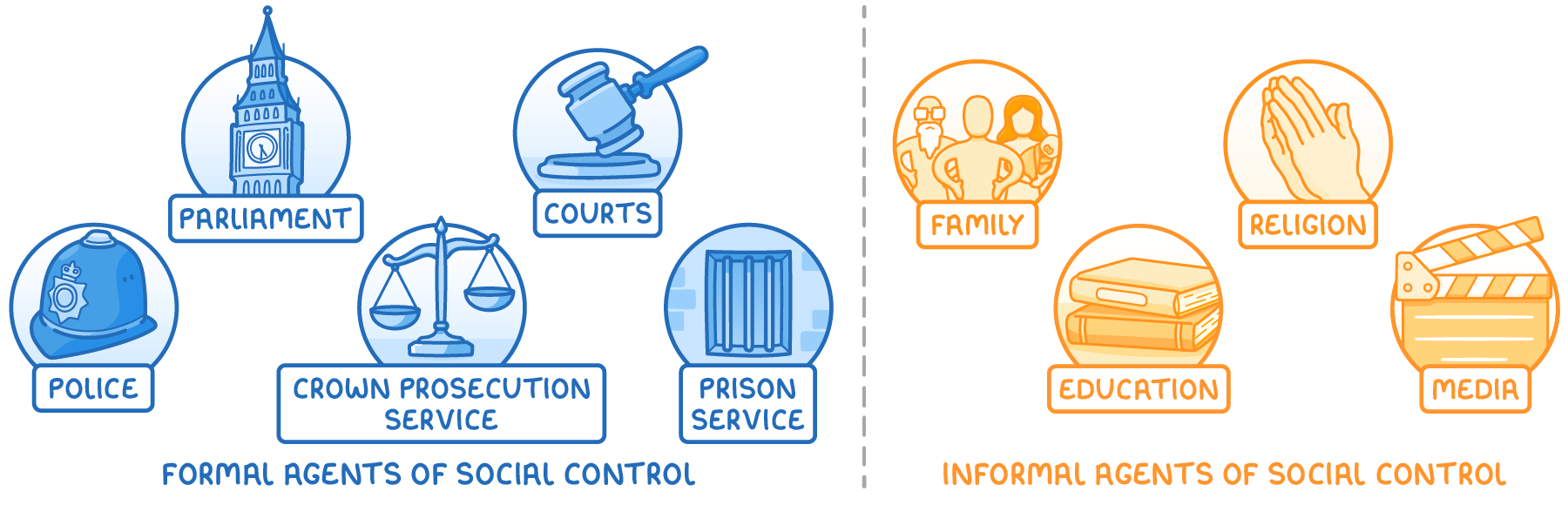
Formal agents of social control
- Police - Enforce laws and maintain public order, though accused of institutional biases, such as racism (highlighted by the Macpherson Report, 1999) and sexism. Black men are disproportionately stopped and searched, and Graef (1989) noted a 'canteen culture' among predominantly white male officers fostering discriminatory attitudes.
- Parliament - Establishes laws defining criminal behaviour.
- Crown Prosecution Service - Decides which cases proceed to court.
- Courts - Determine appropriate punishments for offenders.
- Prison Service - Administers custodial sentences, such as imprisonment.
Informal agents of social control
- Family - Instils early values and norms to guide behaviour.
- Education system - Teaches societal expectations and acceptable conduct.
- Religion - Promotes moral guidelines and respect for authority.
- Media - Shapes perceptions of acceptable behaviour through portrayal of norms and deviance.
Purposes and changing roles of punishment
Punishment serves multiple purposes within society, reflecting different sociological perspectives on its role in maintaining order and addressing crime. The function of prisons, in particular, is evolving.
Purposes of punishment
- Functionalist view (Durkheim) - Sees punishment as essential for societal stability, preventing anarchy by demonstrating retribution. Public punishment fosters unity by collectively condemning criminals.
- Marxist perspective - Argues punishment upholds capitalist interests by controlling the working class, with police targeting poorer areas while the wealthy often evade accountability.
- Interventionist approach - Views punishment, especially prison, as a deterrent to prevent crime, though evidence suggests this is often ineffective.
- Rehabilitation focus - Aims to reform criminals through education or counselling, enabling them to reintegrate as law-abiding citizens upon release.
Changing roles of prisons
- Removal of criminals - Prisons isolate offenders from society to prevent further crime.
- Mass incarceration (Garland, 2001) - Since the 1970s, zero-tolerance policies have significantly increased prison populations in the UK and USA.
- Welfare role expansion - Prisons are increasingly collaborating with welfare and criminal justice bodies, taking on more supportive functions.
- Transcarceration trend - Vulnerable individuals are often moved between controlling institutions like prisons, mental health facilities, and young offender centres, indicating prisons are part of a broader network of social control.