11.6 - Industrialisation & the Environment
Environmental consequences of industrialisation
Industrialisation is a key driver of economic growth in less economically developed countries (LEDCs), but it often comes at a significant cost to the environment. As these countries strive to improve their economies, the resulting environmental damage poses challenges for both current and future generations.
Major environmental issues caused by industrialisation
| Issue | Description |
|---|---|
| Water pollution | Industrial activities frequently contaminate water sources, making clean water scarce in many regions. |
| Deforestation | Vast areas of rainforests are cleared for timber or to create space for agricultural expansion. |
| Desertification | Unsustainable farming practices, such as over-cultivation and over-grazing, exhaust the land. Over time, fertile soil degrades into desert. |
| Urban pollution | Rapid urbanisation, driven by industrial growth, leads to pollution from factories and increasing motor traffic. |
| Concentration of heavy industry | The new international division of labour results in polluting industries being located in LEDCs. These countries often lack access to cleaner technologies or the financial means to adopt less harmful production methods. |
Theoretical perspectives on the environment
Different sociological theories offer varied approaches to addressing the environmental challenges faced by developing countries.
The neo-liberal view on development and environment
- Cost-benefit analysis - Neo-liberals argue that countries should weigh the economic benefits of development against environmental costs. If the environmental impact is deemed too severe, they suggest abandoning the strategy.
- Market competitiveness - Choosing to prioritise the environment may reduce a country's ability to compete in the global market.
The structuralist view on development and environment
- Debt as a barrier - Structuralist theories, including Marxist perspectives, contend that environmental issues cannot be adequately addressed while developing countries are burdened by debt.
- Systemic inequality - The structure of global society perpetuates inequality, placing LEDCs in a position where environmental protection is often sidelined in favour of catching up economically.
Sustainable development and key principles
Sustainable development offers a potential solution to balance economic growth with environmental protection. It aims to meet the needs of the present without compromising the ability of future generations to meet theirs.
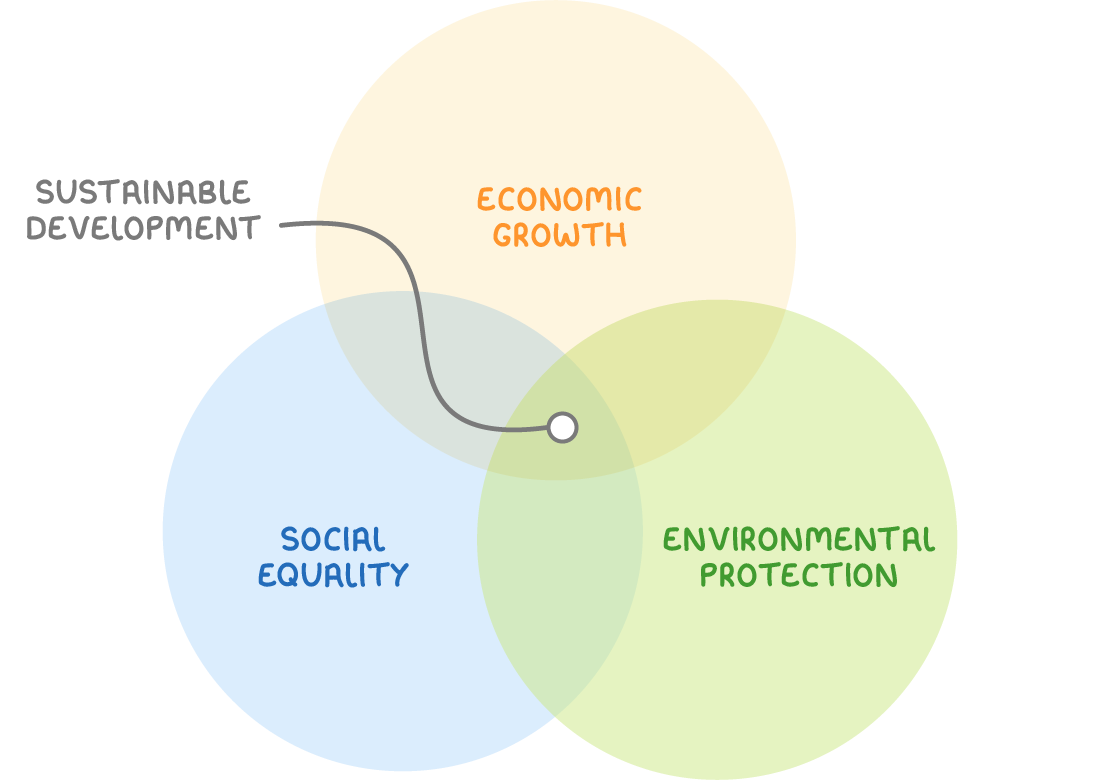
Core pillars of sustainable development
- Environmental protection - Focuses on sustainability by promoting practices like using renewable energy sources in industry instead of fossil fuels.
- Economic growth - Emphasises development while addressing the overexploitation of Earth's resources.
- Social equality - Advocates for ethical benefits, ensuring development provides equal opportunities, access to education, and rights for all. This pillar also addresses the exploitation of workers in industries that harm the environment.
Green growth and ecological modernisation
When economic development utilises natural resources responsibly and minimises pollution, it is referred to as green growth or ecological modernisation.
Criticisms of sustainable development
While sustainable development is widely promoted, it faces significant criticism and practical challenges.
Critiques from different perspectives
- Marxist criticism - Marxists argue that sustainable development often prioritises the interests of wealthier nations, neglecting the needs of poorer countries. Neo-Marxist sociologist Redclift (1987) suggests that some environmentalists focus excessively on ecological issues, sidelining the urgent need to alleviate poverty in LEDCs.
- Short-term economic priorities - Many countries prioritise immediate economic gains over long-term environmental sustainability. For instance, infrastructure projects like road expansions continue despite their contribution to pollution.
- Radical environmentalist stance - Some radical environmentalists believe that sustainable development does not go far enough. They advocate for de-industrialisation as the only way to truly protect the environment.
Practical challenges in implementation
- Balancing growth and sustainability - Developing countries often face pressure to industrialise quickly to improve living standards, which can conflict with sustainable practices.
- Limited resources for change - LEDCs may lack the funds or access to technology needed to adopt greener methods, making sustainable development difficult to achieve in practice.