2.3 - Educational Achievement & Inequality: Class
Social class and educational achievement
Social class plays a significant role in determining how well students perform in education. Various studies highlight stark differences in achievement levels between students from different socio-economic backgrounds.
Disparities in educational outcomes by social class
- Higher education access - Students from professional families are far more likely to pursue higher education compared to those from unskilled backgrounds.
- Qualification choices - Middle-class students often opt for A-levels, while working-class students are more inclined towards vocational qualifications.
- Early literacy skills - Children from disadvantaged backgrounds are less likely to start school with reading abilities already developed.
- Academic performance and streaming - Pupils from unskilled backgrounds tend to score lower in standardised tests like SATs and GCSEs and are often placed in lower academic streams or sets.
In-school factors affecting achievement
Processes within schools can significantly influence student performance, often reinforcing class-based disparities. Factors like labelling, streaming, and the formation of subcultures play a crucial role.
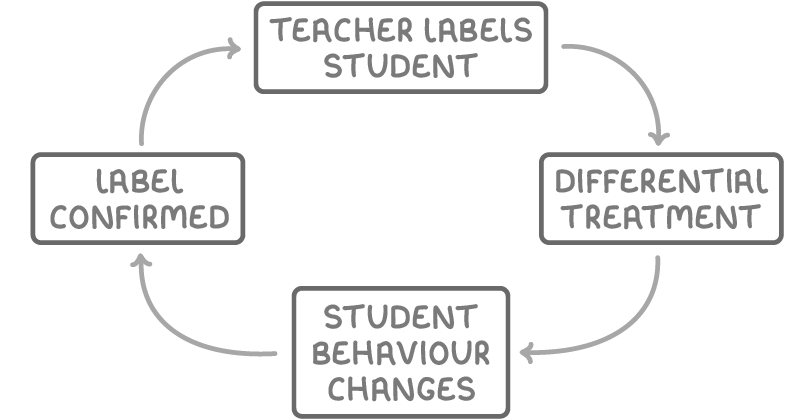
Influences within the school environment
- Negative labelling and self-fulfilling prophecy - Teachers may label students based on social class, appearance, and behaviour, comparing them to an ideal student image. This can lead to a self-fulfilling prophecy where labelled students underperform due to lowered expectations, as noted by Becker (1971) and Keddie (1971).
- Streaming by social class - Research by Ball (1981) indicates that students in higher streams are often from middle-class backgrounds, suggesting a bias in academic grouping that can perpetuate inequality.
- Formation of anti-school subcultures - In response to negative labelling and perceived low status, some students, particularly from working-class backgrounds, may develop anti-school subcultures. Woods (1983) suggests that non-conformist reactions to school are more common among working-class pupils.
Material deprivation and educational outcomes
Material deprivation refers to the economic challenges faced by families that can hinder educational success. Poverty and lack of resources create significant barriers for students from lower socio-economic backgrounds.
Economic barriers to educational success
- Poverty statistics - Research by the Joseph Rowntree Foundation revealed that approximately one in ten children lived in poverty, defined as lacking at least three essentials that other families consider standard.
- Financial constraints on education - Halsey (1980) identified lack of financial support as the primary reason working-class students leave education early.
- Impact of living conditions - Douglas (1964) found that children in poor housing, with inadequate nutrition or overcrowded conditions, performed worse in ability tests compared to peers from more comfortable backgrounds.
- Limited access to resources - Families with low income or facing unemployment struggle to afford educational materials like books, internet access, or school trips. They are also less likely to access nurseries, private schools, or support university education.
- Health and attendance issues - Poverty often leads to health problems and higher rates of school absence, further impacting academic performance.
Cultural deprivation and attitudes to education
Cultural deprivation theory suggests that differences in cultural values and parenting styles between social classes affect educational achievement. Working-class culture is often seen as less aligned with educational success compared to middle-class culture.
Cultural factors influencing achievement
- Parental interest and involvement - Douglas (1964) highlighted parental interest as a key factor in achievement, noting that middle-class parents are more likely to attend school events like open evenings. However, working-class parents may face barriers such as inconvenient work schedules rather than a lack of interest.
- Access to cultural resources - Middle-class students often benefit from exposure to books, museum visits, internet access at home, and parents with knowledge of the education system, giving them an edge in academic settings.
- Class-based attitudes to education - Sugarman (1970) argued that working-class students often seek immediate gratification, while middle-class students are more likely to defer gratification, investing time in studies for future rewards.
- Value placed on education - Hyman (1967) suggested that working-class values may act as a barrier to educational improvement, as they often place less importance on academic success.
- Long-term policy impact - Leon Feinstein (2003) found that social class continues to influence achievement over time, advocating for sustained redistributive policies like Sure Start throughout a student's education, not just in early years.
Critiques of cultural deprivation theory
- Overgeneralisation - The theory often makes broad assumptions about class differences, ignoring working-class families who do value education highly.
- Ethnocentric bias - It risks suggesting that working-class culture is inferior or irrelevant to education, prioritising middle-class norms.
- Measurement issues - Indicators like attendance at parents' evenings may not accurately reflect parental interest, as external factors can prevent participation.
Theories of language and cultural capital
Specific sociological theories focus on how language and cultural resources contribute to differences in educational achievement between social classes. Two key thinkers, Bernstein and Bourdieu, provide influential perspectives on this issue.
Bernstein's theory of language codes
- Restricted and elaborated codes - Bernstein (1971) observed that working-class students in London's East End used a restricted code of speech, characterised by short, simple expressions. In contrast, middle-class students were more adept at using an elaborated code, a detailed and explicit style of speech similar to that of teachers.
- Educational disadvantage - This linguistic difference places working-class students at a disadvantage in academic settings where elaborated code is the norm.
- Critiques of Bernstein's theory - Variations exist within both middle and working classes in language use, and some sociologists, like Labov (1973), argue that the restricted code is not inferior but simply different.
Bourdieu's concept of cultural capital
- Definition of cultural capital - Bourdieu (1971, 1974) proposed that middle-class students possess cultural capital—comprising language, skills, knowledge, and attitudes—that aligns with educational expectations, giving them an advantage.
- Cultural reproduction - Middle-class families transmit cultural capital to their children, reinforcing class advantages across generations through cultural reproduction.
- Impact on success - The more cultural capital a student has, the more likely they are to succeed academically, while working-class students often lack access to these resources.
- Critiques of Bourdieu's theory - Halsey et al. (1980) noted that material factors, such as financial constraints, also significantly impact educational outcomes. Additionally, not all working-class students fail, even without cultural capital, suggesting other influences at play.