11.2 - Globalisation
World Systems Theory and the economic hierarchy
World Systems Theory, proposed by Wallerstein in 1974, views the entire world as a single economic system rather than focusing on individual national economies. It categorises countries based on their role and influence within this global structure.
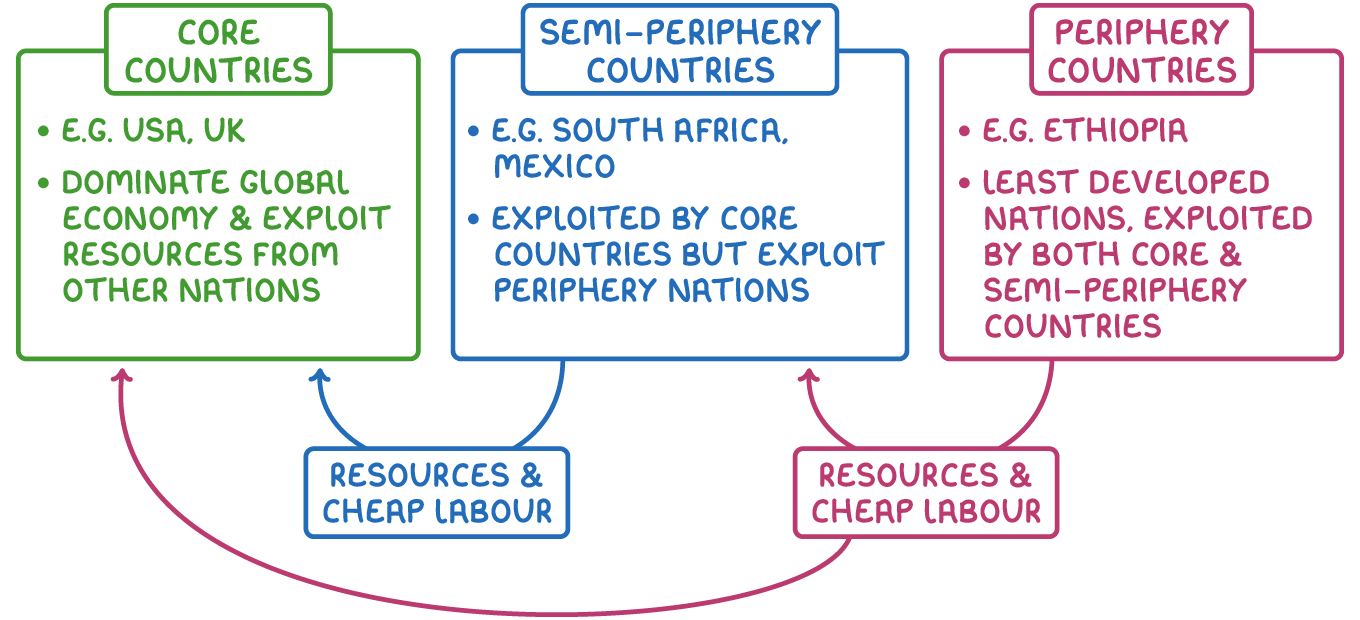
Categories within World Systems Theory
| Category | Description |
|---|---|
| Core countries | These are developed nations that dominate the global economy, benefiting most from capitalism due to their 'global reach'. They control and exploit resources for their own gain. |
| Semi-periphery countries | Nations such as South Africa or Mexico fall into this category. They are exploited by core countries but, in turn, exploit periphery nations. |
| Periphery countries | These are the least developed nations, like Ethiopia, which are exploited by both core and semi-periphery countries. |
Criticisms of World Systems Theory
- Overly deterministic - The theory is criticised for not allowing for individual countries' characteristics.
- Lack of unity - The theory suggests that because semi-periphery countries exploit periphery nations, there is no solidarity among exploited countries, preventing united action to challenge the system.
The impact of globalisation on the global economy
Globalisation has transformed national economies into an interconnected global economy through advancements in technology, trade, and investment. This shift, noted by sociologists like Giddens (1990), has reshaped how goods, services, and information move across borders.
Key drivers of a global economy
- Technological advancements - Developments in communication and transport have made global interaction seamless, enabling instant information transfer and swift movement of goods worldwide.
- Rise of transnational corporations (TNCs) - These companies operate across multiple countries, often basing headquarters in more economically developed countries (MEDCs) while setting up production in regions with lower labour costs to maximise profits.
- New international division of labour - As described by Frobel et al. (1980), manufacturing is often located in developing countries, while knowledge-based work remains in MEDCs. Different production stages can occur in various countries, exemplified by industries like car manufacturing.
Impacts of TNCs
- Benefits - They bring jobs and investment to developing nations, supporting national development strategies, while also offering cheaper goods to international consumers.
- Criticisms - Neo-Marxist perspectives argue that this system creates 'wage slaves' in developing countries, serving capitalist interests.
- Cultural and business influence - TNCs shape global markets for their products and influence host nations' business cultures, operating under ethnocentric (centrally controlled), polycentric (locally managed with central guidelines), or geocentric (integrated management across countries) models.
Global standardisation and McDonaldisation
Weberian sociologist Ritzer (1993) introduced the idea of 'McDonaldisation' to describe the global standardisation of production processes. This concept likens worldwide manufacturing to fast food operations, prioritising uniformity and efficiency.
Core themes of McDonaldisation
| Theme | Description |
|---|---|
| Efficiency | Production mimics fast food assembly lines, focusing on streamlined processes. |
| Calculability | Emphasis is placed on quantity and speed rather than quality. |
| Predictability | Products are standardised globally, ensuring consistency regardless of location, much like a fast food item being identical everywhere. |
| Increased control | Strict protocols and systems are implemented to maintain uniformity. |
| Automation | Human labour is increasingly replaced by machines. |
Political globalisation and cooperation
Globalisation extends beyond economics into the political sphere, where decision-making and governance increasingly occur on an international level.
Features of political globalisation
- International governance - Organisations like the United Nations (UN) enforce international law and undertake peacekeeping roles.
- Regional cooperation - Bodies such as the European Union (EU) exemplify increased political collaboration.
- Role of non-governmental organisations (NGOs) - These international entities coordinate aid efforts and advocacy campaigns.
- Challenges to national sovereignty - Critics argue that international agencies and TNCs diminish national sovereignty, as governments must negotiate with external powers and risk economic consequences, such as job losses, if TNCs relocate.
- Transnational capitalism - Leslie Sklair (2000) views globalisation as a form of capitalism that transcends borders, suggesting that TNCs, global media, and bureaucrats hold more power than nation states.
Perspectives on national importance
- Realist viewpoint - Realists assert that national interests still dominate policy decisions, as seen in the US rejection of the Kyoto Protocol due to potential domestic economic impacts.
- Strengthening national identity - Hall (1995) argues that globalisation heightens the importance of national identity as a means of preserving cultural distinctions.
- Resistance to loss of power - In the UK, concerns over diminishing sovereignty to the EU led to the 2016 referendum, resulting in the decision to leave the EU.
- Devolution trends - Power is increasingly delegated to local bodies, such as the Scottish Parliament and Welsh Assembly, reinforcing regional identities and control over specific policies within the UK.
Cultural globalisation and its effects
The rapid growth of international media and communication has facilitated cultural globalisation, spreading cultural products and practices across borders.
Dynamics of cultural globalisation
- Spread of cultural goods - Media advancements have made local cultures global, with British and American music, as well as American and Indian films, gaining international audiences.
- Postmodernist perspective on hybridisation - Postmodernists argue that cultural globalisation fosters a mix of cultures, allowing individuals to engage with diverse traditions rather than imposing a single dominant culture.
- Two-way cultural exchange - This process is reciprocal, with Western culture influencing other societies and non-Western cultures, such as Bollywood films, gaining prominence in Western mainstream markets.
- Concerns over cultural imperialism - Critics warn that the concentration of cultural production in the hands of a few powerful TNCs risks replacing traditional cultures with Western ones to create new markets for Western goods.