12.5 - The Audience
The hypodermic syringe model
The hypodermic syringe model is one of the earliest theories about media influence, emerging in the 1920s when mass media like radio and newspapers gained prominence. This model suggests that media messages have a powerful, direct effect on audiences, shaping their thoughts and behaviours with little resistance.
Core ideas of the hypodermic syringe model
- Direct injection of messages - Media content is seen as being 'injected' into the audience's mind, much like a drug is administered through a syringe, leaving individuals unable to resist or question the information.
- Uniform impact - The theory assumes that all audience members are affected in the same way, regardless of personal differences or contexts.
A notable case often cited as evidence is the 1938 radio broadcast of The War of the Worlds by Orson Welles. Presented as a series of fake news bulletins about a Martian invasion, it caused panic among some listeners who believed the reports were real, reinforcing the idea of media's dangerous power.
Criticisms of the hypodermic syringe model
- Oversimplification - Critics argue that this model is too basic, portraying audiences as passive and easily manipulated, which does not reflect the complexity of how adults engage with media.
- Varied responses - Research as early as the 1920s demonstrated that not all individuals react identically to the same media content, challenging the idea of a uniform effect.
- Focus on children - Despite criticisms, the model retained popularity in discussions about media influence on younger, more impressionable audiences.
The two-step flow model and opinion leaders
Developed in the 1950s, the two-step flow model offers a more nuanced perspective on media influence, suggesting that media messages are not directly absorbed by all audience members but are mediated through social interactions.
Key aspects of the two-step flow model
- Initial exposure - Media messages first reach individual audience members through traditional channels like television or newspapers.
- Social interaction - The interpretation of these messages is shaped by discussions with others, such as friends or colleagues chatting about a television programme during a break.
- Influence of opinion leaders - Katz and Lazarsfeld (1955) identified certain individuals, termed opinion leaders, within communities who significantly shape others' views. These leaders express their reactions to media content, guiding the opinions of those around them.
- Example in voting behaviour - Research by Katz and Lazarsfeld on American voters showed that many followed the voting preferences of opinion leaders, who often drew their ideas directly from media messages.
- Multi-step process - The flow of influence can extend beyond two steps. Hobson (1990) observed in an office setting that a few key individuals influenced television viewing choices and opinions, which then spread further among colleagues, creating a social norm that new members felt pressured to follow.
Cultural effects theory and social context
Cultural effects theory highlights the importance of social and cultural contexts in shaping how audiences interpret media messages. It moves away from the idea of a uniform media impact, focusing instead on diverse responses based on individual and societal backgrounds.
Principles of cultural effects theory
- Contextual interpretation - Audiences understand media content through the lens of their own cultural and subcultural affiliations, leading to varied reactions.
- Broader societal norms - Responses can be influenced by wider cultural expectations, such as national pride in sports achievements like England winning a major football tournament, which often elicits a generally positive reaction across the population.
- Subcultural differences - Within a society, smaller group affiliations also play a role. For instance, reactions to a football club's victory will differ based on whether an individual supports that specific team.
Cantril (1940) revisited the War of the Worlds broadcast, noting that the panic it caused was influenced by the era's climate of insecurity in America, marked by economic struggles and looming war in Europe. Frequent real news interruptions on radio at the time made listeners more likely to believe the fictional invasion reports.
Neo-Marxist perspective:
- Stuart Hall (1980) argued that media often carry dominant ideological messages.
- However, audiences from different backgrounds decode these messages in unique ways, ranging from full agreement to complete opposition.
Challenges in studying cultural effects:
- A major criticism of this approach is the challenge of quantifying the causes and effects of media influence.
- For example, measuring the intensity of emotions like fear or concern triggered by media content.
Moral panic and media reporting of deviance
Media reporting can amplify social issues, sometimes creating a moral panic where public fear and concern are heightened, often leading to calls for action. This concept was explored by Stan Cohen in the 1970s.
Process of creating moral panic
- Initial deviant behaviour - A small group engages in behaviour perceived as outside societal norms.
- Media coverage - The media report on this behaviour, often exaggerating or sensationalising the event.
- Repeated reporting - Similar stories are highlighted repeatedly, increasing public awareness and concern.
- Labelling as a threat - The group or behaviour is portrayed as a danger to social order, intensifying public reaction.
- Increased participation - The publicity can draw more individuals to engage in the deviant behaviour, further fuelling the cycle.
Cohen's study of the Mods and Rockers in the 1960s illustrates this. Media predictions of clashes between these youth subcultures led to large gatherings, either to participate or observe, which in turn caused public panic over the reported scale of the events.
Long-term effects and violent media impact
Media influence is not always immediate; effects can accumulate over time, shaping cultural norms and behaviours. Additionally, significant research has focused on the impact of violent media content, especially on younger audiences, sparking ongoing debates.
Long-term media effects on society
- Cultural norm reinforcement - Repeated exposure to certain media portrayals, such as stereotypical images of women, can solidify societal expectations. Campaigns, like those against topless images in newspapers (e.g., the Sun ending its 'Page Three' feature in 2015), argue that such content perpetuates harmful objectification.
- Impact of media technology - Beyond content, the form of media itself influences society. Marshall McLuhan (1964) famously stated 'the medium is the message', suggesting that technologies like the internet reshape communication, shopping, and job applications more than the specific messages they carry.
- Hot and cool media - McLuhan categorised media as 'hot' (e.g., films, requiring little effort to understand) or 'cool' (e.g., comics, needing active interpretation), indicating different engagement levels affect audience impact.
- Measurement challenges - Objectively assessing long-term effects remains difficult, making much of the discussion theoretical rather than empirical.
Effects of violent media content
- Desensitisation hypothesis - Newson (1994) suggested that frequent exposure to violence in television, films, and games can desensitise individuals, making violent acts seem less shocking over time.
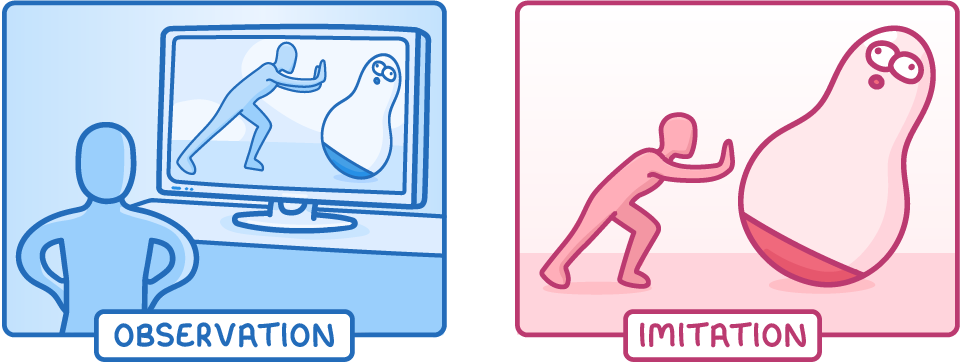
- Imitation research - Bandura et al. (1963) conducted a well-known study showing children a video of an adult striking a doll. Children who viewed the violent footage later mimicked the behaviour when given the same doll, unlike a control group who did not see the video, suggesting media violence can inspire similar actions.
- Real-world connections - Media often links violent films or games to real acts of violence, such as the 2012 Aurora shooting during a The Dark Knight Rises screening, where the attacker dressed as a character from the film. Although widely discussed, direct causal links are often unproven.
- Glasgow University Media Group (GUMG) findings:
- Since 1974, GUMG has studied news reporting effects, finding that media can strongly shape audience beliefs.
- During the 1984–5 miners' strike, over half of surveyed viewers who saw coverage believed picket lines were mostly violent, despite contrary accounts from those present, showing media's role in forming perceptions.
Critiques and alternative views on violent media effects
- Lack of conclusive evidence - Cumberbatch (2004) reviewed over 3000 studies and found no definitive proof that violent media directly causes violent behaviour in children or adults.
- Sensitisation theory - Young (1981) proposed that violent media might heighten awareness of violence's consequences, potentially deterring real-world aggression by sensitising audiences rather than desensitising them.
- Catharsis argument - Fesbach and Sanger (1971) suggested that engaging with violent media, such as shouting at a video game, provides a safe outlet for aggression, reducing the likelihood of harmful behaviour through a process known as catharsis.
- Methodological criticisms:
- Gauntlett (2008) critiqued experimental approaches like Bandura's, arguing that lab settings produce artificial results unreflective of real-world behaviour where social influences like peers and parents play a role.
- He also challenged the view of children as passive media consumers, advocating for ethnographic studies in natural settings, such as observing children creating videos on environmental themes.
- Definitional issues:
- Some critics note that media effects research often focuses solely on fictional violence without clarifying what 'violence' encompasses.
- This ignores varied audience reactions to different contexts (e.g., comedic versus realistic violence) as highlighted by Morrison (1999).