11.1 - Concepts of Development & Underdevelopment
Defining and measuring development
Development refers to the process of economic growth, industrialisation, and improvements in living standards, such as increased life expectancy and access to education. Different terminologies and metrics are used to classify countries based on their level of development, though many carry cultural biases.
Terminologies used to describe development levels
- More Economically Developed Countries (MEDCs) - Nations with high economic growth, industrialisation, and living standards.
- Less Economically Developed Countries (LEDCs) - Nations with lower levels of economic progress and living standards compared to MEDCs.
- Developed vs. Developing - Richer countries are termed 'developed', while poorer ones are 'developing'. 'Underdeveloped' refers to countries lagging behind others with similar resources.
- Ethnocentric bias - Many terms are based on Western ideals, assuming these standards as superior, which can skew perceptions of development.
- Outdated and neutral terms - 'First World' and 'Third World' are obsolete, previously distinguishing wealthy and poor nations. 'Northern' and 'Southern' are more neutral but not always accurate, as some developed countries like Australia are in the southern hemisphere.
Methods of measuring development
- Economic indicators - Capitalists often use Gross Domestic Product (GDP), which measures the total value of goods and services produced by a country annually. However, GDP per capita can mask wealth disparities within a country.
- Social indicators - Development can also be assessed through human needs metrics like the Human Development Index (HDI), Human Poverty Index (HPI), and Physical Quality of Life Index (PQLI). These reveal deprivation even in developed nations.
- Global inequality comparisons - Examining income differences between countries highlights disparities. For instance, in 2002, the lowest earners in a developed nation might still have higher income than the top earners in a country like India.
Modernisation theory
Modernisation theory posits that all countries progress towards liberal capitalism, viewing underdeveloped nations as less advanced compared to those with higher production and wealth.
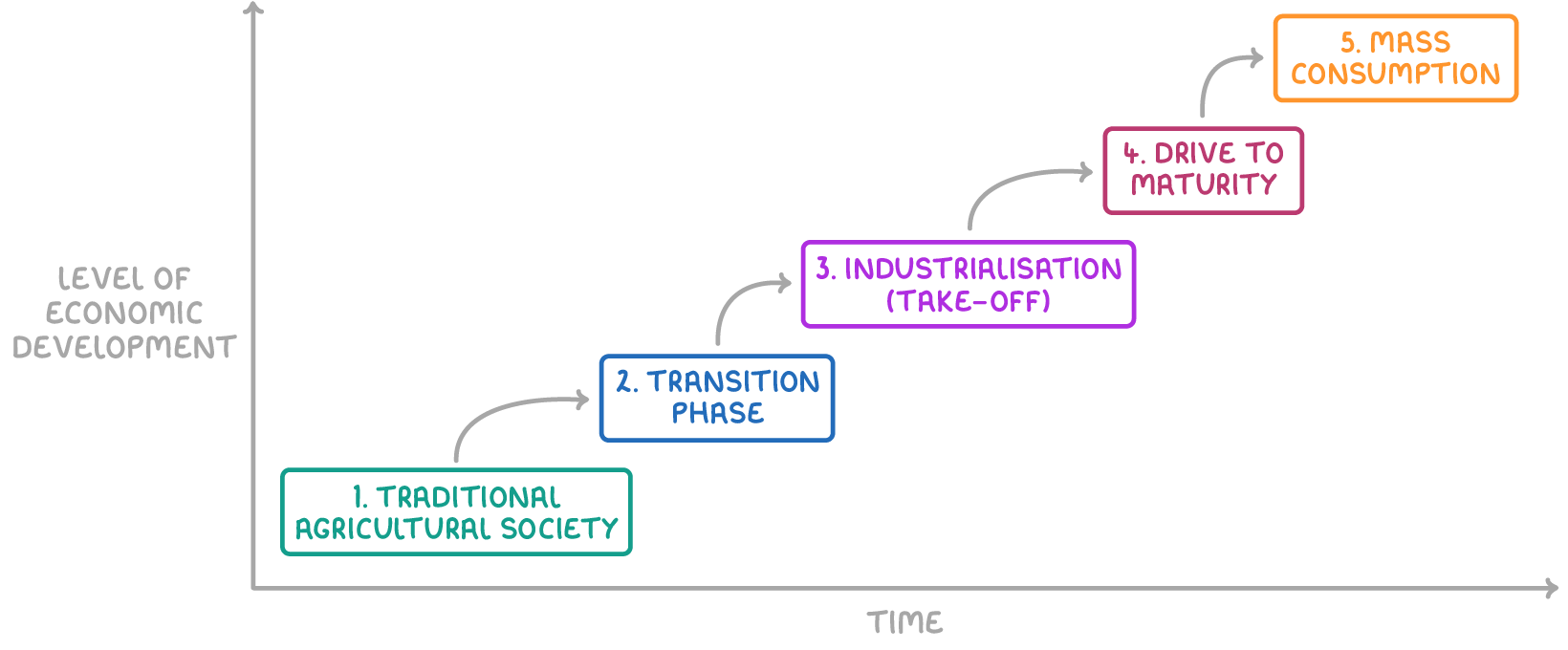
Stages of development according to Rostow (1971)
- Traditional agricultural society - Dominated by basic farming with limited economic activity.
- Transition phase - Preparation for 'take-off' where farmers generate surplus for sale, small towns emerge, and minor industrial activity begins.
- Industrialisation or 'take-off' - Rapid manufacturing growth, accompanied by migration from rural to urban areas.
- Drive to maturity - Significant investment and conducive social conditions fuel growth, with large cities developing.
- Mass consumption - Wealth becomes widespread, consumer spending increases, and the service sector expands.
Cultural factors in modernisation
- Western values as a prerequisite - Kerr (1962) argued that adopting Western-style politics and social values is essential for development, often at the expense of traditional cultures.
- Criticism of ethnocentrism - This perspective is seen as biased, assuming Western models are universally superior and applicable.
- Reasons for underdevelopment - Identified as insufficient agricultural surplus for investment, lack of technological advancement, and a shortage of entrepreneurial drive.
Neo-liberalism and free trade
Neo-liberalism advocates for minimal government interference in economic processes, promoting free market principles as a pathway to development.
Core principles of neo-liberalism
- Free market advocacy - Neo-liberals like Friedman (1962) believe that unrestricted trade fosters development by allowing natural economic dynamics to operate.
- Support from global organisations - Institutions such as the International Monetary Fund (IMF) and World Bank endorse neo-liberal policies, citing Newly Industrialised Countries (NICs) like the 'Tiger economies' (Singapore, Hong Kong, South Korea, and Taiwan) as success stories due to reduced tariffs and open trade policies.
- Rapid growth and challenges - These economies saw significant growth between the 1960s and 1990s but faced economic crises in the late 1990s due to overexpansion.
- Critiques of neo-liberalism - Like modernisation theory, it faces criticism for ethnocentric bias and for oversimplifying the applicability of Western development models, ignoring historical complexities of global interactions.
Dependency theory and exploitation
Dependency theory offers a contrasting view to modernisation theory, focusing on how historical and economic relationships perpetuate underdevelopment.
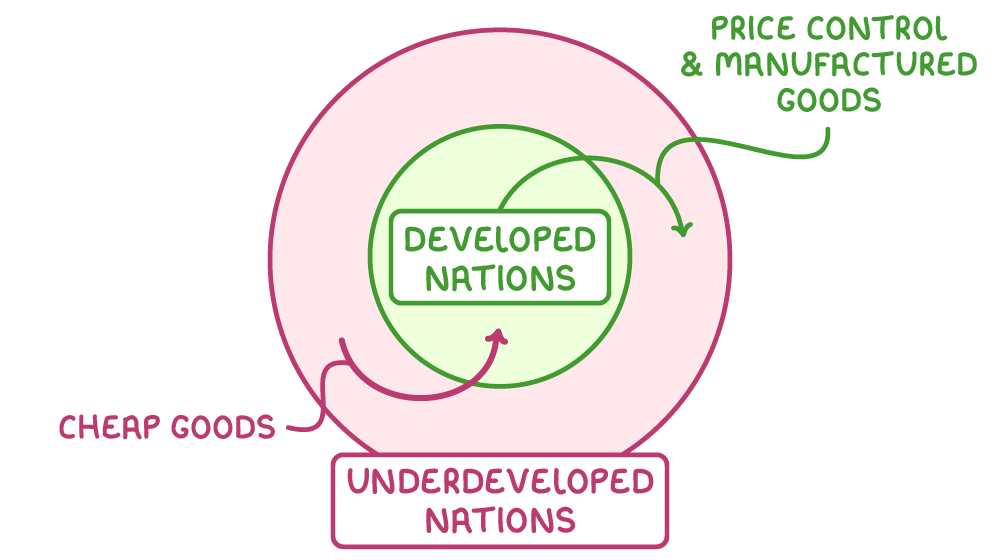
Key ideas of dependency theory
- Historical exploitation - Frank (1967), a prominent dependency theorist, argued that developed nations exploited underdeveloped ones during colonial times, hindering their industrial progress.
- Post-colonial economic dependency - Even after gaining political independence, many poorer nations remain economically tied to former colonial powers, with trade relationships often skewed in favour of richer countries who control pricing.
- Marxist foundation - This theory suggests that markets in poorer countries are shaped by a ruling class that reaps profits while workers receive minimal wages. Developed nations buy goods cheaply and sell them at a profit domestically.
- Limitations of the theory - It lacks a clear definition of development and practical solutions. It is also criticised for being deterministic, assuming inevitable exploitation in LEDCs, and for not addressing similar dependencies in socialist contexts, such as Eastern European states under Russian influence.
Alternative perspectives on development
Beyond economic and political theories, alternative views question the very concept and consequences of development.
Environmentalist concerns on development
- Sustainability issues - Environmentalists highlight the ecological damage caused by rapid development, such as industrial pollution and the use of harmful agricultural chemicals like pesticides.
- Conflict with capitalism - There is a concern that environmental priorities are often sidelined in favour of economic growth, potentially leading to a global ecological crisis as LEDCs pursue fast-paced development.
Post-development theory and cultural critique
- Rejection of Western constructs - Post-development theory challenges the notions of 'developed' and 'underdeveloped' as Western impositions that devalue other cultures and societies.
- Criticism of intervention - Arturo Escobar (1995) argued that Western-led development initiatives are a modern form of colonialism, driven by materialistic goals that may be unattainable.
- Advocacy for autonomy - This perspective suggests that societies should evolve according to their unique cultural and historical paths rather than adopting imposed models of progress.