13.4 - Class Structure: Globalisation
Shift from national to global class stratification
Traditionally, sociological studies of class structure focused on individual nations, such as the working class within the United Kingdom. However, globalisation has transformed this perspective by enabling the movement of production, workers, and capital across borders.
Key changes in class analysis due to globalisation
- Cross-border production - Goods and services are produced in multiple countries, breaking the traditional focus on national economies.
- Mobile capital and labour - Money and workers move freely between nations, creating interconnected economic systems.
- Global political influence - Power is no longer just national; involvement in international bodies affects an individual's or country's standing on the world stage.
This has led to the idea that social stratification now operates on a global scale, where inequalities are not confined to single countries but span the entire world. Political power has become globalised through international organisations like the European Union (EU) and the United Nations (UN), making it necessary to consider international influence when assessing an individual's or group's power.
Stratification of nations by development level
Countries are often categorised by their level of economic growth and the living standards of their populations. Sociologists typically label wealthier nations as 'developed' and poorer ones as 'developing'. Globalisation has widened the gap between these categories, creating distinct layers of global inequality.
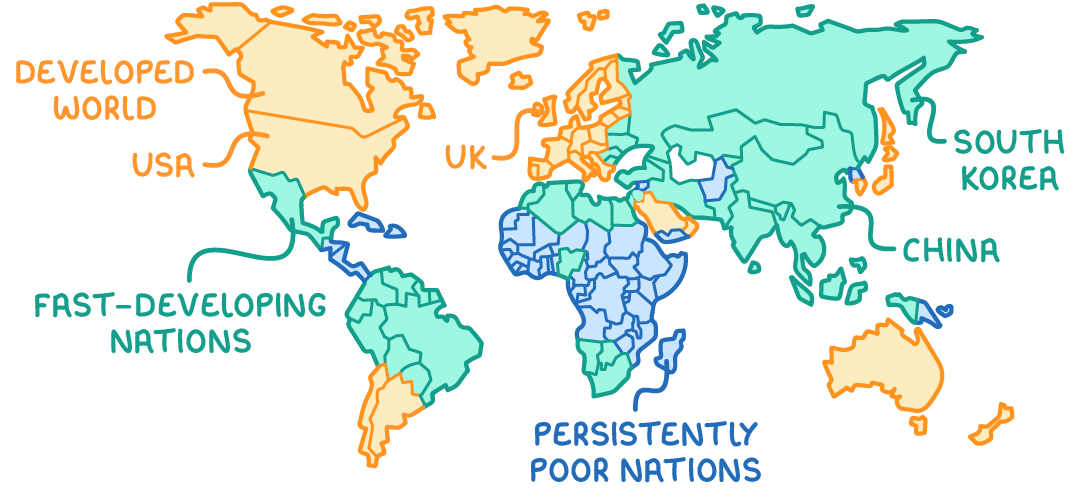
Levels of global stratification
- Developed world - Nations like the UK and the USA have seen their wealth increase over time.
- Fast-developing nations - Some developing countries, such as South Korea and China, have experienced rapid economic growth by focusing on manufacturing for global export (e.g., textiles and electronics) due to lower labour costs.
- Persistently poor nations - Other parts of the developing world remain in poverty, with little improvement in economic conditions.
Challenges in fast-developing nations
- High absolute poverty - Many people still live in extreme deprivation despite overall economic gains.
- Low wages - Workers often earn far less than the cost of the goods they produce, making these products unaffordable for them.
- Poor working conditions - Long working hours and inadequate health and safety standards are common in manufacturing sectors.
The concept of the transnational capitalist class
Beyond national boundaries, some sociologists argue that a global class system has emerged, dominated by powerful transnational corporations (TNCs). Neo-Marxist Leslie Sklair (2001) introduced the idea of a transnational capitalist class, describing it as a global ruling class that wields significant economic and political influence through TNCs.
Fractions of the transnational capitalist class
| Fraction | Description |
|---|---|
| Corporate fraction | Owners and top executives who control TNCs and often hold influential positions in other sectors like charities or education. |
| State fraction | Bureaucrats and politicians who use their authority to advance the interests of TNCs on a global scale. |
| Technical fraction | Skilled professionals who develop products and services for TNCs, enhancing their market dominance. |
| Consumerist fraction | Media and marketing experts who promote TNC products to the public, shaping consumer behaviour worldwide. |
The global working class
Alongside this elite group, a global working class has also emerged. According to Fröbel et al (1980), there is a new international division of labour where TNCs are managed from developed countries, while labour-intensive manufacturing occurs in developing nations. Workers in these regions often face low pay and limited rights, highlighting global inequalities.
Impact of transnational corporations on inequality
The transnational capitalist class, through TNCs, often exploits the global working class, leading to significant social and health consequences. A clear example of this dynamic is seen in the food industry, particularly in developing countries.
Critiques of the transnational capitalist class concept
- Persistence of national stratification - Some argue that global stratification does not fully replace national class structures; TNCs may simply exploit existing local inequalities, as seen in Mexico.
- Resistance from state actors - Not all governments align with TNC interests; for instance, the Mexican government introduced a 'soda tax' to curb soft drink consumption, showing pushback against corporate influence.
Migration and its effects on class structures
Globalisation involves not only the movement of capital but also of people, with over 240 million migrants worldwide. Most migrate from developing to developed countries, driven by economic opportunities or the need for safety.
Reasons for migration
- Economic motivation - Many seek better jobs or higher wages in wealthier nations.
- Asylum seeking - Others flee conflict, oppression, or persecution in search of a secure place to live.
Impact of migration on class structures in developed countries
- Expansion of the working class - Many immigrants take up low-skill or unskilled jobs, increasing the size of the working class. Research indicates that they often remain in this class across generations.
- Social mobility variations - According to Modood et al (1997), while some skilled immigrants experience downward mobility upon arrival in the UK, their children, particularly those of Indian or Chinese descent, often secure middle-class, skilled positions.
- Emergence of a sub-class - Mass illegal immigration has created a vulnerable group of exploited workers in developed nations. These individuals, sometimes trafficked against their will, face low pay, long hours, and poor conditions, with employers using the threat of deportation to prevent complaints.