11.5 - Industrialisation & Urbanisation
Urbanisation and industrialisation
Industrialisation and urbanisation are closely linked processes that have shaped the development of societies across the world. Industrialisation refers to the shift from agriculture and small-scale production to large-scale manufacturing in factories, often requiring a centralised workforce. Urbanisation, on the other hand, describes the growth in the proportion of people living in urban areas compared to rural ones.
Key connections between industrialisation and urbanisation
- Migration for work - As industrialisation creates factory-based jobs, people move from rural areas to urban centres in search of employment opportunities.
- Historical patterns - In Western Europe, these processes peaked during the 19th century, while in countries like Mexico, they occurred predominantly in the 20th century.
- Population shift - The movement of populations leads to a significant increase in urban dwellers, altering the social and economic fabric of a region.
Modernisation theory on urbanisation
Modernisation theory presents urbanisation as a crucial step in the economic and social development of a country, aligning with Western models of progress and values.
Core ideas of modernisation theory
- Symbol of progress - Cities are viewed as centres of advancement, moving away from traditional values towards ideals like meritocracy, individualism, and active participation in society.
- Economic contribution - According to Hoselitz (1964), urban environments encourage hard work and economic engagement by rewarding achieved status, where success is based on personal effort rather than inherited position.
- Measuring development - Development can be assessed by the level of urbanisation, calculated by comparing the number of people living, working, and socialising in cities versus rural areas.
Criticisms of the theory:
- Critics highlight its ethnocentric bias, as it is rooted in Western urban models and capitalist ideals.
- It lacks clarity on how wealth and development spread from urban to rural areas, assuming this happens automatically.
Dual economy and dependency theories
Not all theories view urbanisation as inherently positive. Dual economy and dependency theories offer alternative perspectives on the impacts of urban growth, particularly in less economically developed countries (LEDCs).
Dual economy theory on urban-rural divide
- Separate economies - This theory suggests that urbanisation creates two distinct societies within a country: a rural economy focused on subsistence and local needs, and an urban economy geared towards national and international growth.
- Colonial legacy - The theory argues that colonialism advanced urban areas at the expense of rural ones, creating a disconnect between the two.
- Practical insight - It helps explain why urban and rural areas have different needs and challenges.
- Criticism of assumptions - Critics note that the theory often portrays rural economies as inherently 'backward', which may oversimplify their role and potential.
Dependency theory on urban poverty
- Rejection of modernisation ideals - Dependency theorists argue that cities in LEDCs do not reflect the meritocratic success stories described by modernisation theory. Instead, they are marked by stark inequality between the wealthy elite and the poor.
- Colonial roots of inequality - The theory attributes urban poverty and problems like poor public health and inadequate infrastructure to the legacy of colonialism, which designed cities to serve colonial elites rather than local populations.
- Dependence on rich nations - LEDC cities are seen as serving the interests of wealthier countries through trade, rather than addressing the needs of their own people.
- Urban challenges - Issues such as inequality, limited access to education, and minimal social security are seen as direct consequences of urbanisation without adequate support systems.
- Criticism of the theory - It overlooks examples of countries where urbanisation has led to genuine economic benefits for local populations.
Strategies for industrialisation: ISI and EOI
Countries often adopt specific strategies to drive industrialisation, with two prominent approaches being import substituting industrialisation (ISI) and export oriented industrialisation (EOI). Each has distinct methods, benefits, and drawbacks.
Import substituting industrialisation (ISI)
- Core principle - ISI focuses on developing local industries to replace imported goods with domestically produced alternatives, using trade tariffs and taxes to shield local manufacturers from foreign competition.
- Government role - This approach requires significant state intervention to protect markets, control borders, and guide the industrialisation process.
- Advantages of ISI - It reduces reliance on developed countries, allowing nations to plan their economies and reinvest profits into further growth.
- Disadvantages of ISI:
- Lack of competition can lead to inefficiency or corruption within local industries.
- protectionist measures may strain relations with trading partners, who could retaliate by refusing to purchase the country's goods.
- Without incentives to grow, some companies may cut wages to increase profits, potentially lowering overall wage standards in the country.
Export oriented industrialisation (EOI)
- Core principle - EOI prioritises the production of consumer goods for export, capitalising on high demand in more economically developed countries (MEDCs) where labour-intensive manufacturing has declined, and leveraging lower labour costs in LEDCs for competitive pricing.
- Success stories - This strategy has been highly effective for the 'tiger economies' such as South Korea, Hong Kong, Taiwan, and Singapore, which emerged as newly industrialised countries (NICs) in the 1970s and 1980s, significantly improving living standards and health for their populations.
- Challenges of EOI:
- Focus on export markets can make goods too expensive for the local population to afford.
- Intense global competition may pressure companies to reduce wages to maintain profitability.
Challenges of rapid and over-urbanisation
Rapid industrialisation often accelerates urbanisation, bringing a host of social issues as populations shift to cities. This phenomenon, termed over-urbanisation by Webster (1984), results from various push and pull factors driving migration.
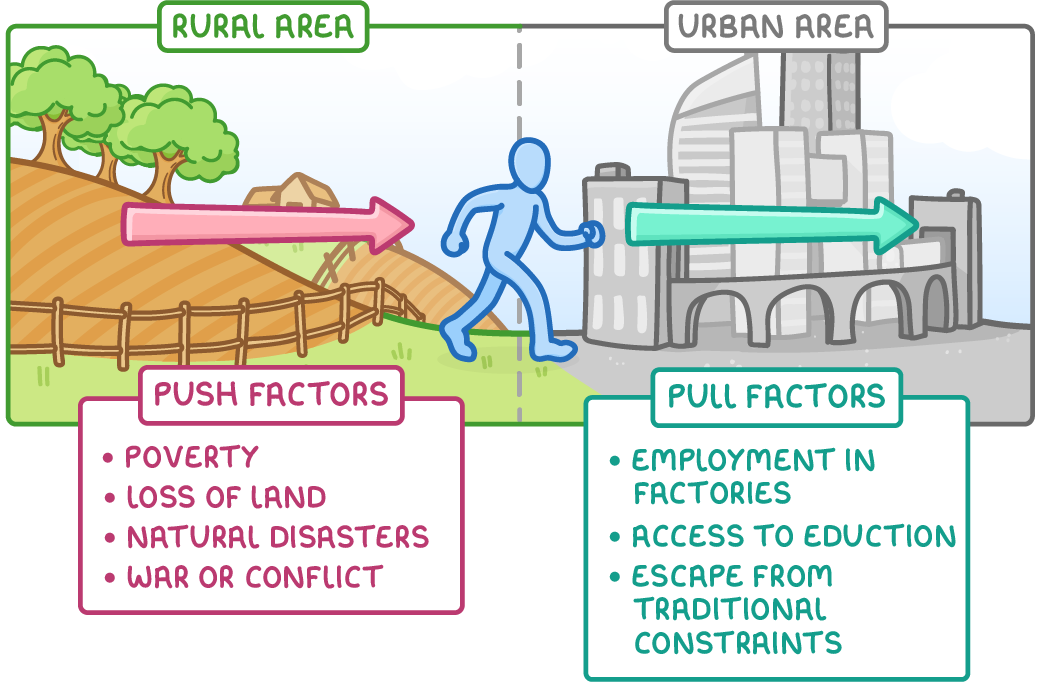
Push and pull factors of urban migration
- Push factors - Poverty, loss of land, natural disasters, war or conflict drive people to leave rural areas
- Pull factors - Employment opportunities in factories, access to education, escape from traditional constraints attract people to urban areas
Consequences of over-urbanisation
- Housing issues - Many new urban migrants cannot afford standard city housing, leading to the creation of shanty towns. These informal settlements often lack basic services like clean water, healthcare, or effective policing, resulting in very low living standards.
- Social strain - The rapid influx of people can overwhelm urban infrastructure, exacerbating problems like poverty and inequality, and creating tension within communities.
- Environmental impact - Overcrowded urban areas may suffer from pollution and resource depletion, further deteriorating living conditions for residents.