6.4 - Cognitive Approach to Depression
The cognitive model of abnormality and its focus on thoughts and beliefs
The cognitive approach to understanding mental health issues, such as depression, centres on the idea that behaviours and emotions are shaped by an individual's thoughts and beliefs. According to this perspective, when thoughts become distorted or irrational, they can lead to abnormal behaviours and psychological disorders.
Core assumptions of the cognitive model
- Thought-driven behaviour - Actions and emotional responses are influenced by internal thought processes rather than just external events.
- Irrational thinking as a cause - Negative or illogical beliefs can trigger and sustain mental health issues like depression.
- Focus on mental processes - Unlike other approaches that might prioritise biological factors, the cognitive model examines how perceptions and interpretations of events contribute to psychological distress.
Key theories explaining depression through faulty cognitions
Several influential models within the cognitive approach provide frameworks for understanding how distorted thinking patterns contribute to depression.
Ellis's ABC model
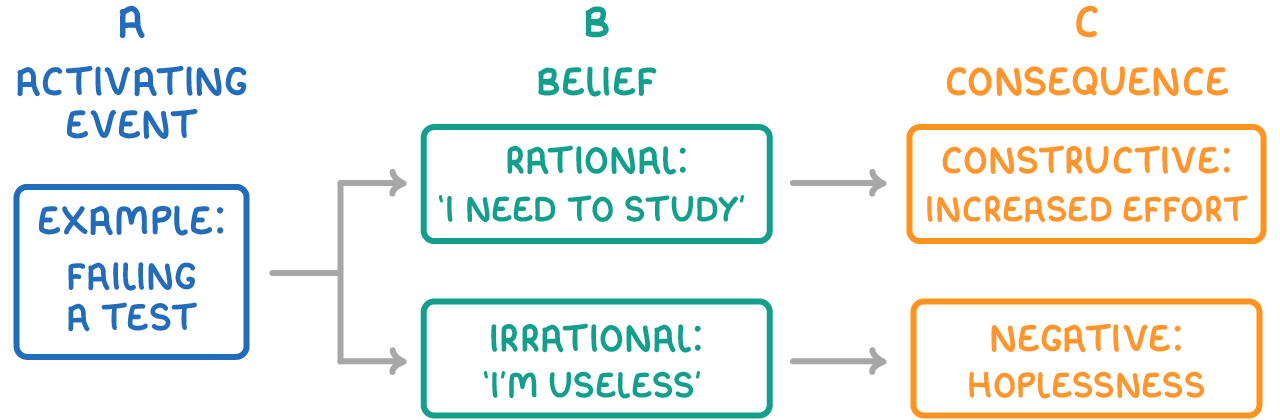
- Activating event (A) - A specific situation or trigger, such as failing a test, initiates the thought process.
- Belief (B) - The individual forms a belief about the event. This can be rational, such as "I need to study harder," or irrational, like "I'm completely useless."
- Consequence (C) - The belief results in an outcome. Rational beliefs lead to constructive responses, like increased effort, while irrational beliefs result in negative emotional or behavioural outcomes, such as feelings of hopelessness or withdrawal.
Beck's negative triad
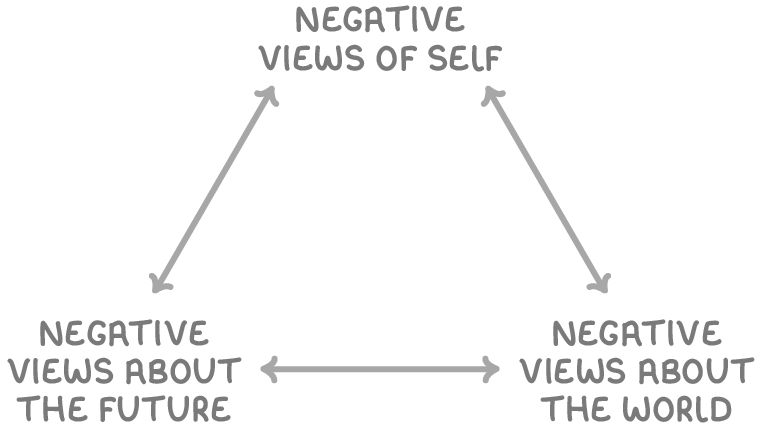
- Negative views of self - Individuals may believe they are inherently flawed or incapable, for example, thinking "I always fail at everything."
- Negative views of the world - They might perceive their environment as overly demanding or unfair, such as believing "Everyone expects too much of me."
- Negative views of the future - A sense of despair about what lies ahead, like thinking "Things will never get better," perpetuates a cycle of negativity.
Strengths and weaknesses of the cognitive explanation of depression
The cognitive approach offers valuable insights into the role of thought patterns in mental health but also faces certain criticisms regarding its scope and implications.
Strengths of the cognitive explanation
- Focus on thought processes - It provides a meaningful perspective by addressing how beliefs and perceptions directly influence emotional well-being, which is central to conditions like depression.
- Empirical support - Research, such as studies using the Automatic Thoughts Questionnaire (ATQ) by Hollon and Kendall (1980), demonstrates a clear link between negative thinking and depressive symptoms. In a study by Harrell and Ryon (1983), 114 participants were assessed, and those with depression consistently showed higher levels of negative thoughts compared to non-depressed individuals.
- Basis for effective therapy - The cognitive model underpins successful therapeutic interventions, such as cognitive behaviour therapy, which have helped many manage depressive symptoms.
Weaknesses of the cognitive explanation
- Causation uncertainty - It remains unclear whether faulty thinking causes depression or if depression, possibly due to biological factors like chemical imbalances, leads to negative thoughts as a symptom.
- Risk of self-blame - Emphasising personal thought patterns might lead individuals to feel responsible for their condition, potentially worsening their emotional state.
Cognitive behaviour therapy (CBT) as a treatment for depression
Cognitive behaviour therapy (CBT) is a widely used treatment rooted in the cognitive approach. It focuses on identifying and altering negative thought patterns to improve emotional and behavioural outcomes, particularly for conditions like depression.
Key processes in CBT
- Identifying faulty cognitions - The therapist works with the client to recognise distorted thoughts or beliefs that contribute to their distress.
- Challenging negative thoughts - Clients are guided to question the validity of these thoughts, for instance, by examining evidence that contradicts beliefs like "I never succeed at anything."
- Setting positive goals - Together, therapist and client establish objectives to encourage healthier thinking, such as focusing on past achievements to build confidence.
- Present-focused approach - While past experiences may be discussed, the emphasis is on current issues and how to manage them effectively.
- Thought diaries - Clients are often encouraged to maintain records of their thoughts, emotions, and behaviours to track patterns and progress over time.
Advantages and disadvantages of CBT in treating depression
CBT has been extensively studied as a treatment for depression, revealing both significant benefits and notable limitations in its application.
Advantages of CBT
- Empowerment through self-help - CBT equips individuals with practical strategies to manage their thoughts independently, reducing reliance on therapists or medication.
- Comparable efficacy to medication - Research by DeRubeis et al. (2005) involved a trial with 240 participants comparing CBT to drug therapy and a placebo over 8 weeks. Both CBT and medication outperformed the placebo, showing similar effectiveness in many cases.
- Lower relapse rates - Hollon et al. (2005) followed up on participants from the DeRubeis study, finding that after one year, those who had completed CBT were less likely to relapse compared to those withdrawn from medication, matching relapse rates of those who continued drug treatment.
- Targeted effectiveness - Studies, such as Brandsma et al. (1978), indicate CBT is particularly beneficial for individuals who experience intense self-imposed pressure or guilt over perceived inadequacies.
Disadvantages of CBT
- Time and cost implications - The therapy often requires multiple sessions over an extended period, which can be expensive and demanding for clients.
- Need for complementary approaches - CBT might yield better results when paired with other treatments, such as medication, especially in severe cases.
- Dependence on therapist expertise - As highlighted by DeRubeis et al. (2005), the success of CBT can hinge on the therapist's experience, with less experienced practitioners potentially achieving poorer outcomes compared to drug therapy.
- Potential for self-blame - Focusing on personal thought patterns might inadvertently lead clients to feel at fault for their condition, which could exacerbate feelings of guilt or inadequacy.