3.7 - How Early Attachment Affects Later Relationships
The internal working model and its influence on adult relationships
The internal working model, a concept developed by Bowlby, is a mental blueprint formed during early childhood through interactions with primary caregivers. This framework guides how individuals perceive themselves and others in relationships, significantly impacting their adult relational patterns.
How childhood attachments shape adult relationships
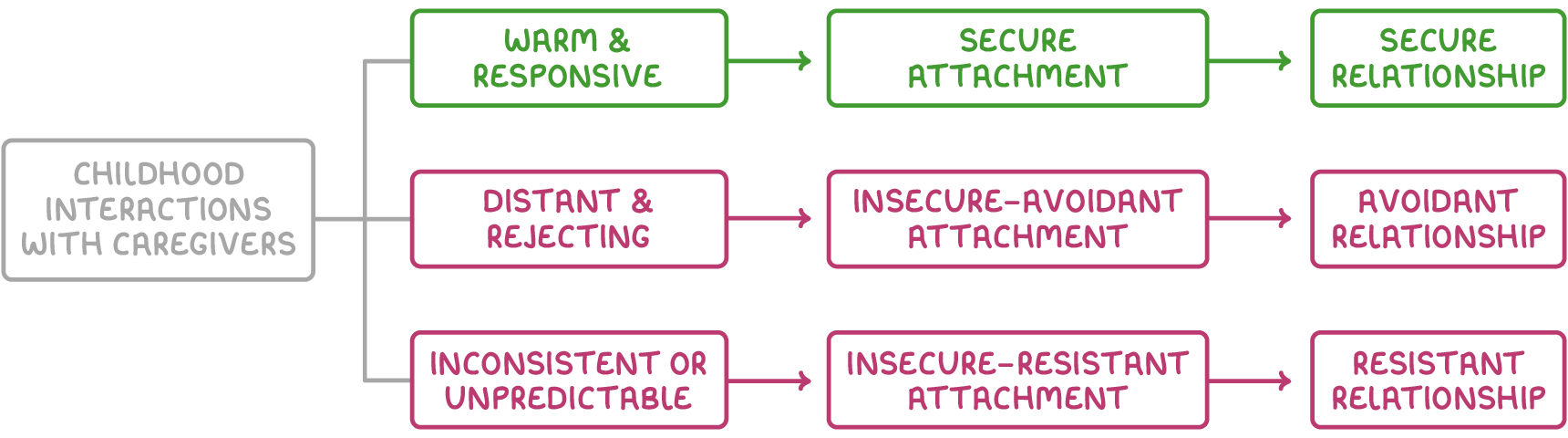
- Secure attachment - Warm and responsive care creates views of self as worthy of love and others as dependable, leading to trusting and stable bonds
- Insecure-avoidant attachment - Distant or rejecting care creates views of self as unworthy and others as unapproachable, developing fear of closeness and emotional distance
- Insecure-resistant attachment - Inconsistent or unpredictable care creates views of self with uncertainty and others as unreliable, experiencing anxiety over love and fearing rejection or abandonment
Research on early attachments shaping romantic bonds
Studies have demonstrated a clear link between the type of attachment formed in childhood and the nature of romantic relationships in adulthood. One pivotal study explored this connection through a unique approach.
Hazan and Shaver (1987) study on attachment and romantic love
- Method - Designed a 'love quiz' published in a local newspaper, split into two sections:
- Assessing participants' childhood attachment styles with their caregivers.
- Evaluating their current perspectives on romantic love.
- Results - From 620 responses, patterns emerged showing:
- Those with secure childhood attachments often described fulfilling and reliable romantic connections.
- Individuals with insecure-avoidant attachments tended to shy away from intimacy.
- Those with insecure-resistant attachments frequently expressed concerns about not being loved.
- Evaluation - Limitations include reliance on memory of childhood experiences, which may be unreliable. The sample was self-selected, potentially attracting specific personality types. There's also a chance of biased responses due to social desirability. However, a follow-up study in 2003 confirmed similar patterns, strengthening the original findings.
- Conclusions - Bowlby's theory that early attachment experiences create a template for future romantic interactions via the internal working model.
The role of the Adult Attachment Interview in understanding attachment
The Adult Attachment Interview (AAI) is a psychological tool used to examine how memories of early childhood attachments influence adult relationship styles. It prioritises the way these experiences are recalled and interpreted over the actual events themselves.
Main et al. (1985) and the Adult Attachment Interview
- Method - A semi-structured interview where participants are asked to:
- Provide five adjectives describing their childhood relationship with each parent.
- Explain the reasoning behind each chosen adjective.
- Reflect on moments of distress or rejection and discuss how these shaped their adult relationships.
- Results - Responses are categorised by trained coders into types such as secure, dismissing, preoccupied, or unresolved/disorganised, revealing links between recalled childhood experiences and current attachment styles.
- Conclusions - The way early attachments are remembered and processed plays a crucial role in shaping adult relationship behaviours, reinforcing the significance of the internal working model.
Long-term effects of privation on parenting and mental health
Privation, defined as the absence of consistent caregiving or attachment during early life, can have lasting consequences on an individual's capacity to nurture others and maintain emotional well-being.
The cycle of privation
Children who grow up without stable attachments may struggle to offer emotional warmth to their own children, perpetuating a generational cycle of emotional neglect.
Quinton et al. (1984) study:
- Method - Investigated 50 women raised in institutional care compared to 50 raised in family homes.
- Results - Women from institutional backgrounds showed greater challenges in parenting, such as difficulty forming emotional bonds with their children.
- Conclusions - Early privation can hinder the development of nurturing skills, potentially leading to repeated cycles of deprivation across generations unless support or intervention is provided.
Reactive attachment disorder
Reactive attachment disorder is a severe and rare condition stemming from significant early privation or disrupted attachments, affecting emotional and social development.
Parker and Forrest (1993) identified key symptoms including:
- Difficulty in giving or receiving affection.
- Tendency to be untruthful.
- Challenges in building social connections.
- Higher likelihood of engaging in criminal activities.
Contrasting findings on the outcomes of early privation
While privation often leads to negative long-term effects, some evidence suggests that positive outcomes are possible, particularly when other supportive factors are present during or after early deprivation.
Freud and Dann (1951) study on war orphans
- Method - Examined six children orphaned during World War II, raised in a deportation camp with limited adult care but strong peer relationships. They were later adopted into supportive British families.
- Results - Despite early privation, these children exhibited average intelligence levels and formed healthy relationships in adulthood, showing minimal signs of emotional distress.
- Conclusions - The presence of strong peer bonds or later nurturing environments can counteract the adverse effects of early privation, indicating that negative outcomes are not always inevitable.