1.2 - Humanistic Approach
Core principles of humanistic psychology
Humanistic psychology emerged in the 1950s, primarily through the work of Carl Rogers and Abraham Maslow. This approach offers a unique perspective on human behaviour, focusing on personal growth and individual experiences rather than rigid scientific models.
Key ideas of humanistic psychology
- Holistic view of the individual - It considers the person as a whole, taking into account their emotions and personal experiences rather than just observable actions.
- Inherent goodness and potential - It assumes that all individuals are naturally good and driven to reach their fullest potential through personal growth.
- Uniqueness of each person - Every individual is seen as distinct, with their own feelings and perspectives shaping their behaviour.
- Idiographic approach - Unlike nomothetic methods that seek general laws from group data, this approach focuses on in-depth study of the individual.
- Subjective feelings and self-concept - Behaviour is influenced by personal thoughts and feelings about oneself, particularly the desire for self-improvement and learning.
- Emphasis on free will - It rejects strict determinism, suggesting that people have the freedom to choose their actions rather than being controlled by external, biological, or past influences.
Maslow's hierarchy of needs and self-actualisation
Abraham Maslow proposed a framework to understand human motivation based on a prioritised set of needs. His theory suggests that individuals are motivated to achieve their potential by fulfilling these needs in a specific order.
Structure of Maslow's hierarchy of needs
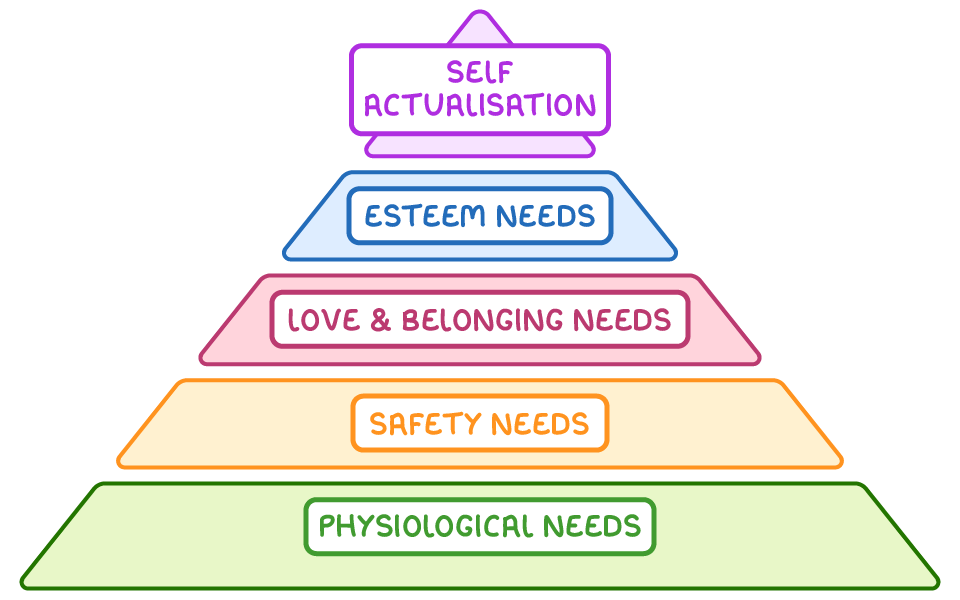
Maslow's hierarchy is often visualised as a pyramid with five levels, where lower needs must be met before higher ones can be addressed. For instance, someone lacking food or safety is unlikely to prioritise personal growth.
The levels, from base to top, are:
- Physiological needs - Basic requirements for survival, such as food, water, shelter, sleep, and reproduction.
- Safety needs - The need for physical, psychological, and economic security.
- Love and belonging needs - The desire for affection, acceptance, and a sense of belonging within relationships.
- Esteem needs - The pursuit of achievement, self-respect, and recognition from others.
- Self-actualisation - Reaching one's fullest potential, becoming the best version of oneself.
Limitations of self-actualisation:
- This model is often considered a Western concept, as it prioritises individual achievement over collective needs, which may not align with other cultural values.
- Not everyone may have the capacity to reach self-actualisation, as it could be limited by factors like education or intelligence.
Characteristics of self-actualised individuals
Maslow identified specific traits in those who achieve self-actualisation, including:
- High self-awareness - A deep understanding of oneself and personal motivations.
- Acceptance of self and others - Embracing themselves and others without judgement.
- Comfort with uncertainty - The ability to handle unknown or ambiguous situations confidently.
- Creativity - A strong inclination towards innovative thinking and problem-solving.
Maslow also introduced the idea of 'peak experiences', moments of intense wonder and euphoria that inspire greater self-awareness and motivation after they occur.
Research on Maslow's hierarchy: Aronoff (1967) study
- Method - Aronoff examined workers in the British West Indies, comparing fishermen (who worked independently with higher earnings but less job security) and cane cutters (who had stable but low-paying group-based work). Both groups were assessed for their position on Maslow's hierarchy.
- Results - Cane cutters were more often at lower levels, focusing on safety and security, while fishermen, having met basic needs, were positioned at higher levels like esteem.
- Conclusions - The findings suggest that only individuals who satisfy lower needs pursue roles allowing for higher needs like self-esteem, supporting Maslow's hierarchical model.
- Evaluation:
- The study has ecological validity as it was conducted in a real-world setting.
- However, being limited to one cultural context, its results may not apply universally.
- There is little broader evidence to confirm the strict hierarchical nature of needs, with some cases (like historical figures sacrificing basic needs for higher ideals) contradicting the model.
Rogers' concepts of self-actualisation and self
Carl Rogers, another key figure in humanistic psychology, also focused on self-actualisation but offered a different perspective on how it is achieved. His ideas centre on personal perceptions and interpersonal relationships.
Rogers' view on self-actualisation
- Drive for potential - Like Maslow, Rogers believed individuals are inherently good and motivated to achieve their fullest potential.
- Flexible path to growth - Unlike Maslow's structured hierarchy, Rogers suggested that self-actualisation depends on one's self-perception and how others treat them, rather than a fixed progression.
- Impact of environment - A supportive environment fosters psychologically healthy development, while obstacles, such as a harsh upbringing, can lead to psychological issues.
- Need for positive regard - Individuals, especially children, seek approval and affection from others. Receiving this approval promotes happiness, while perceived disapproval can cause distress.
Components of the self according to Rogers
Rogers distinguished between two aspects of identity and how they interact based on external influences:
- Self-concept - How individuals perceive themselves in reality, shaped by personal experiences and interactions.
- Ideal self - The person they aspire to be, representing their goals and desired traits.
Influencing factors on self-development:
- Unconditional positive regard - Receiving love and support regardless of behaviour, which nurtures a positive self-concept and aids personal growth.
- Conditions of worth - Approval given only when behaving in specific ways, which can hinder self-actualisation by prioritising others' expectations over personal development.
Outcomes of self-perception:
- Congruence - When self-concept aligns with the ideal self due to unconditional positive regard, leading to a fully-functioning person who is authentic and balanced.
- Incongruence - A mismatch between self-concept and ideal self, often caused by conditions of worth, resulting in psychological tension and dissatisfaction.
Rogers' client-centred therapy and its effectiveness
Rogers developed a therapeutic approach to address incongruence and support personal growth. This method has had a lasting impact on modern counselling practices.
Principles of client-centred therapy
- Focus on the client - Also known as person-centred therapy, it places the client at the centre of the process, allowing them to guide discussions and take responsibility for resolving their issues.
- Role of the therapist - The therapist facilitates self-awareness by rephrasing and reflecting the client's statements, helping them understand their thoughts and behaviours. For example:
- Client: "I feel so trapped by my family's expectations; they never let me make my own choices."
- Therapist: "It sounds like you're feeling restricted, as if your family doesn't trust you to decide for yourself."
- Key therapeutic qualities - The therapist must show unconditional positive regard (non-judgemental support), genuineness (authenticity), and empathy (understanding the client's perspective) to build trust and encourage self-worth.
Evidence of effectiveness: Gibbard and Hanley (2008) study
- Method - Investigated the impact of person-centred therapy on over 600 patients with common mental health issues like anxiety and depression over a five-year period. Participants completed questionnaires assessing their condition before and after therapy.
- Results - Approximately 65% of participants demonstrated notable improvement in their mental health following therapy.
- Conclusions - The study supports the effectiveness of person-centred therapy in alleviating mental health challenges by fostering self-understanding and acceptance.
- Evaluation - The large sample size strengthens the reliability of the findings, though self-reported data may be influenced by personal bias. The long-term nature of the study adds depth to understanding therapy outcomes.
Strengths and weaknesses of humanistic psychology
Humanistic psychology offers a distinctive lens on human behaviour, but it also faces criticism for its methods and assumptions.
Strengths of the humanistic approach
- Positive outlook - Emphasises personal growth and the inherent potential for improvement in all individuals.
- Recognition of free will - Highlights individual choice in behaviour, avoiding the restrictive determinism of other theories and acknowledging the complexity of human actions.
- Individual focus - Treats each person as unique, considering the whole individual rather than reducing behaviour to simple cause-and-effect patterns.
- Rich qualitative data - Collects detailed personal insights, often through recorded therapy sessions, allowing for in-depth analysis of therapeutic progress.
- Effective counselling methods - Techniques derived from this approach, such as person-centred therapy, have proven beneficial in supporting mental health.
Weaknesses of the humanistic approach
- Limited biological consideration - Places less focus on genetic or physiological factors compared to biological psychology, potentially overlooking important influences on behaviour.
- Lack of objectivity - Relies heavily on subjective feelings and personal reports, making it difficult to test scientifically or measure concepts like self-actualisation.
- Idiographic limitations - Its focus on individual cases prevents the development of general laws or principles applicable to broader populations, reducing its scientific rigour.