2.2 - Memory: Models
The multi-store model of memory by Atkinson and Shiffrin
The multi-store model, developed by Atkinson and Shiffrin in 1968, provides a framework for understanding how memory functions. It describes memory as a system comprising three distinct stores through which information must pass to be retained.
Structure and process of the multi-store model
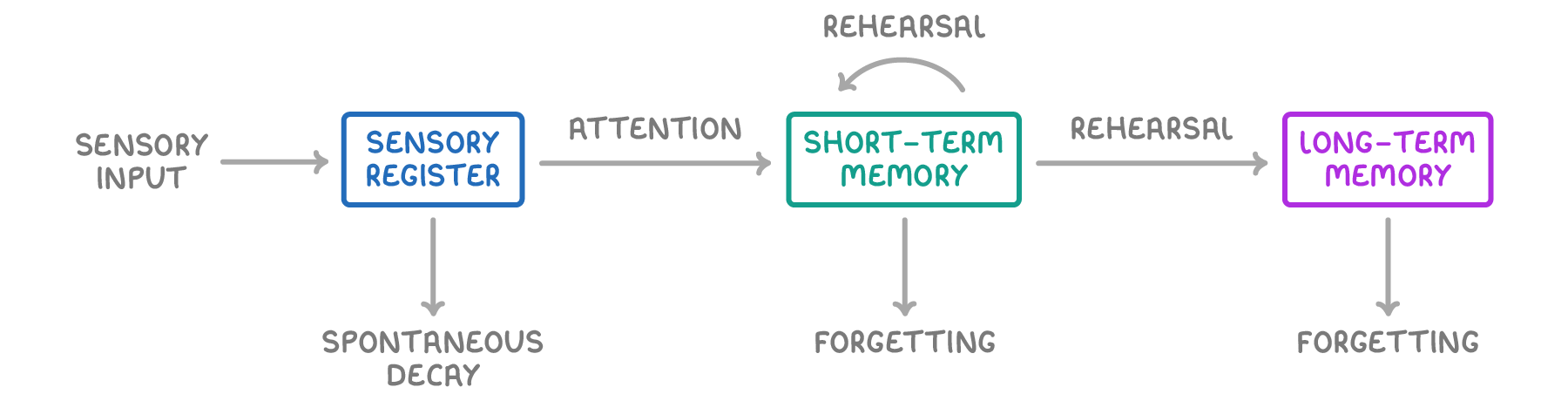
- Sensory register - This is the initial store where information from the environment, such as sights or sounds, is briefly held. Most of this input goes unnoticed unless attention is directed towards it.
- Short-term memory (STM) - When attention is paid to sensory input, it moves to STM. This store has a limited capacity and duration, typically holding information for only a short period unless further processed.
- Long-term memory (LTM) - Through rehearsal, information from STM can be transferred to LTM, where it can be stored indefinitely. Without rehearsal, information in STM is likely to be forgotten.
- Flow of information - The process is linear: sensory input enters the sensory register, moves to STM with attention, and reaches LTM through rehearsal. Forgetting can occur at any stage due to decay or displacement.
Supporting evidence and limitations of the multi-store model
The multi-store model has been supported by various studies, demonstrating the existence of separate memory stores. However, it also faces criticism for oversimplifying the complexity of human memory.
Evidence supporting the multi-store model
- Primacy effect - Studies show that individuals recall the first items of a list better than middle items. This is explained by the model as early items being rehearsed more and transferred to LTM.
- Recency effect - The last items of a list are also recalled better, as they remain in STM at the time of recall due to its limited capacity displacing earlier unrehearsed items.
- Korsakoff's syndrome - Patients with this condition, often resulting from chronic alcoholism, show an intact recency effect (functional STM) but impaired LTM, supporting the separation of these stores.
- Case study of HM (Milner et al., 1957) - HM, who underwent brain surgery to treat epilepsy, could form short-term memories but not new long-term ones after the operation. This case highlights the distinction between STM and LTM as separate systems.
Limitations of the multi-store model
- Overemphasis on rehearsal - The model suggests rehearsal is necessary to transfer information from STM to LTM, yet in everyday life, memories form without deliberate repetition, such as remembering a scent.
- Oversimplification of stores - It assumes a single STM and LTM store, but evidence from brain-damaged patients indicates multiple types of short-term and long-term stores exist, challenging the model's basic structure.
The working memory model by Baddeley and Hitch
Developed by Baddeley and Hitch in 1974, the working memory model offers a more detailed view of short-term memory (STM). Unlike the multi-store model, it presents STM as an active processor with multiple components rather than a single store.
Components of the working memory model
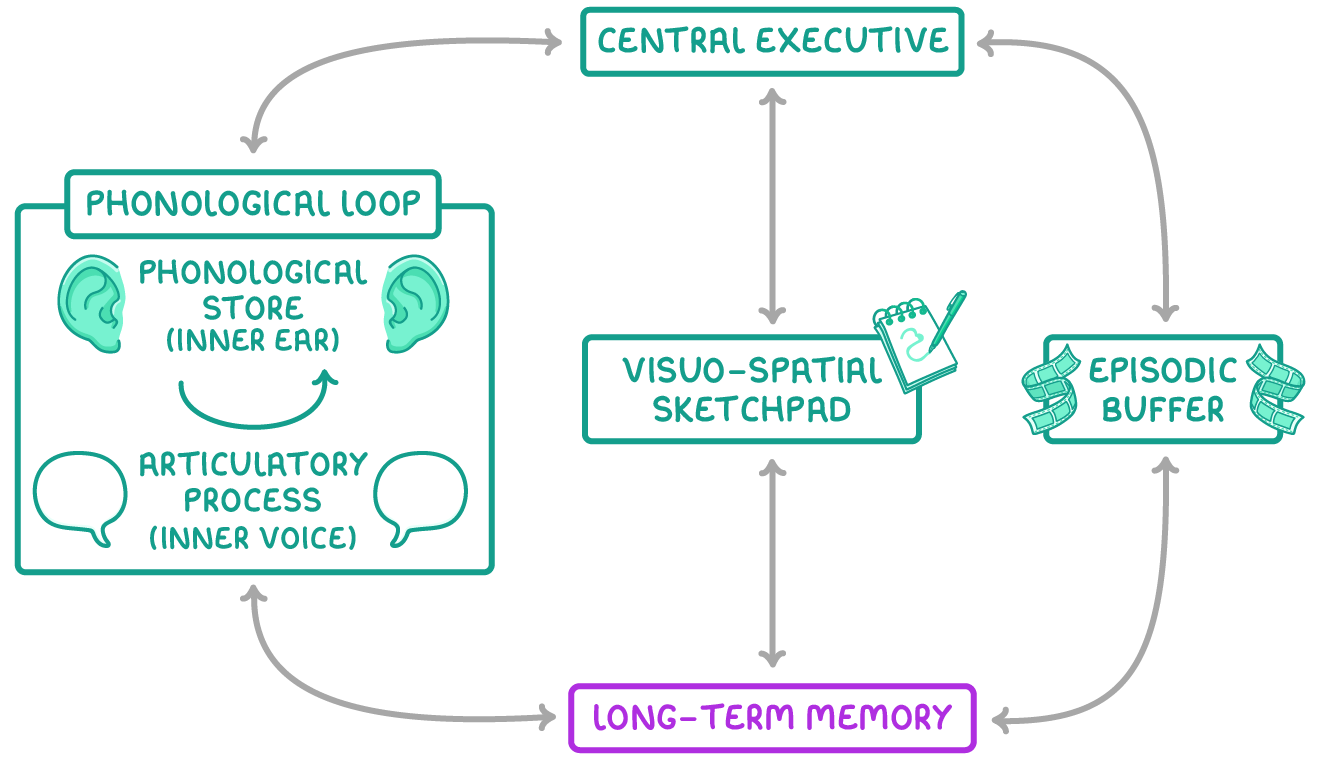
- Central executive - Acts as the control system with limited capacity, directing attention and coordinating the activities of the other components, often described as the 'boss' of working memory.
- Phonological loop - Manages speech-based information with two sub-components:
- Phonological store (inner ear) - Holds auditory information briefly.
- Articulatory process (inner voice) - Rehearses information through repetition.
- Visuo-spatial sketchpad - Handles visual and spatial data, aiding in tasks like navigation or recalling images.
- Episodic buffer - Added in 2000, this component integrates information from the other subsystems and long-term memory (LTM) to create complete scenes or episodes, acting as a temporary storage bridge.
Supporting evidence and criticisms of the working memory model
The working memory model is grounded in experimental research and offers a nuanced perspective on STM. However, it is not without its challenges and limitations, as highlighted by various studies and critiques.
Evidence supporting the working memory model
- Interference task experiments - Research by Baddeley and Hitch shows that performing two tasks using the same system (e.g., repeating a phrase while reading silently) impairs performance due to the limited capacity of the phonological loop. Tasks using different systems (e.g., verbal repetition while tracking movement) show no such impairment.
- Case study of KF (Shallice and Warrington, 1974) - KF, a brain-damaged patient, struggled with verbal recall but not visual information, indicating a damaged phonological loop but an intact visuo-spatial sketchpad, supporting the model's multi-component view of STM.
- Laboratory study (Gathercole and Baddeley, 1993) - Participants tracking a light spot (visuo-spatial task) performed worse when paired with another visuo-spatial task (describing letter angles) compared to a verbal task using the phonological loop. This demonstrates the separation of systems within working memory.
Strengths of the working memory model
- Reduced focus on rehearsal - Unlike the multi-store model, rehearsal is not the sole process for memory retention, explaining why unrehearsed information can still reach LTM through other cognitive processes.
- Detailed explanation of STM - Offers a more comprehensive understanding of STM as an active system with distinct components, supported by evidence that the multi-store model cannot account for.
Criticisms of the working memory model
- Vague central executive - The central executive's role is not clearly defined beyond attention, and designing experiments to test its specific functions remains challenging.
- Limited scope - The model focuses solely on STM and does not address how information transfers to LTM, leaving a gap in explaining long-term retention.
- Low ecological validity - Much supporting evidence comes from controlled laboratory studies, which may not fully reflect real-world memory processes due to their artificial nature.