6.1 - Definitions of Abnormality
Deviation from social norms as a definition of abnormality
Abnormality can be understood as behaviour or attitudes that differ from the accepted standards within a society. These social norms act as unwritten rules guiding how individuals are expected to act, and deviating from them may be seen as abnormal.
Challenges in using social norms to define abnormality
- Cultural variation - Social norms differ across cultures, meaning there is no single, universal set of rules. What is abnormal in one society may be acceptable in another.
- Potential for misuse - Defining abnormality based on social norms can be exploited to marginalise or remove individuals deemed undesirable, such as those opposing political regimes.
- Changing standards over time - Societal views on what is acceptable evolve. For instance, homosexuality was classified as a mental disorder in the Diagnostic and Statistical Manual of Mental Disorders (DSM) until 1974, but was later removed as evidence showed it was neither rare nor linked to psychological distress.
Deviation from statistical norms and its limitations
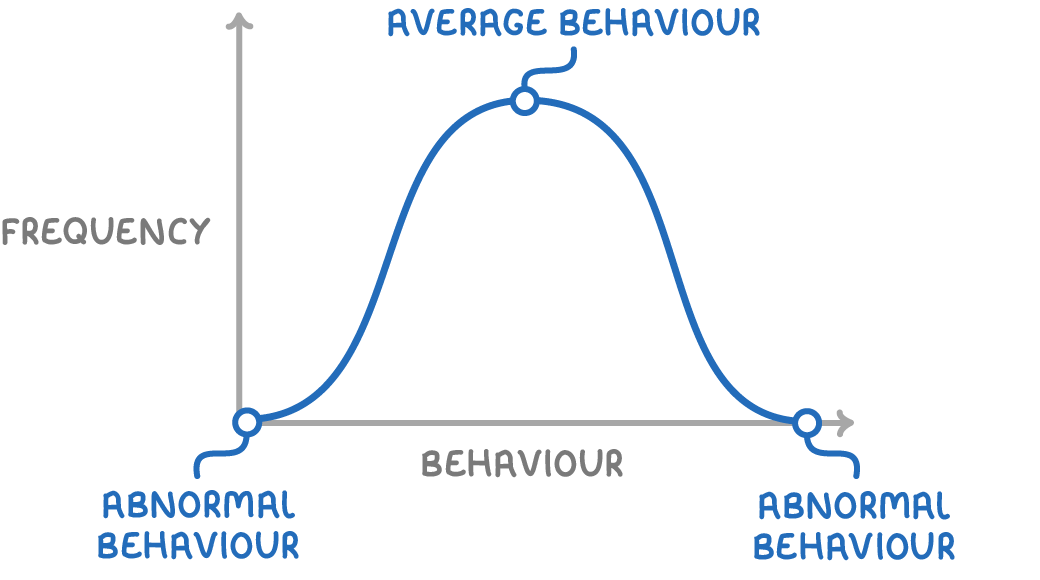
Abnormality can also be defined as behaviour that is statistically rare within a population. This approach often uses the normal distribution curve, where most people fall in the middle (common behaviour), and the extremes (rare behaviour) are considered abnormal.
Understanding statistical infrequency
- Normal distribution curve - In this model, frequent behaviours form the peak of a bell-shaped curve, while rare or abnormal behaviours are at the tails.
- Measurement of behaviour - Behaviours can be quantified, for example, by counting actions like the frequency of handwashing per week, to determine where they fall on the distribution.
Limitations of statistical infrequency as a definition
- Desirability not considered - Rarity alone does not indicate whether a behaviour is negative. For example, an exceptionally high intelligence quotient (IQ) is statistically rare but desirable, unlike a very low IQ.
- Lack of distinction - There is no clear separation between merely unusual behaviour and psychologically abnormal behaviour.
- No clear cut-off point - It is difficult to pinpoint exactly when behaviour shifts from normal to abnormal based on frequency alone.
- Common abnormal behaviours - Some psychological conditions, such as mild depression, are relatively frequent in the population, contradicting the idea that abnormality must be rare. Hassett and White (1989) argue that statistical infrequency cannot fully define abnormality due to such discrepancies.
Failure to function adequately as a criterion for abnormality
Abnormality can also be identified when an individual struggles to meet the demands of everyday life. This definition focuses on the ability to cope with routine tasks and interactions, labelling behaviour as abnormal if it hinders normal functioning.
Criteria for assessing failure to function adequately
- Dysfunctional behaviour - Actions that contradict accepted societal standards, disrupting daily life.
- Observer discomfort - Behaviours that make others feel uneasy or distressed when witnessed.
- Unpredictable behaviour - Impulsive or uncontrollable actions that lack a clear pattern or reason.
- Irrational behaviour - Actions or thoughts that appear illogical or unreasonable to others.
- Personal distress - Experiencing excessive emotional pain or discomfort that impacts well-being.
If an individual exhibits multiple of these traits, their behaviour is often classified as abnormal under this definition.
Jahoda's concept of ideal mental health
Jahoda (1958) proposed a positive approach to mental health, suggesting that abnormality could be defined as the absence of certain ideal characteristics. This shifts the focus from illness to well-being.
Six conditions for ideal mental health
- Positive self-attitude - Having a healthy sense of self-worth and confidence.
- Self-actualisation - Achieving personal potential and feeling fulfilled in life.
- Resistance to stress - Coping effectively with challenges without becoming overwhelmed.
- Personal autonomy - Making independent decisions and feeling in control of one's life.
- Accurate perception of reality - Viewing the world and oneself realistically, without distortion.
- Adaptation to the environment - Adjusting successfully to changing circumstances and surroundings.
Challenges with the ideal mental health model
- Subjectivity - The interpretation of these conditions varies between individuals and cultures, making them hard to apply universally.
- Difficulty in meeting standards - Few people consistently meet all six criteria, raising questions about whether failing to do so always indicates abnormality.
- Misleading outcomes - Some individuals, such as violent offenders, might exhibit traits like positive self-attitude or stress resistance, yet their behaviour would not be considered mentally healthy by societal standards.
- Cultural and historical variation - Concepts of ideal mental health differ across time and cultures. For example, attitudes towards women's enjoyment of sex have varied widely, from being labelled as abnormal in Victorian times to differing views in modern cultures.
Symptoms associated with mental illness
Mental illness is often identified through specific, persistent symptoms that affect an individual's thoughts, emotions, or behaviours. These symptoms provide a framework for diagnosis when they are not temporary.
Key symptoms indicating mental illness
- Impairment of intellectual functions - Difficulties with memory, comprehension, or other cognitive abilities.
- Alterations to mood - Extreme mood changes leading to distorted views of the past or future, or an inability to assess situations.
- Delusional beliefs - Holding unfounded beliefs, such as feelings of persecution or irrational jealousy.
- Disordered thinking - Struggling to evaluate personal circumstances or communicate effectively with others.
The presence of one or more of these symptoms over a sustained period may suggest a mental illness, as outlined by guidelines from the Department of Health.