1.3 - Treatments & Interactionist Approach
Biological therapy using antipsychotic drugs
Biological therapy, often referred to as chemotherapy, is based on the dopamine hypothesis which suggests that schizophrenia is linked to increased dopamine activity in the brain.
Mechanism of antipsychotic drugs
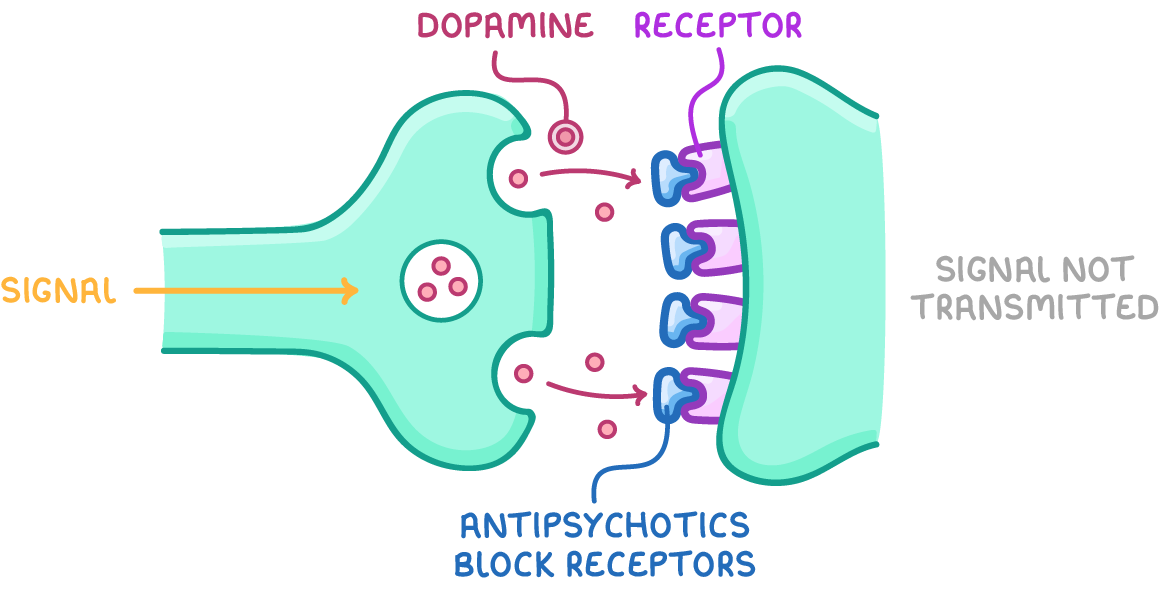
- Dopamine receptor blockade - Antipsychotic drugs, also known as neuroleptics, function by blocking dopamine receptors in the brain.
- Impact on neuronal communication - By preventing dopamine from binding to receptors on receiving neurons, these drugs reduce the transmission of signals that contribute to symptoms.
Types of antipsychotic drugs
- Typical antipsychotics - Developed in the 1950s, these drugs primarily target dopamine receptors and are effective for positive symptoms. However, they often cause severe side effects like muscle spasms, tremors, dry mouth, and blurred vision.
- Atypical antipsychotics - Introduced in the 1990s after being developed in the 1970s, these drugs act on both dopamine and serotonin receptors. They address both positive and negative symptoms and tend to have fewer side effects compared to typical antipsychotics, though serious side effects can still occur.
Strengths of biological therapy
- Effectiveness on positive symptoms - Drug therapy significantly reduces hallucinations and delusions.
- Community living - Successful treatment allows many individuals to live outside institutional settings.
- Widespread application - As the most common and effective treatment for schizophrenia, it often forms the basis for combining with other therapies.
Limitations of biological therapy
- Limited impact on negative symptoms - Symptoms like social withdrawal often persist despite treatment.
- Ethical concerns - Some critics describe drug therapy as a 'chemical straitjacket', suggesting it merely controls behaviour rather than addressing the patient's needs.
- Side effects - Short-term issues include drowsiness, constipation, and weight gain, while long-term risks involve diabetes and tardive dyskinesia.
- Discontinuation rates - Clinical studies indicate that up to two-thirds of patients stop taking antipsychotics due to side effects, although newer drugs show reduced long-term issues.
- Symptom management only - This approach targets symptoms rather than underlying causes, leading to the 'revolving door phenomenon' where patients relapse upon stopping medication.
Psychological therapies including cognitive behaviour therapy and family therapy
Psychological therapies offer non-biological approaches to managing schizophrenia by addressing thought patterns and social dynamics.
Cognitive behaviour therapy (CBT)
CBT operates on the principle that identifying and altering distorted thinking patterns can help manage symptoms of schizophrenia.
Techniques used in CBT:
- Ellis's ABC model - Patients identify an activating event (A), explore associated beliefs (B), and recognise consequences (C), enabling cognitive restructuring.
- Reality testing - Individuals are encouraged to question the validity of hallucinations or delusions.
- Challenging beliefs - Patients investigate the origins of their hallucinations and challenge faulty assumptions.
- Self-help strategies - Positive self-talk and role-playing exercises help test and adjust distorted thinking, supported by homework tasks.
Chadwick et al. (1996) study on CBT:
- Method - Focused on a patient named Nigel who believed he could predict conversations. Over 50 video scenarios were shown, paused at intervals, and Nigel was asked to predict outcomes.
- Results - Nigel failed to make any correct predictions.
- Conclusions - Through reality testing, Nigel recognised he did not possess special abilities.
- Evaluation - As a case study, findings cannot be broadly applied, but they highlight CBT's success in specific contexts.
Advantages of CBT:
- Effectiveness in resistant cases - Research by Sensky et al. (2000) showed CBT benefited patients unresponsive to drugs, improving both positive and negative symptoms with lasting effects.
- Patient empowerment - CBT equips individuals with self-help tools, reducing ethical concerns compared to other treatments.
Disadvantages of CBT:
- Symptom focus - Like drug therapy, CBT addresses symptoms rather than causes.
- Measurement challenges - Effectiveness relies on subjective self-reports and therapist assessments.
- Dependency risk - Patients may become overly reliant on their therapist.
- Engagement barriers - Requires self-awareness and willingness to participate, which can be difficult for those with severe symptoms.
- Time-intensive nature - Long durations of therapy can lead to high dropout rates.
- Individual variability - Not all patients respond well to confrontational styles.
Family therapy
Family therapy, also known as family intervention, has been refined over the last four decades. It focuses on improving family dynamics to support individuals with schizophrenia.
Aims and methods of family therapy:
- Reducing conflict - Aims to lower tension and high emotional expression within the family to prevent relapse.
- Building alliances - Encourages supportive relationships among family members.
- Easing care burden - Helps distribute responsibilities to reduce stress on primary caregivers.
- Setting realistic goals - Promotes achievable expectations to maintain harmony.
- Combination with other treatments - Often paired with drug therapy for comprehensive care.
Advantages of family therapy:
- Reduced readmissions - Pilling et al. (2002) found that family therapy decreased hospital readmission rates for some patients.
- Support for limited insight - Particularly effective for individuals who struggle to articulate thoughts or recognise their condition.
Disadvantages of family therapy:
- Consent and confidentiality issues - Obtaining agreement from all family members and maintaining privacy can be challenging.
- Family engagement - Success depends on willingness to change behaviours, which not all families possess.
Behavioural management through token economies
Token economies are a behavioural approach grounded in operant conditioning, using reinforcement to encourage positive behaviours in institutional settings for individuals with schizophrenia.
How token economies function
- Reinforcement principle - Patients receive tokens for performing socially desirable actions, such as personal care tasks.
- Reward exchange - Tokens can be traded for desired items or privileges, reinforcing the behaviour.
Ayllon and Azrin (1968) study on token economy
- Method - Involved 45 female patients with schizophrenia in a psychiatric ward. Tokens were awarded for positive behaviours and withdrawn for undesirable actions.
- Results - Patients, institutionalised for an average of 16 years and exhibiting severe behaviours, showed marked improvement when motivated by privileges.
- Conclusions - Token economies can restore dignity by controlling and encouraging positive behaviour.
- Evaluation - Limited to female participants, so findings may not apply universally to all populations.
Benefits of token economies
- Improved self-care - Significant enhancements in personal hygiene and desirable behaviours, even among long-term institutionalised patients.
- Motivation boost - Directly counters the lack of incentive often seen in institutional settings.
- Evidence of success - Paul and Lentz (1977) demonstrated that token economies outperformed standard hospital care in improving patient behaviour.
Drawbacks of token economies
- Limited real-world application - Behaviours learned in institutions often do not persist outside due to lack of reinforcement.
- Superficial change - Patients may only exhibit positive behaviours to earn tokens, not due to genuine change.
- Ethical dilemmas - Critics argue this method prioritises control over genuine improvement, and withholding rewards may infringe on rights, though it could be justified if independence is achieved.
The interactionist approach to treatment
The interactionist approach, also known as the biopsychosocial model, integrates multiple perspectives to provide a holistic treatment plan for schizophrenia, combining biological, psychological, and social strategies.
Principles of the interactionist approach
- Holistic treatment - Combines drug therapy with cognitive and behavioural interventions to address various facets of the condition.
- Addressing medication limitations - Recognises that medication alone manages symptoms without tackling causes and that many patients discontinue it due to side effects or forgetfulness, necessitating additional therapies.
Strengths of the interactionist approach
- Comprehensive care - Since no single treatment fully addresses schizophrenia, combining methods offers a broader impact.
- Skill development - Psychological therapies alongside medication help manage symptoms while equipping patients with tools to challenge distorted thinking.
Challenges of the interactionist approach
- Effectiveness uncertainty - Determining which specific treatment contributes to improvement is difficult.
- Severity barriers - Patients with severe symptoms may require higher medication doses and show less willingness to engage in new therapies or social skills training.
- Need for flexibility - Treatments must be tailored to individual needs at specific times, requiring adaptability.
- Complexity and time - Managing multiple therapies, including medication, family therapy, CBT, and social support, can be intricate and time-consuming.