2.4 - Eyewitness Testimony & Cognitive Interview
The nature and importance of eyewitness testimony
Eyewitness testimony (EWT) refers to the account provided by individuals who have witnessed a specific event or crime, relying on their memory to recall details. This testimony often includes descriptions of suspects, such as their physical appearance, and specifics of the incident, like the time and place it occurred.
However, the accuracy of such accounts can be unreliable:
- Witnesses frequently misremember details.
- This can lead to wrongful convictions or missed opportunities in solving crimes.
- This poses significant challenges in legal contexts, particularly during police interviews.
Cognitive psychologists investigate the factors influencing the precision of EWT and identify variables that affect memory accuracy. They can then develop techniques to improve the quality of witness statements and methods to enhance their reliability.
How misleading information distorts recall
Misleading information, often introduced through leading questions or post-event discussions, can significantly alter a witness's memory of an event. Leading questions subtly suggest a particular answer, thereby influencing how an individual recalls details.
Studies on leading questions and memory distortion
Loftus and Palmer (1974) experiment:
- Method - Participants watched a video of a car accident and were asked to estimate the speed of the vehicles using different verbs like 'smashed', 'hit', or 'bumped' in the question.
- Results - Those asked with the word 'smashed' estimated higher speeds (around 41 mph on average) compared to those with 'contacted' (approximately 32 mph). In a follow-up, participants in the 'smashed' group were more likely to falsely recall seeing broken glass, despite none being present.
- Conclusions - The phrasing of questions can distort memory, affecting the perceived severity of an event.
- Evaluation - This laboratory study lacks the emotional intensity of real events, potentially reducing its applicability to actual crimes. Demand characteristics may also have influenced responses, as participants might have guessed the study's purpose.
Loftus and Zanni (1975) experiment:
- Method - After viewing a film of a car crash with no broken headlight, participants were asked either 'Did you see the broken headlight?' or 'Did you see a broken headlight?'.
- Results - About 17% of those asked about 'the' broken headlight reported seeing one, compared to only 7% for 'a' broken headlight.
- Conclusions - Even subtle wording differences, such as 'the' versus 'a', can lead to memory distortion.
- Evaluation - The controlled setting allowed for clear cause-and-effect conclusions but lacked real-world relevance due to its artificial nature.
The impact of age and anxiety on eyewitness accuracy
The accuracy of EWT can vary depending on the age of the witness and the level of anxiety experienced during the event. Both factors influence how details are encoded and recalled.
Effect of age on memory accuracy
Valentine and Coxon (1997) study:
- Method - Three groups (children, young adults, and elderly individuals) viewed a video of a kidnapping and answered both leading and non-leading questions.
- Results - Children and elderly participants provided more incorrect answers to non-leading questions. Children were particularly susceptible to leading questions compared to the other groups.
- Conclusions - Age significantly affects the reliability of EWT, with children and elderly individuals being less accurate.
- Evaluation - The artificial setting of watching a video lacks the emotional impact of real-life events, limiting the study's real-world applicability. Results may reflect memory for televised content rather than actual incidents.
Effect of anxiety on memory focus
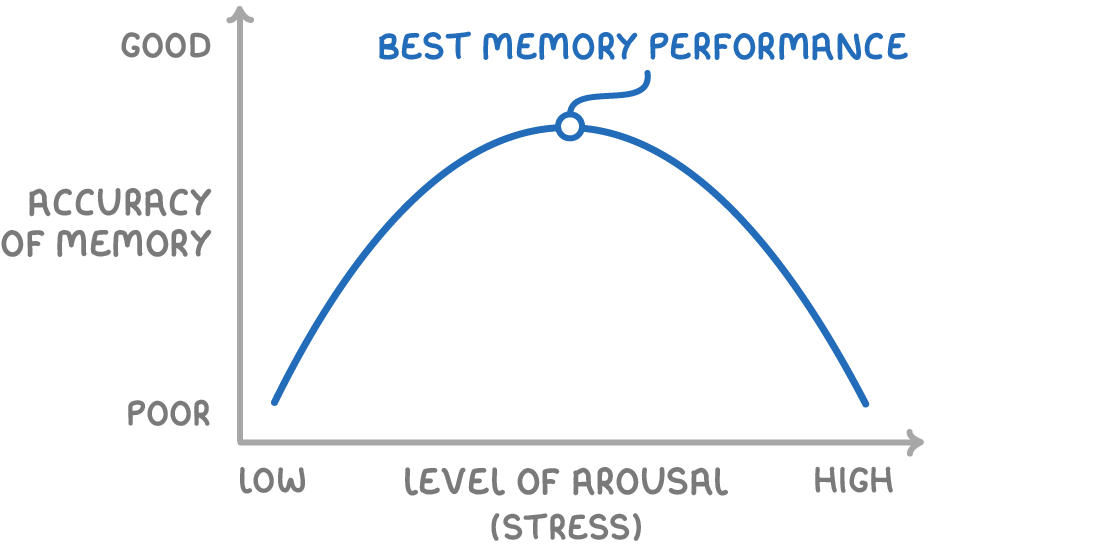
Moderate levels of anxiety can enhance memory accuracy, but high levels, often associated with violent crimes, tend to impair it. Witnesses may focus on central details, such as a weapon, while neglecting peripheral information like the perpetrator's clothing.
Loftus (1979) weapon focus study:
- Method - Participants overheard a discussion in a nearby room. In one condition, a man emerged with a pen and greasy hands; in another, he held a blood-covered knife. They were later asked to identify the man from photographs.
- Results - Accuracy was 49% in the pen condition but dropped to 33% in the knife condition.
- Conclusions - High anxiety causes witnesses to fixate on threatening elements like weapons, reducing attention to other details.
- Evaluation - The study has strong real-world relevance as participants were unaware it was staged, though this raises ethical concerns due to potential distress caused by the knife scenario.
Yuille and Cutshall (1986) field study:
- Method - Witnesses to a real gun shooting were interviewed immediately after the event and again five months later, including misleading questions.
- Results - Recall remained highly accurate over time, and misleading questions had no impact on responses.
- Conclusions - Real-life incidents may produce more durable and accurate memories compared to lab settings, even under stress.
- Evaluation - High ecological validity due to the real-world context, but it's unclear whether accuracy stemmed from stress levels or proximity to the event.
The effect of post-event discussion on memory
Discussions after an event, particularly with others who may provide misleading information, can contaminate a witness's memory, leading to inaccuracies in recall.
Research on post-event discussion
Shaw et al (1997) study:
- Method - Participants were paired with a confederate and shown videos of a staged robbery. They were interviewed together, alternating who answered first.
- Results - Accuracy was 58% when participants answered first, 67% when the confederate gave accurate answers first, but only 42% when the confederate provided inaccurate information.
- Conclusions - Misleading information from others during discussions can reduce recall accuracy.
- Evaluation - The controlled setup allows for clear insights but may not fully replicate natural conversations post-event.
Gabbert et al (2004) study:
- Method - Young (17-33 years) and older adults (58-80 years) watched a staged crime and were exposed to misleading information either through conversation with a confederate or by reading a false report. A recall test followed.
- Results - Both age groups reported more inaccuracies after conversing with a confederate compared to reading the report.
- Conclusions - Conversational exchanges are more likely to distort memory than written misinformation.
- Evaluation - Reflects real-life scenarios where witnesses discuss events, though the staged nature limits full generalisation to actual crimes.
The cognitive interview technique for improving recall accuracy
The cognitive interview technique (CIT) was developed to enhance the accuracy of EWT during police questioning by addressing factors that distort memory. It creates a supportive environment and uses specific strategies to aid recall.
Components of the cognitive interview technique
- Building rapport - The interviewer establishes a comfortable atmosphere, adapting language to suit the witness.
- Context reinstatement - Witnesses mentally recreate the scene, recalling environmental details (e.g., weather) and internal states (e.g., emotions) from the event.
- Reporting everything - Witnesses are encouraged to share all memories, even seemingly trivial details.
- Varied recall order - Events are recalled in different sequences to uncover additional details.
- Multiple perspectives - Witnesses describe the event from other viewpoints, such as another person's perspective.
- Non-judgemental approach - Interviewers avoid personal or critical comments to maintain an open dialogue.
Evidence supporting the cognitive interview
Geiselman et al (1986) study:
- Method - Participants witnessed a staged classroom intrusion involving a thief with a blue rucksack. Two days later, they were interviewed using either a standard method or CIT. Early questions included a misleading prompt about a 'green backpack', followed by a query on the bag's actual colour.
- Results - Those interviewed with CIT were less likely to incorrectly recall the bag as green compared to the standard interview group.
- Conclusions - CIT reduces susceptibility to misleading information, improving memory accuracy.
- Evaluation - The realistic staging enhances ecological validity, though individual differences in susceptibility to leading questions could affect results due to the independent groups design.