4.2 - Behaviourist Approach
The origins and core assumptions of behaviourism
Behaviourism, often called learning theory, emerged in the early 20th century in America, largely through the work of John Watson. Watson aimed to make psychology more scientific, criticising earlier methods like introspection, which relied on subjective self-analysis and lacked verifiable evidence. He proposed a framework based on observable actions for a more rigorous approach to studying human and animal behaviour.
Core assumptions of behaviourism
- Behaviour is mostly learnt:
- Apart from a small number of innate reflexes (such as blinking to remove dirt from the eye) and instincts (like fleeing from immediate danger), nearly all behaviours are acquired through experience.
- Although modern research suggests genetics can play a role in conditions like schizophrenia, behaviourism maintains that learning is the primary driver of most actions.
- There are similar learning processes in humans and non-human animals:
- While humans can perform more complex tasks, the fundamental ways in which learning occurs are believed to be the same across species.
- This is rooted in the concept of forming associations between a stimulus and a response, such as a dog learning to associate a sound with food or a person learning to operate a machine.
- However, humans also use other learning methods, like social learning, which may differ from animal processes.
- The mind is irrelevant:
- As thoughts and mental processes cannot be directly observed or measured, behaviourists focus only on visible actions.
- They argue that only measurable behaviour, not internal cognition, can provide scientific data.
- Alternative theories like social learning suggest that mental processes may offer a fuller understanding of behaviour.
Research methods used by behaviourists
Behaviourist research methods are designed to align with their core assumptions, focusing on observable actions and controlled environments to uncover the principles of learning.
Key features of behaviourist research design
- Focus on learning principles - Since behaviour is considered mostly learnt, the primary aim is to investigate how learning occurs through specific stimuli and responses.
- Use of animal subjects - Given the assumption that humans and animals learn similarly, animals are often used in experiments. They are easier to control, often unaware of being studied, and can be subjected to procedures that would be unethical for humans, such as mild electric shocks to test learning responses.
- Observation of quantifiable behaviour - Research avoids speculation about internal thoughts and instead measures concrete actions, such as the frequency of a specific response or the time taken to complete a task. This often involves laboratory experiments with animals to ensure controlled conditions.
Classical conditioning and its principles
Classical conditioning is a learning process first explored by Ivan Pavlov in Russia during the early 1900s. While studying digestion in dogs, Pavlov observed that they salivated not just at the sight of food but also in response to other cues associated with feeding, leading to experiments that shaped this theory.
Process of classical conditioning
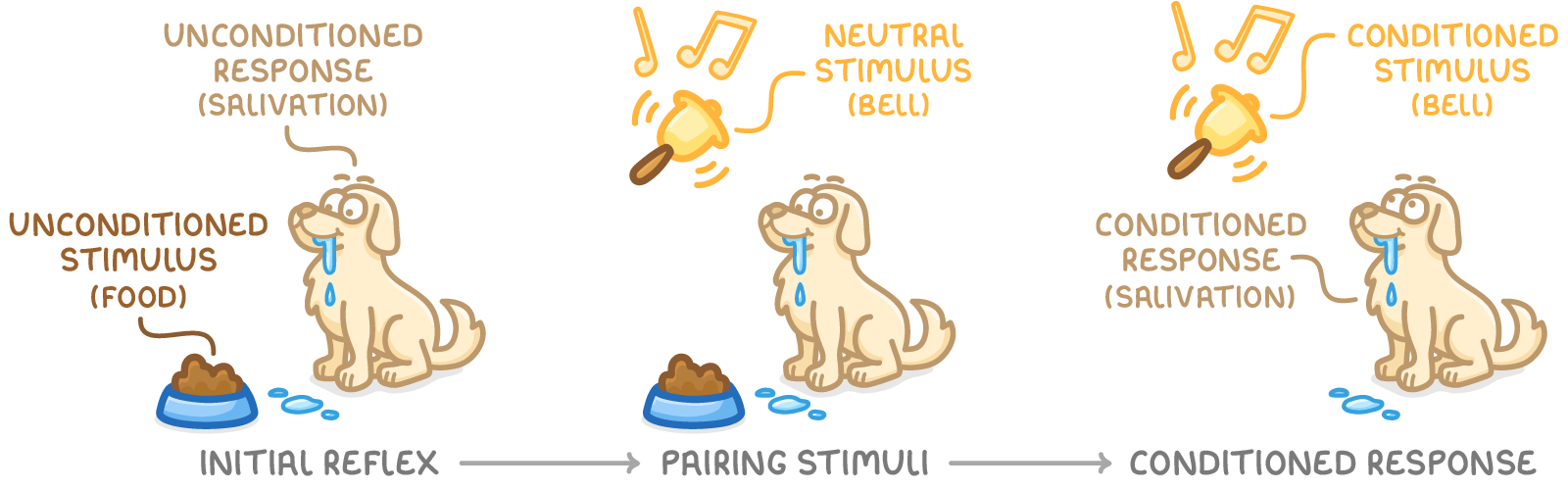
- Initial reflex - Dogs naturally salivate when presented with food. Here, food is an unconditioned stimulus (UCS) that triggers an unconditioned response (UCR), which is salivation.
- Pairing stimuli - Pavlov paired the food (UCS) with a neutral stimulus, such as a bell. Over repeated trials, the bell was rung each time food was given.
- Conditioned response - Eventually, the bell alone caused salivation, becoming a conditioned stimulus (CS) that elicited a conditioned response (CR).
Application to human behaviour
Classical conditioning can explain certain human responses. For instance, a baby feels comfort (UCR) when its needs are met (UCS). If the mother's voice is consistently heard during these comforting moments, the voice becomes a CS. Over time, just hearing the voice can evoke happiness (CR) in the baby, even without immediate comfort.
Principles of classical conditioning
- Generalisation - A response can be triggered by stimuli similar to the original CS. For example, a dog might salivate to a bell with a slightly different tone.
- Discrimination - The response may not occur if a similar stimulus is presented without the UCS, teaching the subject to distinguish between stimuli.
- Extinction - If the CS is repeatedly presented without the UCS, the CR diminishes. For instance, if the bell rings repeatedly without food, salivation stops.
- Spontaneous recovery - After a period of no exposure, presenting the CS can revive the CR, showing that the association is not entirely lost.
- Higher order conditioning - A new stimulus can produce the CR if paired with the original CS. For example, a light shown before the bell can eventually trigger salivation on its own.
Operant conditioning and its mechanisms
Operant conditioning, developed by B.F. Skinner, focuses on how behaviour is shaped by its consequences. Unlike classical conditioning, which deals with automatic reflexes, this theory explores voluntary actions influenced by rewards or penalties.
Types of reinforcement in operant conditioning
- Positive reinforcement - A desirable outcome follows a behaviour, encouraging its repetition. For instance, a child receiving a sweet for tidying their room is likely to repeat the action.
- Negative reinforcement - An undesirable condition is removed following a behaviour, also encouraging repetition. For example, a student studies hard to avoid extra assignments, thus reinforcing the study habit.
Skinner's experiment on operant conditioning
- Method - Skinner used a device called a Skinner box, placing a hungry rat inside. The box included a lever that, when pressed, dispensed food. The time taken for the rat to learn to press the lever was measured.
- Results - At first, the rat pressed the lever by chance and received food. With repeated trials, it learned the connection faster, pressing the lever more quickly each time.
- Conclusions - This demonstrated that behaviour can be shaped through positive reinforcement, as the rat associated lever-pressing with receiving food.
- Evaluation - Skinner's work significantly advanced behavioural psychology. However, using animals limits how directly the findings apply to humans, and a small sample size may affect reliability.
Variations in operant conditioning
Skinner also tested negative reinforcement. In one variation, a rat learned to press a lever when a light appeared to avoid a mild electric shock, showing that removing an unpleasant stimulus can reinforce behaviour.
Strengths and limitations of the behaviourist approach
Strengths of behaviourism
- Empirical support - Extensive evidence demonstrates that both animals and humans can learn through conditioning, as seen in Pavlov's and Skinner's experiments.
- Practical applications - Techniques derived from conditioning are used in areas like education and therapy to modify behaviour effectively.
Limitations of behaviourism
- Incomplete explanation - Conditioning does not account for all human behaviour. Learning through observation, as explained by social learning theory, is another significant mechanism.
- Challenges in generalisation - Most research involves animals, making it difficult to apply results directly to humans. Further studies on human subjects are needed.
- Species differences - Different animals have varying abilities to learn through conditioning, and some learn through observation without reinforcement.
- Genetic influences - Research suggests genetics can limit or influence what can be learned through conditioning, challenging the idea that behaviour is entirely learnt.
- Ethical concerns - Many animal experiments raise ethical issues. Modern research requires a cost-benefit analysis to justify animal use, ensuring their welfare is prioritised.
Human studies
Studies on humans reveal that genetics influence behaviour, other learning methods exist beyond conditioning, and cognitive processes play a role in shaping actions, challenging the behaviourist focus on observable actions alone.
Watson and Rayner's 'Little Albert' experiment (1920):
- Method - An 11-month-old boy, Little Albert, initially showed no fear of white fluffy objects like rats. Researchers paired a white rat with a loud noise by striking a metal bar behind him as he reached for the rat, repeating this several times.
- Results - Albert began to cry at the sight of the rat and later showed fear towards other white fluffy items, like a Santa Claus beard.
- Conclusions - This demonstrated that fear responses can be conditioned, suggesting abnormal behaviours can be learnt through association.
- Evaluation - The experiment is considered unethical by today's standards and could not be replicated. It also lacks ecological validity due to its artificial setting, and not everyone develops fears after negative experiences, indicating other factors are at play. However, it supports classical conditioning principles.