1.1 - Psychodynamic Approach
The origins and key assumptions of the psychodynamic approach
The psychodynamic approach is a psychological perspective that explores how unconscious mental processes influence personality and behaviour. Developed by Sigmund Freud in the late 19th and early 20th centuries, it focuses on the dynamic, ever-changing nature of the mind. The term 'psycho' relates to the mind, while 'dynamic' suggests movement or activity within mental processes.
Core assumptions of the psychodynamic approach
- Unconscious influences - Much of human behaviour is driven by unconscious motives and desires that individuals are not aware of.
- Biological drives - From birth, humans are motivated by basic instincts such as the need for food, rest, and comfort.
- Impact of early experiences - Childhood events play a significant role in shaping adult personality and can contribute to psychological issues later in life.
Freud's levels of consciousness and their role in behaviour
Freud proposed that the mind operates on different levels of awareness, which affect how thoughts, memories, and desires influence behaviour. His interest in conditions like hysteria, where physical symptoms had no apparent physical cause, led him to conclude that unseen mental processes were at play.
The three levels of consciousness
- Conscious mind - This includes everything an individual is currently aware of, such as immediate thoughts, sensations, and perceptions like sights or sounds.
- Preconscious mind - This holds information that can be easily recalled when needed, such as personal details like one's home address or memories of recent events.
- Unconscious mind - This contains repressed memories, fears, and desires that cause significant anxiety if brought to awareness. Though hidden, these elements still affect behaviour through phenomena like dreams or accidental slips of the tongue, often called Freudian slips.
Freudian slips occur when unintended words or phrases reveal underlying thoughts or feelings, such as mistakenly using a past partner's name when addressing a current one. Accessing the unconscious often requires techniques like psychoanalysis to uncover buried conflicts.
The structure of personality and conflicts between its parts
Freud described personality as comprising three distinct components, each operating at different levels of consciousness. These parts interact and sometimes conflict, shaping how individuals think and behave.
Components of personality
- Id - Present from birth, the id is the primitive, instinctual part of personality driven by the pleasure principle. It seeks immediate gratification of basic urges like aggression and sexual desires, often disregarding consequences.
- Ego - Developing in the first few years of life, the ego operates on the reality principle. It acts as a mediator, balancing the id's demands with real-world constraints and moral considerations, existing in both conscious and unconscious realms.
- Superego - Emerging around age four or five, the superego represents moral standards and ideals learned from parents and society. It causes feelings of guilt when rules are broken and also spans both conscious and unconscious levels.
Conflicts and defence mechanisms
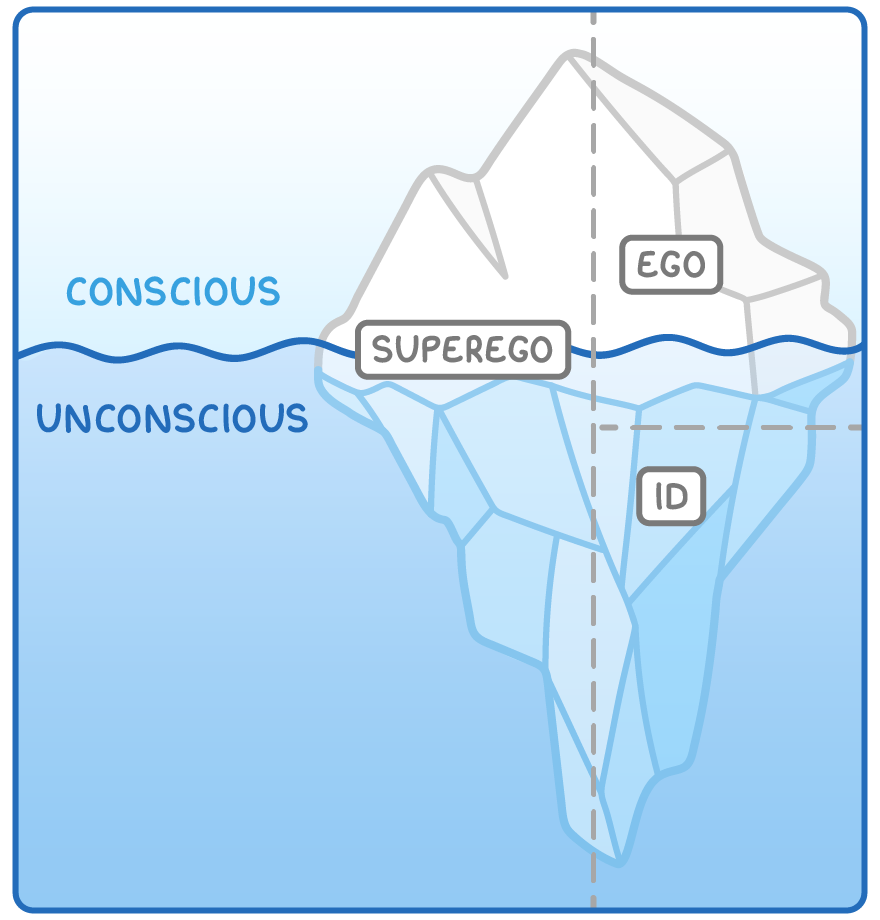
The id, ego, and superego can clash, particularly when the id's impulsive desires oppose the superego's ethical standards. This conflict generates anxiety, which the ego attempts to manage through unconscious defence mechanisms. Freud likened the mind to an iceberg, with the conscious mind (parts of ego and superego) visible above the surface, while the unconscious (id and remaining parts of ego and superego) lies hidden below.
Common defence mechanisms:
- Repression - Blocking distressing thoughts or memories from reaching consciousness, such as forgetting a traumatic event like a car accident.
- Denial - Refusing to acknowledge a painful reality, for instance, a person with a serious illness insisting they are fine.
- Displacement - Redirecting negative emotions towards a safer target, like venting frustration from a bad day at work by arguing with a family member over a minor issue.
These mechanisms help reduce anxiety but may distort reality or lead to maladaptive behaviours if overused.
Psychosexual stages of development and their impact on personality
Freud believed that personality develops through a series of stages in childhood, each focusing on pleasure derived from different parts of the body. The way these stages are navigated, influenced by parental interaction, affects adult personality traits.
Psychosexual stages
- Oral stage (0 to 1.5 years) - Focus on mouth activities like sucking and biting. Fixation may lead to habits like overeating or smoking.
- Anal stage (1.5 to 3 years) - Focus on bowel control. Fixation could result in obsessiveness or messiness.
- Phallic stage (3 to 6 years) - Focus on genitals and the Oedipus/Electra complex. Fixation might cause issues with authority or relationships.
- Latent stage (6 years to puberty) - Sexual feelings are dormant. Focus on social skills development.
- Genital stage (puberty to adulthood) - Focus on mature sexual relationships. Healthy resolution leads to balanced adult personality.
Impact of fixation
If a child experiences too little or too much gratification at any stage, they may become fixated, meaning unresolved conflicts from that stage persist into adulthood.
For instance, during the anal stage, overly strict toilet training might lead to an overly orderly personality, while leniency could result in disorganisation. These unresolved issues are buried in the unconscious but influence behaviours and may contribute to psychological disorders.
Freud's methods of psychoanalysis - the case study of Little Hans (1909)
Freud developed psychoanalysis as a therapeutic method to explore the unconscious mind, often through detailed case studies of his patients. These studies aimed to uncover hidden conflicts and help individuals confront and resolve deep-seated issues.
Method
- Freud analysed a young boy named Hans, who had a severe fear of horses.
- Hans's father recorded his son's dreams, conversations, and behaviours, which were then interpreted by Freud.
Results
- Hans expressed fears of horses biting him or collapsing.
- He also showed fascination with his genitals and dreamt of marrying his mother while relegating his father to a lesser role.
Conclusions
- Freud interpreted Hans's fear as evidence of the Oedipus complex during the phallic stage, where Hans desired an exclusive bond with his mother and felt rivalry with his father.
- The horse represented his father, and the fear of being bitten symbolised castration anxiety—fear of punishment for his feelings.
- This fear was displaced onto horses as a defence mechanism.
Evaluation
- The case study offers rich, detailed insight into one individual but cannot be generalised to others.
- Freud's interpretations support his theories but rely heavily on subjective analysis, lacking empirical evidence.
- Alternative explanations, such as Hans witnessing a horse fall or receiving threats from his mother, could also account for his phobia.
- Additionally, data came through Hans's father, introducing potential bias.
Strengths and weaknesses of the psychodynamic approach
Strengths of the psychodynamic approach
- Pioneering focus on psychology - It was among the first theories to attribute mental disorders to psychological rather than physical or supernatural causes.
- Link to biological needs - It introduced the idea that unresolved conflicts tied to basic instincts could underlie mental health issues.
- Therapeutic methods - Psychoanalysis offers a way to explore unconscious conflicts, helping individuals understand and alleviate their distress.
- Emphasis on childhood - The approach highlights the lasting impact of early experiences, influencing many subsequent psychological theories.
Weaknesses of the psychodynamic approach
- Subjective interpretations - Freud's conclusions often depended on personal analysis of patients' dreams and memories, making them prone to bias and unreliability.
- Unfalsifiable concepts - The unconscious mind cannot be directly observed or tested, so Freud's theories cannot be disproven scientifically.
- Challenges in therapy - Psychoanalysis can be lengthy and costly, and revisiting past conflicts may cause emotional distress or rely on potentially inaccurate memories.
- Past-focused approach - It concentrates on historical events rather than addressing current problems or symptoms.
- Limited generalisation - Based on case studies of distressed individuals, findings may not apply to the broader population.
- Lack of scientific rigour - The methods used do not allow for establishing clear cause-and-effect relationships, reducing scientific credibility.