3.6 - How Early Attachment Affects Later Relationships
Bowlby's internal working model
Bowlby's internal working model refers to the mental framework formed during early childhood that shapes expectations about relationships throughout life.
How childhood attachments influence adult relationships
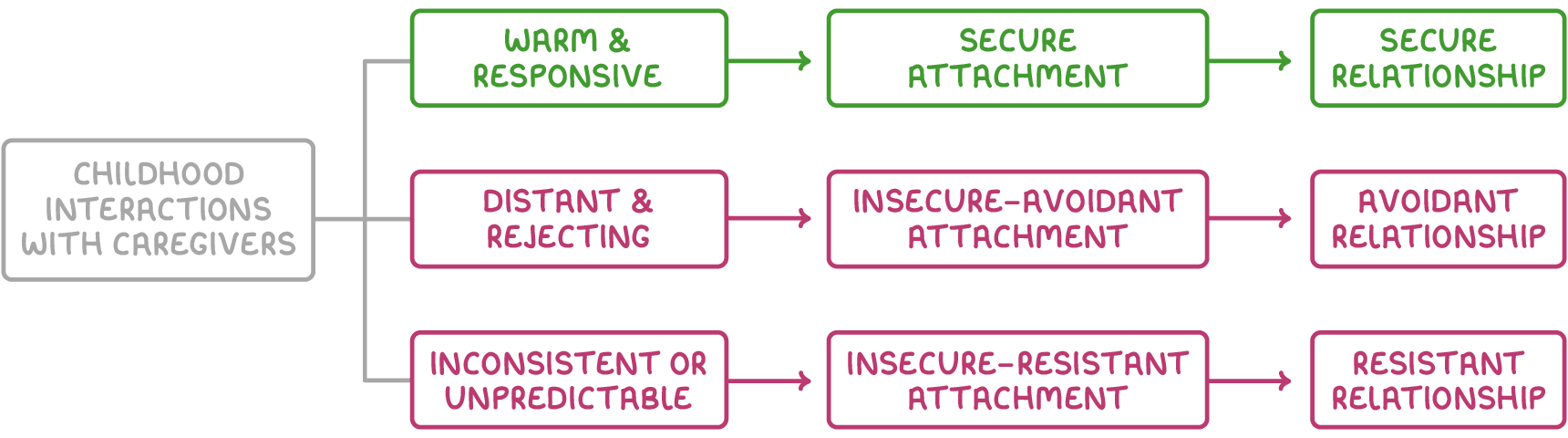
- Secure attachments in infancy, where caregivers are consistently responsive, foster a positive self-image. Individuals see themselves as worthy of love, which promotes trusting and stable adult relationships.
- Insecure attachments, arising from inconsistent or neglectful caregiving, can lead to a negative self-view. People may feel unworthy of affection, resulting in difficulties forming secure bonds later in life.
Pathways from childhood attachments to adult relationships
Three main pathways illustrate the continuity between early experiences and adult relational patterns:
- Secure attachment - Leads to secure adult relationships.
- Insecure-avoidant attachment - Results in avoidant adult relationships.
- Insecure-resistant attachment - Produces resistant adult relationships.
Hazan and Shaver's love quiz study
Hazan and Shaver (1987) investigated the link between early attachment styles and adult romantic experiences, providing empirical support for Bowlby's theory.
Method
The study involved a 'love quiz' published in a newspaper, consisting of two sections. Participants first evaluated their attachment type with parents during childhood, then described their beliefs about romantic love in adulthood. Responses came from 620 individuals.
Results
A clear correlation emerged between childhood attachment and adult romantic attitudes. Those with secure childhood attachments reported happy, trusting relationships. Insecure-avoidant individuals expressed fears of closeness, while insecure-resistant participants worried about being unloved.
Conclusions
The findings reinforced Bowlby's internal working model, demonstrating that early attachment patterns predict adult relationship quality.
Evaluation
Strengths:
- The study was replicated in 2003 with consistent results.
Limitations:
- Reliance on retrospective self-reports, which may be inaccurate due to memory biases.
- Potential dishonesty in responses.
- Sample bias from volunteers.
The adult attachment interview
The adult attachment interview (AAI) is a tool designed to assess how childhood attachments influence adult relational patterns by examining memories rather than direct experiences.
Main et al's development of the adult attachment interview
Main et al (1985) created this semi-structured interview to explore childhood relationships and their impact on adulthood.
Procedure
Participants describe their early bonds with parents using five adjectives per parent, followed by explanations. Questions cover experiences of distress, rejection, and perceived effects on current attachments. Trained coders classify responses into categories: secure, dismissing, preoccupied, or unresolved/disorganised.
Results
Classifications reliably predicted adult attachment styles based on how childhood was remembered.
Conclusions
The interview highlights that the quality of recall, rather than events themselves, indicates attachment security and influences later relationships.
Long-term effects of privation
Privation occurs when children lack opportunities to form attachments, often leading to lasting psychological impacts. Research identifies key negative outcomes, though these are not inevitable.
The cycle of privation
Children who experience privation may struggle as parents, perpetuating deprivation across generations.
Quinton et al's study on institutional care (1984):
- Method - Compared 50 women raised in institutions with 50 from typical family backgrounds. Assessed parenting skills and family outcomes in adulthood.
- Results - Women from institutions were more prone to parenting challenges, increasing the risk of their children entering care.
- Conclusions - This supports a cycle where privation impairs caregiving abilities, leading to further attachment issues.
Reactive attachment disorder
Reactive attachment disorder (RAD) is a severe condition stemming from extreme privation, as described by Parker and Forrest (1993).
Symptoms and causes:
- Symptoms - Inability to give or receive affection, tendencies towards dishonesty, poor social relationships, and involvement in crime.
- Causes - Permanent damage from early emotional deprivation, preventing normal attachment development.
Evidence that privation does not always lead to negative outcomes
While privation often has harmful effects, some cases show resilience, suggesting that recovery is possible with supportive interventions.
Freud and Dann's study on WWII orphans
Freud and Dann (1951) examined six children orphaned during infancy and raised in a wartime camp without adult attachments:
- Method - Observed the children's development after rescue and adoption into British families.
- Results - Despite severe early privation, the children formed strong peer bonds in the camp. Post-adoption, they displayed normal intelligence, formed healthy relationships, and showed few signs of troubled upbringing.
- Conclusions - Peer attachments and later nurturing environments can mitigate privation's effects, challenging the idea of inevitable damage.