5.1 - Behaviourist Approach: Conditioning
Origins and main assumptions of behaviourism
Behaviourism, also known as learning theory, emerged in the United States in the early 1900s, largely through the work of John Watson. It promoted a scientific method for studying psychology, focusing on observable actions rather than internal mental states.
Core assumptions underlying behaviourism
- Behaviour is mostly learnt - The majority of actions develop through experience, though some exceptions exist such as innate reflexes (e.g., blinking at dust in the eyes) or instincts (e.g., running from danger). While genetics may play a role in conditions like schizophrenia, behaviourism emphasises learning as the primary driver.
- Similar learning processes in animals and humans - Both form associations between stimuli and responses, even though humans can handle more intricate tasks. Additional mechanisms like social learning apply to humans, but the fundamental principles remain consistent.
- Irrelevance of the mind - Internal thoughts cannot be directly observed or quantified, so scientific study should concentrate on measurable behaviours alone, excluding unobservable cognitive processes.
Behaviourist research methods
Behaviourist approaches to investigation stem directly from the theory's assumptions, prioritising empirical evidence of learning through controlled settings.
Key features of behaviourist research
- Focus on learning mechanisms - Investigations aim to uncover how behaviours are acquired and modified.
- Use of animal subjects - Animals are often studied because results are expected to generalise to humans. They offer practical benefits, including easier management, natural behaviour in experiments, and the ability to conduct procedures that would be unethical with people.
- Emphasis on quantifiable data - Only observable and measurable actions are recorded, such as the number of lever presses or time taken to complete a task.
- Preference for laboratory experiments - Controlled environments, typically with animals, allow precise manipulation of variables to test learning principles.
Classical conditioning
Classical conditioning involves learning through associations between stimuli, first identified by Ivan Pavlov while examining salivation in dogs. It links a neutral stimulus with a natural response to create a new learnt reaction.
Process of classical conditioning
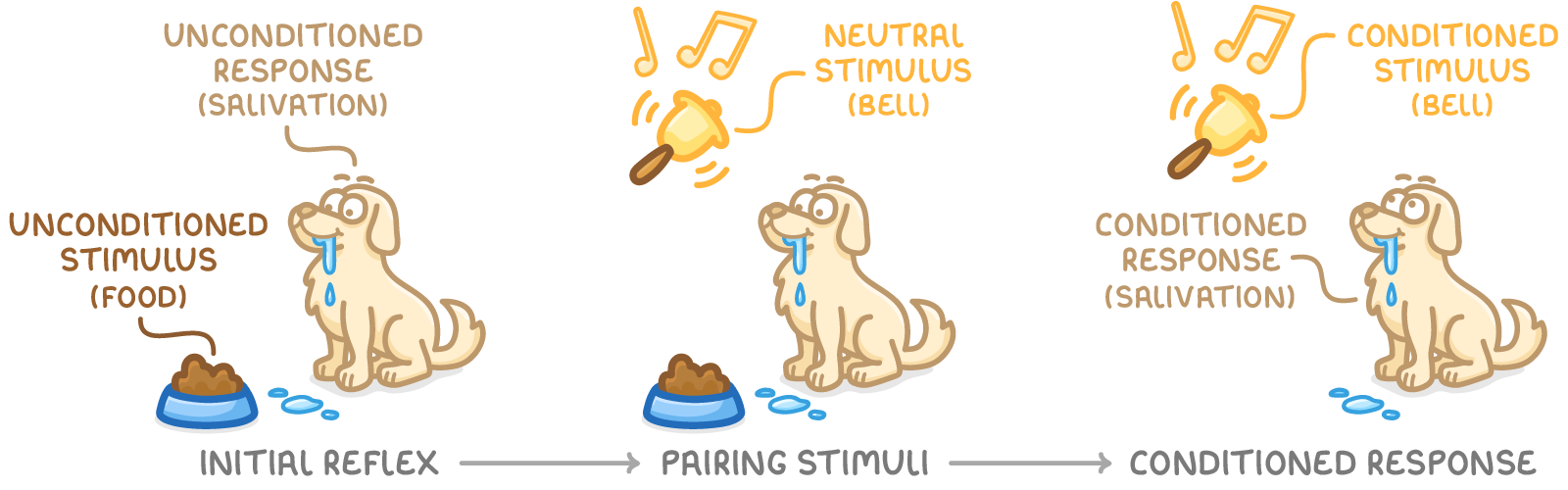
- Unconditioned stimulus (UCS) - A trigger that naturally elicits a response, such as food.
- Unconditioned response (UCR) - The automatic reaction to the UCS, like salivating.
- Conditioned stimulus (CS) - An initially neutral element, such as a sound, that becomes linked to the UCS.
- Conditioned response (CR) - The learnt reaction to the CS alone, mirroring the UCR.
For example, an infant feels contentment (UCR) when needs are fulfilled (UCS). If a parent's voice consistently accompanies this, the voice becomes a CS, eliciting contentment as a CR.
Principles governing classical conditioning
- Generalisation - Responses extend to stimuli resembling the original CS.
- Discrimination - Responses do not occur to similar stimuli if the UCS is not paired with them.
- Extinction - The CR diminishes when the CS appears repeatedly without the UCS.
- Spontaneous recovery - An extinguished CR can re-emerge after a period without the CS.
- Higher-order conditioning - A new stimulus gains the ability to produce the CR by associating with the existing CS.
Operant conditioning
Operant conditioning, explored by B.F. Skinner, explains how consequences following a behaviour influence its future occurrence. Unlike classical conditioning, which deals with reflexes, this applies to voluntary actions.
Consequences in operant conditioning
Reinforcement increases the likelihood of a behaviour repeating:
- Positive reinforcement - Introduces a desirable outcome, such as rewarding homework completion with a sticker.
- Negative reinforcement - Removes an unpleasant element, like waiving an extra task after strong exam results.
Punishment decreases the likelihood of a behaviour repeating:
- Positive punishment - Adds an undesirable consequence, such as giving extra chores for misbehaviour.
- Negative punishment - Withdraws something valued, like limiting screen time for unfinished tasks.
Key studies in behaviourism
Behaviourism is supported by influential experiments that demonstrate conditioning principles, though they have notable limitations.
Skinner (1938) study on operant conditioning in rats
- Method - Rats were placed in a 'Skinner box' equipped with a lever, food dispenser, lights, speaker, and electrified floor. The setup allowed observation of responses to stimuli.
- Results - Rats initially pressed the lever by chance and received food, leading to quicker learning and more frequent presses over time.
- Conclusions - Behaviours can be shaped through operant conditioning, with positive reinforcement strengthening associations.
- Evaluation - The study was groundbreaking in illustrating reinforcement but relied on a small animal sample, raising questions about applicability to humans and ethical concerns over animal use.
Watson and Rayner (1920) study on conditioned fear in Little Albert
- Method - A young infant was exposed to a white rat paired with a startling loud noise.
- Results - The child developed fear towards the rat, which generalised to other white, fluffy items.
- Conclusions - Emotional responses like fear can be conditioned, suggesting that atypical behaviours may arise from learning.
- Evaluation - The experiment lacked ethical standards, as it caused distress without consent, and its artificial lab setting reduces real-world relevance.
Strengths and weaknesses of the behaviourist approach
Behaviourism provides a foundational view of learning but has limitations in explaining the full spectrum of human actions.
Strengths of behaviourism
Extensive evidence supports conditioning in both animals and humans, offering practical applications in areas like therapy and education.
Weaknesses of behaviourism
- Limited explanatory power - Fails to account for all behaviours, oversimplifying learning to basic stimulus-response links (reductionism).
- Neglect of biology - Ignores genetic influences on behaviour and learning capabilities.
- Issues with animal research - Findings may not fully transfer to humans due to species differences in cognitive abilities.
- Ethical concerns - Early studies often involved unethical practices; modern research demands justification through cost-benefit analysis and humane treatment.