3.1 - Biological Responses to Stress
The definition and terminology of stress
Stress refers to the response that arises when individuals perceive that they cannot cope with environmental pressures.
Dual meanings in stress terminology
- Stress as a stimulus - Refers to environmental factors that trigger a response, such as encountering a large spider in the bath.
- Stress as a response - Describes the reaction to the stimulus, for example, rapidly retreating from the situation.
Stress emerges when perceived demands surpass one's ability to manage them. These judgments can involve overestimating or underestimating either the demands or personal coping resources. Importantly, the individual's perception overrides objective reality; if someone believes they cannot cope, stress occurs irrespective of whether this belief is accurate.
The role of the hypothalamus in stress responses
The hypothalamus plays a central role in coordinating the body's reaction to stress.
How the brain detects and signals stress
- Stressor evaluation takes place in the higher brain centres, specifically the cerebral cortex.
- Upon detecting an environmental stressor, these centres send signals to the hypothalamus.
- The hypothalamus then initiates the body's stress-related physiological activities.
This process ensures a rapid and coordinated response to perceived threats. The stress response encompasses two primary pathways, depending on whether the stress is immediate or prolonged.
The sympathomedullary pathway for immediate stress
The sympathomedullary pathway handles acute, short-term stress by preparing the body for immediate action through hormonal and nervous system activation.
Sequence of the immediate stress response
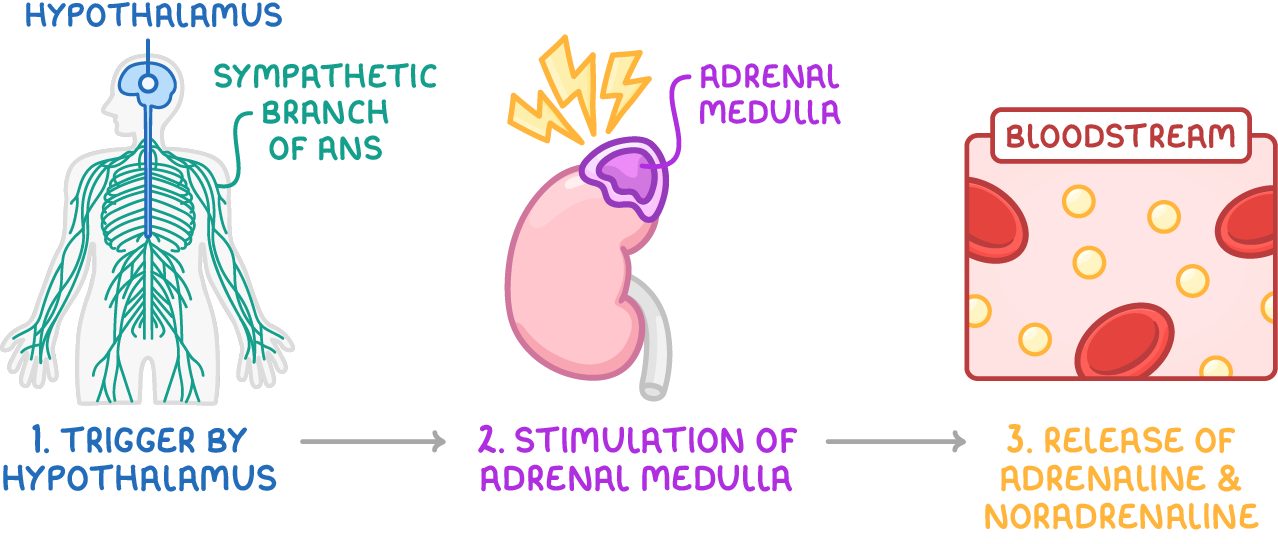
- The hypothalamus triggers the sympathetic branch of the autonomic nervous system.
- This activation leads to the release of adrenaline and noradrenaline from the adrenal medulla, the inner core of the adrenal glands located above the kidneys.
- These hormones enter the bloodstream, causing various physical changes.
Physical effects of adrenaline and noradrenaline
- Cardiovascular changes - Increased heart rate to deliver more oxygen to muscles.
- Respiratory adjustments - Elevated breathing rate to enhance oxygen intake.
- Sensory enhancements - Dilated pupils to improve vision.
- Digestive suppression - Reduced digestion to redirect energy to essential functions.
These alterations equip the body for quick reactions, such as fighting or fleeing from danger.
The hypothalamic pituitary-adrenal system for long-term stress
For ongoing or chronic stress, the hypothalamic pituitary-adrenal (HPA) system activates a sustained response, often termed the countershock phase, which provides ongoing energy to the body.
Sequence of the long-term stress response
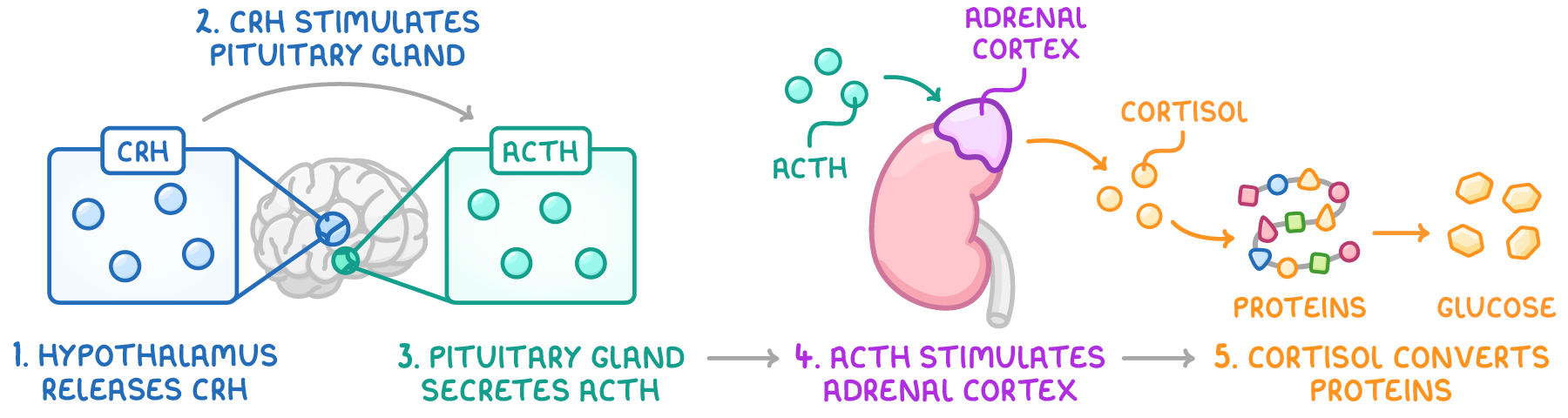
- The hypothalamus releases corticotropin-releasing hormone (CRH).
- CRH stimulates the anterior pituitary gland.
- The anterior pituitary secretes adrenocorticotropic hormone (ACTH).
- ACTH prompts the adrenal cortex, the outer layer of the adrenal glands, to release cortisol.
- Cortisol converts proteins into glucose, elevating blood sugar to provide sustained energy and replenish stores depleted during the initial acute response.
Consequences of prolonged cortisol exposure
- Immune system impairment - Elevated cortisol can suppress immune function, increasing vulnerability to illness.
- Cognitive effects - High levels may harm memory processes over time.
This system is designed to maintain readiness during extended threats, but persistent activation can lead to health issues.
Evolutionary perspectives and types of stress
From an evolutionary viewpoint, the stress response developed to enhance survival in ancestral environments, though it may be less adaptive in contemporary settings.
Evolutionary basis of stress responses
- Bodily changes, such as those in the fight-or-flight mechanism, evolved to provide energy for escaping physical dangers like predators.
- In prehistoric times, threats were typically acute and physical, requiring immediate action.
- Modern stressors are often psychological and chronic, including work demands, traffic congestion, or noise pollution.
- The physical responses triggered today are frequently unnecessary and can become detrimental if sustained, as they are mismatched to non-physical threats.
Types of stress
- Eustress - A positive form of stress that feels exciting and motivating, such as the thrill of a demanding amusement park ride.
- Distress - The negative form, arising from perceived inability to cope, whether from ancient threats like being pursued by an animal or modern ones like a high-stakes job interview.
Stress remains a natural reaction to any perceived threat, highlighting its role in human adaptation across different eras.