2.4 - Eyewitness Testimony & Cognitive Interview
The nature of eyewitness testimony and factors affecting its accuracy
Eyewitness testimony (EWT) refers to the account given by individuals who have observed a specific incident or offence. It depends on the ability to retrieve information from memory and often includes details about suspects, such as hair colour or stature, as well as aspects of the scene, like the timing or setting.
Witnesses frequently provide unreliable recollections of events and individuals, which carries significant consequences for law enforcement procedures. Cognitive psychologists examine elements that influence the precision of EWT and methods to enhance it during questioning.
Key factors influencing eyewitness testimony accuracy
- Leading questions - These are phrased in a way that suggests a particular response, potentially altering the witness's memory. For instance, "How loud was the music when the fight started?" implies there was loud music, compared to a neutral query like "Was there music playing when the fight started?"
- Post-event discussion - Conversations after the event can introduce new information, leading to memory distortion as witnesses incorporate details from others.
- Age - Younger and older individuals may show reduced accuracy in recall.
- Anxiety - Moderate arousal can enhance memory, but extreme stress often impairs it, causing focus on key elements at the expense of surrounding details.
Research into leading questions and post-event discussion
Studies have demonstrated how leading questions and discussions after an event can compromise the reliability of eyewitness accounts. These investigations highlight the malleability of memory and the need for careful interviewing techniques.
Loftus and Palmer (1974) study on leading questions
- Method - In the first experiment, participants viewed footage of a multi-vehicle collision and were questioned using varying verbs (e.g., smashed, collided, bumped, contacted). The second experiment divided participants into groups exposed to different verbs, followed by a query about broken glass a week later.
- Results - Speed estimates were highest (average 41 mph) with "smashed" and lowest (average 32 mph) with "contacted". In the second part, those in the "smashed" group were more prone to falsely report seeing broken glass, despite its absence.
- Conclusions - Verb choice in questions can skew memory accuracy, showing that leading questions influence recall of events.
- Evaluation - The lab setting may lack real-world applicability, but it reveals memory's susceptibility to suggestion.
Loftus and Zanni (1975) study on article usage in questions
- Method - Participants watched a film of a car accident and were asked either "Did you see the broken headlight?" or "Did you see a broken headlight?", even though no such damage occurred.
- Results - 17% of those questioned with "the" claimed to have seen it, versus 7% with "a".
- Conclusions - Definite articles like "the" can create false memories by implying existence, affecting recall precision.
Shaw et al (1997) study on post-event discussion
- Method - Participants recalled details, with some responding after a confederate who provided either correct or incorrect information.
- Results - Individual recall accuracy was 58%; it increased to 67% with accurate confederate input but dropped to 42% with inaccurate input.
- Conclusions - Exposure to others' accounts can alter one's own memory, reducing accuracy when misinformation is present.
Gabbert et al (2003) study on memory conformity in pairs
- Method - Paired participants viewed slightly different versions of an event and discussed it before individual recall.
- Results - 71% of participants in pairs incorrectly recalled details obtained solely from the discussion, not from their own observation.
- Conclusions - Social interactions post-event lead to memory conformity, where individuals adopt others' recollections as their own.
The impact of age and anxiety on eyewitness recall
Age and emotional states like anxiety play critical roles in how accurately witnesses remember events. Research shows varying effects, with some groups more prone to errors under certain conditions.
Valentine and Coxon (1997) study on age differences
- Method - Children, adults, and elderly participants viewed a video and answered non-leading and leading questions.
- Results - Elderly and children provided more incorrect responses to non-leading questions; children were more misled by leading questions than adults or elderly people.
- Conclusions - Age influences susceptibility to misinformation, with children particularly at risk from suggestive questioning.
Effects of anxiety on recall
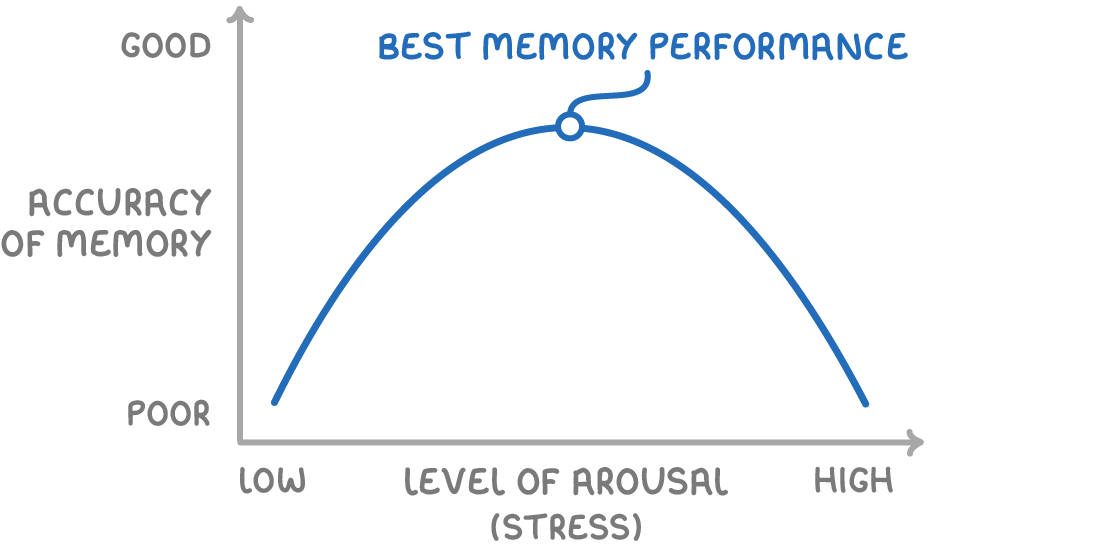
Anxiety can have dual impacts on memory. Mild elevations in arousal may sharpen focus and improve accuracy. However, intense anxiety often diminishes precision, as attention narrows to central features (e.g., a threat) while overlooking peripheral ones (e.g., clothing details).
Johnson and Scott (1976) study on weapon focus effect
- Method - Participants overheard an argument; one group saw a man with a pen, the other with a bloody knife, before identifying him from photos.
- Results - Identification accuracy was 49% for the pen condition but only 33% for the knife condition.
- Conclusions - Presence of a weapon heightens anxiety, diverting attention and reducing recall of other details.
Yuille and Cutshall (1986) field study on real-world anxiety
- Method - Witnesses to an actual shooting were interviewed immediately and five months later, including with leading questions.
- Results - Memories remained highly accurate over time, unaffected by leading questions.
- Conclusions - In genuine high-stress scenarios, recall can be robust, contrasting with lab findings and suggesting real events may enhance memory consolidation.
The cognitive interview technique
The cognitive interview is a method designed to boost the accuracy of eyewitness recall by drawing on psychological principles of memory retrieval. It aims to minimise distortions and maximise detail recovery.
Geiselman et al (1984) techniques in cognitive interviews
The approach incorporates four main strategies:
- Reinstate the context - Encourage witnesses to mentally reconstruct the external environment and their internal state (e.g., emotions) at the time.
- Report everything - Instruct witnesses to recount all details, no matter how minor they seem.
- Reverse the order - Have witnesses describe events in non-chronological sequences to uncover additional memories.
- Change perspective - Prompt recall from alternative viewpoints, such as that of another person present.
Geiselman et al (1986) evaluation of cognitive interviews
- Method - Participants were interviewed using either cognitive or standard techniques after viewing an event, including exposure to leading questions.
- Results - Those in the cognitive interview group provided more accurate information and were less influenced by misleading queries.
- Conclusions - The technique enhances recall reliability by reducing susceptibility to suggestion, making it valuable for police work.
- Limitations - It requires more time and training than standard interviews, which may limit its practical use.