1.2 - Humanistic Approach
The origins and core assumptions of humanistic psychology
Humanistic psychology emerged in the 1950s, primarily through the work of psychologists such as Carl Rogers and Abraham Maslow. It represents a response to more deterministic approaches like behaviourism and psychoanalysis, emphasising personal growth and individual potential.
Key features of humanistic psychology
Humanistic psychology considers the individual as a complete entity, integrating thoughts, feelings, and behaviours rather than isolating observable actions. It posits that all humans possess an innate goodness and a drive towards achieving their maximum capabilities. This approach values the uniqueness of each person, adopting an idiographic method that examines individual experiences instead of seeking universal laws through a nomothetic lens.
Core assumptions about human behaviour
- Behaviour stems from personal perceptions and subjective interpretations of oneself, known as self-concept.
- Individuals are motivated to improve themselves and acquire new knowledge.
- Human actions are guided by free will, rejecting the idea that behaviour is strictly determined by external forces or biological factors.
Maslow's hierarchy of needs and self-actualisation
Abraham Maslow proposed a model of human motivation organised as a pyramid, where needs are arranged in a hierarchy. Individuals are driven by free will to fulfil these needs progressively, starting from basic survival requirements and advancing towards personal fulfilment. While some needs are universal, such as those for sustenance, higher-level motivations vary between people.
The levels in Maslow's hierarchy of needs
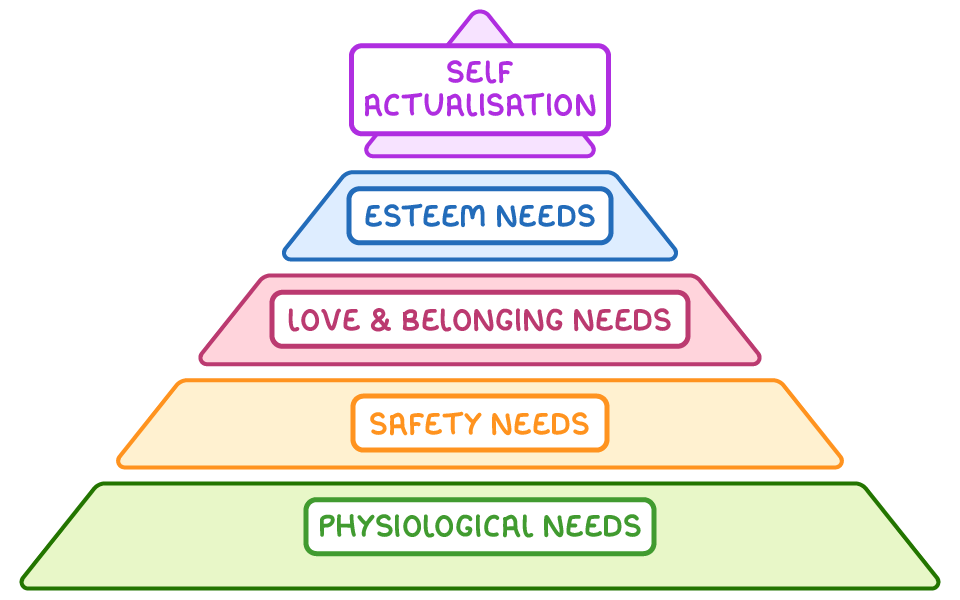
Needs must be addressed in sequence, with lower levels typically satisfied before higher ones can be pursued. Few individuals reach the pinnacle of the hierarchy.
The five levels of the hierarchy:
- Physiological needs - Essential for survival, including food, water, shelter, and rest.
- Safety needs - Encompassing physical protection, emotional security, and financial stability.
- Love and belonging needs - Involving relationships, affection, and a sense of community.
- Esteem needs - Related to accomplishments, self-respect, and recognition from others.
- Self-actualisation - Achieving one's utmost potential and personal growth.
Characteristics of self-actualised individuals
Those who attain self-actualisation exhibit distinct traits, often measured through "peak experiences" – intense moments of awe and inspiration that enhance self-awareness.
Key characteristics include:
- A profound awareness of oneself.
- Complete acceptance of self and others.
- Capacity to handle ambiguity and unpredictability.
- Heightened creativity in various aspects of life.
Rogers' theory of self-concept and congruence
Carl Rogers argued that psychological well-being arises when individuals can progress towards self-actualisation without obstacles. Environmental factors, particularly in childhood, influence this process, with a need for positive regard – such as love and respect – being crucial for healthy development.
Two main components of the self according to Rogers
- Self-concept - An individual's perception of their own identity and abilities.
- Ideal self - The version of oneself that a person aspires to become.
Self-concept forms through experiences of unconditional positive regard or conditions of worth.
The role of unconditional positive regard
This involves receiving love and support irrespective of one's actions, fostering a healthy self-concept and enabling personal growth.
The impact of conditions of worth
These are expectations where approval depends on specific behaviours, which can aid social integration but may hinder self-actualisation by shifting focus to external validation rather than internal development.
Congruence and incongruence in personal development
Congruence arises from unconditional positive regard, leading to alignment between self-concept and ideal self, resulting in a fully functioning individual. Incongruence, often caused by conditions of worth, creates a discrepancy between self-concept and ideal self, potentially leading to psychological distress.
Research support for humanistic psychology
Humanistic theories have been examined through various studies, providing insights into their applicability while highlighting cultural and methodological constraints.
Aronoff's (1967) study on Maslow's hierarchy
- Method - Aronoff compared workers in the British West Indies, specifically fishermen and sugar cane cutters, to assess if lower needs must be met before pursuing higher ones.
- Results - A greater proportion of sugar cane cutters remained at basic levels of the hierarchy compared to fishermen.
- Conclusions - Individuals who had fulfilled lower needs were more likely to select occupations that supported higher esteem and self-actualisation.
- Evaluation - The research demonstrates ecological validity by examining real-world job choices, but its findings may not generalise beyond this specific cultural context.
Strengths and limitations of the humanistic approach
The humanistic approach offers a distinctive perspective in psychology, but it is not without criticisms regarding its scientific rigour and cultural applicability.
Strengths of humanistic psychology
- It adopts an optimistic view, focusing on human potential and self-improvement.
- It prioritises free will, contrasting with deterministic theories.
- It respects individuality and examines the person holistically.
- It relies on qualitative data, providing in-depth insights.
- It has led to practical applications, such as effective counselling methods.
Limitations of humanistic psychology
- It largely overlooks biological influences on behaviour, unlike other approaches.
- It depends on subjective self-reports, reducing objectivity.
- Concepts like self-actualisation are challenging to quantify scientifically.
- Its idiographic focus limits the ability to form broad generalisations.
- The theory reflects Western values emphasising individualism, potentially ignoring collectivist cultures.
- It presumes universal potential for self-actualisation, which may not apply to all, such as those without access to education.
- Evidence for the strict hierarchy in Maslow's model is weak, and it fails to account for self-actualised individuals who neglect basic needs.