6.4 - Endocrine System: Fight or Flight
The role of the hypothalamus in the fight or flight response
The hypothalamus acts as a central coordinator in the endocrine system, linking the nervous system to hormonal responses. It detects threats and initiates the body's preparation for immediate action, known as the fight or flight response. This response equips the body to either confront or escape danger by rapidly altering physiological states.
The process of the fight or flight response
When a threat is perceived, the body undergoes a sequence of neural and hormonal activations to prepare for action. This begins in the brain and extends to the endocrine glands, ensuring quick energy mobilisation.
Stages in the fight or flight response:
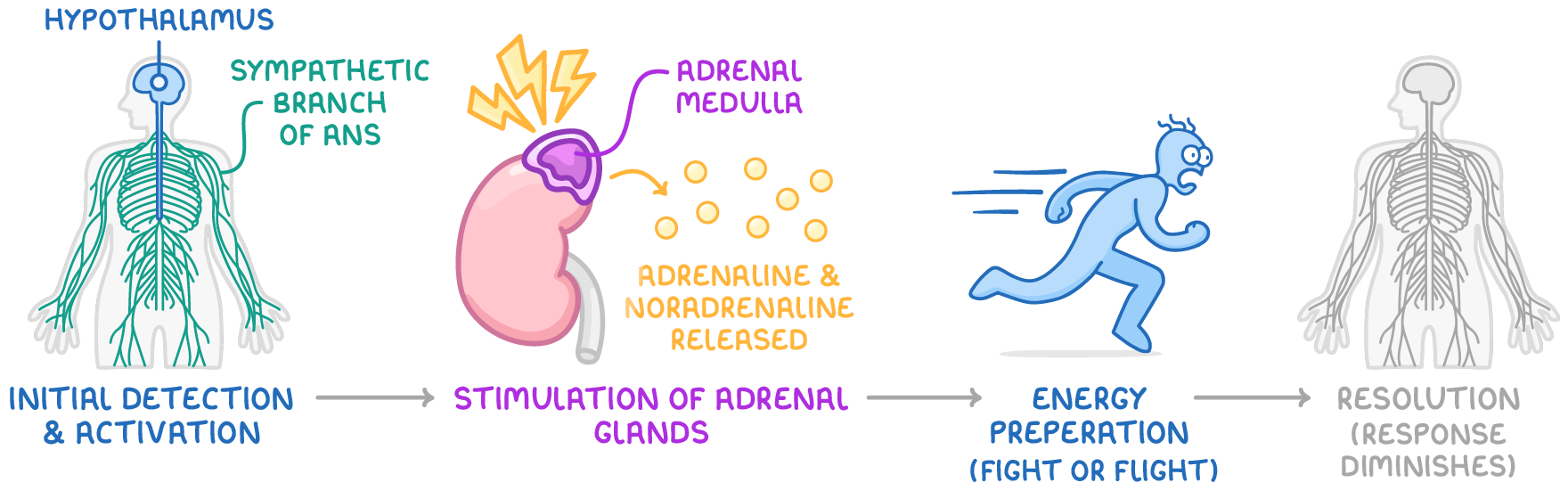
- Initial detection and activation - The hypothalamus senses the threat and stimulates the sympathetic branch of the autonomic nervous system (ANS).
- Stimulation of adrenal glands - The ANS signals the adrenal medulla, the inner part of the adrenal glands, to release hormones into the bloodstream.
- Hormonal release - Adrenaline and noradrenaline are secreted, circulating through the blood to trigger widespread bodily changes.
- Energy preparation - These changes ready the body for intense physical activity, such as fighting or fleeing.
- Resolution phase - After the threat passes, the response diminishes to conserve energy and avoid strain.
Physiological effects of adrenaline and noradrenaline
Adrenaline and noradrenaline, released during the fight or flight response, cause specific changes that enhance survival chances. These hormones target various organs and systems to optimise performance under stress.
Key physiological changes triggered by stress hormones:
- Cardiovascular adjustments - Heart rate and blood pressure rise to pump blood faster to muscles and the brain.
- Respiratory enhancements - Breathing rate increases to deliver more oxygen to muscles for energy production.
- Muscular preparations - Muscles tense up, improving readiness for quick movements.
- Sensory improvements - Pupils dilate to let in more light, sharpening vision.
- Metabolic shifts - Digestion slows down, redirecting blood flow away from the digestive system to areas needed for action; salivation decreases as it's not required during stress.
- Thermoregulation - Sweating increases to cool the body during potential physical exertion.
These adaptations collectively enable the body to respond effectively to immediate dangers.
The role of the parasympathetic nervous system in recovery
Once the stressful situation resolves, the body must return to a balanced state to prevent exhaustion or damage from prolonged arousal. The parasympathetic nervous system counteracts the fight or flight effects, promoting rest and conservation of resources.
Functions of the parasympathetic nervous system:
- Restoration of normal functions - It reduces heart rate and blood pressure, allowing the cardiovascular system to relax.
- Reversal of hormonal effects - Digestion and salivation resume as blood flow is redirected back to these systems.
- Overall relaxation - Muscle tension eases, breathing slows, and pupil size normalises, helping the body recover and maintain homeostasis.
This recovery process ensures the body does not remain in a heightened state unnecessarily, preserving long-term health.
Key terminology related to the endocrine system
- Autonomic nervous system (ANS) - The part of the nervous system that regulates involuntary actions, such as heart rate and digestion.
- Sympathetic branch - The division of the ANS that activates arousal and energy expenditure during stress.
- Adrenal medulla - The core section of the adrenal glands that produces and releases stress-related hormones.
- Adrenaline - A hormone that initiates rapid physiological changes to prepare for threats.
- Noradrenaline - A hormone that supports the stress response by maintaining alertness and focus.
- Parasympathetic nervous system - The branch that calms the body after stress, restoring normal operations.