1.3 - Treatments & Interactionist Approach
Biological treatments for schizophrenia
Biological treatments primarily involve drug therapy, also known as chemotherapy, which is the main method used to manage schizophrenia. This approach is based on the dopamine hypothesis, which suggests that schizophrenia results from excessive dopamine activity in the brain.
How antipsychotic drugs work
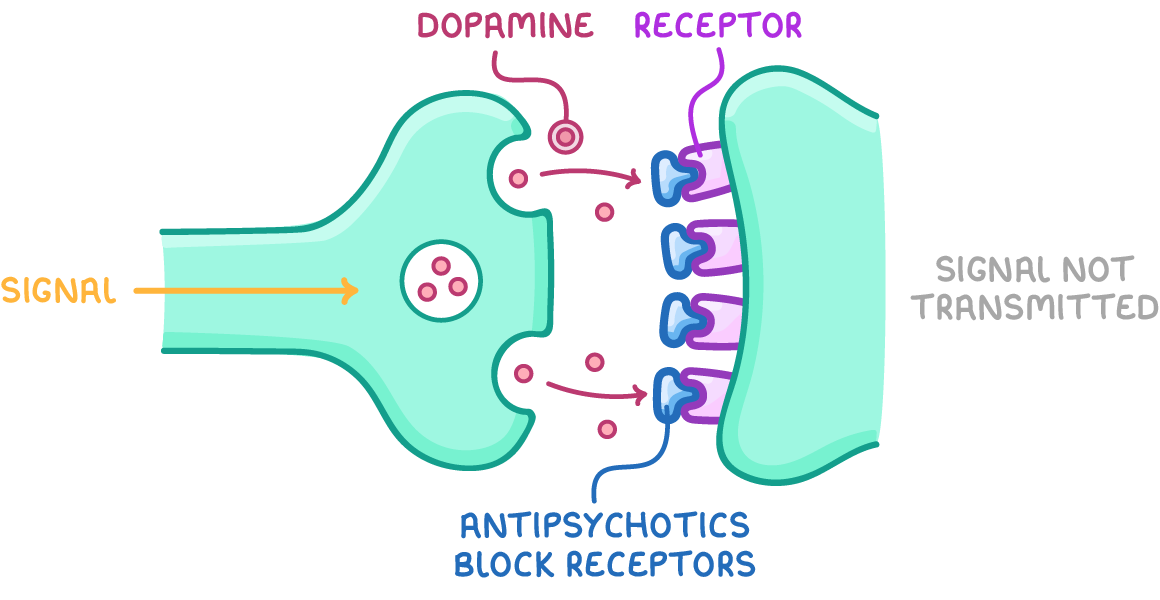
Antipsychotic drugs, sometimes called neuroleptics, function by blocking dopamine receptors in the brain, which helps to reduce the impact of high dopamine levels associated with schizophrenic symptoms.
Types of antipsychotics
- Typical antipsychotics - Developed in the 1950s, these mainly target dopamine receptors and are effective at alleviating positive symptoms, such as hallucinations and delusions.
- Atypical antipsychotics - Introduced in the 1970s, these act on both dopamine and serotonin receptors, addressing both positive symptoms and negative symptoms.
Effectiveness of drug therapy
Drug therapy is particularly successful in managing positive symptoms but less so for negative symptoms. It enables many individuals to live independently in community settings rather than requiring long-term institutional care. However, it addresses symptoms rather than the root cause, and many patients experience the "revolving door phenomenon", where they discontinue medication, symptoms re-emerge, and they require readmission to hospital.
Side effects of antipsychotics
Antipsychotics can cause a range of side effects, which contribute to high discontinuation rates, with approximately two-thirds of patients stopping treatment due to these issues.
These side effects may include:
- Short-term side effects - Include drowsiness, blurred vision, dry mouth, constipation, dizziness, muscle spasms, tremors, and weight gain.
- Long-term side effects - Include an increased risk of diabetes and tardive dyskinesia, which involves involuntary repetitive movements. Newer atypical antipsychotics generally have fewer long-term side effects compared to older typical ones.
Evaluation of drug therapy
- Strengths - Allows for combination with other treatments, improving overall outcomes, and supports community living.
- Limitations - Does not cure the underlying condition, and ethical concerns arise as it may act as a "chemical straitjacket" to control behaviour rather than promote genuine recovery.
Cognitive behavioural therapy (CBT) for schizophrenia
Cognitive behavioural therapy (CBT) is a psychological treatment that helps individuals with schizophrenia by identifying and modifying faulty thought patterns, known as faulty cognitions, which contribute to their symptoms.
Key techniques in CBT
- Ellis's ABC model - Involves identifying activating events (triggers), exploring associated beliefs, and recognising the consequences of those beliefs.
- Reality-testing - Encourages patients to question the validity of hallucinations and delusions, such as by challenging the origin of voices they hear.
- Positive self-talk - Serves as a coping mechanism to manage distressing thoughts.
- Role-play and homework - Used to practice and test alternative thinking patterns in real-life scenarios.
Research studies on CBT
Chadwick et al (1996):
- Method - Applied reality-testing with a patient who held the delusion that he could predict others' speech.
- Results - The patient learned to challenge his beliefs, leading to reduced delusional thinking.
- Evaluation - Demonstrates CBT's potential for targeted symptom reduction, though reliant on individual case studies.
Sensky et al (2000):
- Method - Compared CBT with other therapies in patients resistant to drug treatment.
- Results - CBT showed effectiveness in reducing symptoms for those who had not responded to medication alone.
- Evaluation - Highlights CBT's value as an adjunct therapy, but outcomes may vary due to reliance on self-reported measures.
Evaluation of CBT
- Strengths - Empowers patients with self-help strategies, placing them in control of their recovery, and raises fewer ethical concerns than drug therapy since it requires voluntary participation and self-awareness.
- Limitations - Effectiveness is hard to measure objectively as it depends on subjective self-reports; it can be time-consuming with high dropout rates, and individual differences mean it does not work for everyone.
Family therapy for schizophrenia
Family therapy, also known as family intervention, addresses the role of family dynamics in schizophrenia by reducing dysfunction that can heighten relapse risks. It is typically combined with other treatments like medication.
Aims and techniques in family therapy
- This approach seeks to create a supportive family environment.
- Focuses on lowering high levels of expressed emotion within the family.
- Helps families form supportive networks, share the burden of care, manage anger, and establish realistic expectations.
Research on family therapy: Pilling et al (2002)
- Method - Reviewed multiple studies on family interventions.
- Results - Found that family therapy significantly lowered hospital readmission rates for patients with schizophrenia.
- Evaluation - Supports its use alongside drugs, especially for patients with limited insight into their illness, though results depend on family engagement.
Evaluation of family therapy
- Strengths - Particularly beneficial for reducing relapse by improving family understanding and support.
- Limitations - Challenges include obtaining informed consent from all family members, maintaining confidentiality, and ensuring family participation, as not all families are willing or able to engage.
The interactionist approach to treating schizophrenia
The interactionist approach, also called the biopsychosocial model, integrates multiple treatment methods to provide a holistic response to schizophrenia, recognising that no single treatment is sufficient for all cases.
Key features of the interactionist approach
This method combines biological elements, such as drug therapy, with psychological interventions like CBT and behavioural strategies, addressing the complex interplay of factors in schizophrenia.
Research on combined treatments
Tarrier et al (2004):
- Method - Compared drug therapy alone with combinations including CBT or counselling.
- Results - Combined treatments led to greater symptom improvement than medication on its own.
- Evaluation - Shows the benefits of integration, though isolating the most effective component is difficult.
Guo et al (2010):
- Method - Studied patients receiving combined treatments.
- Results - Found improved adherence to treatment, lower relapse rates, and better quality of life.
- Evaluation - Emphasises holistic benefits, but individual differences must be considered.
Evaluation of the interactionist approach
- Strengths - Less reductionist than single-method treatments, accounting for personal variations in needs and promoting comprehensive care.
- Limitations - More complex, expensive, and time-intensive, requiring coordination among professionals, and it can be challenging to pinpoint which element drives success.