2.2 - Memory: Models
The multi-store model of memory
The multi-store model, proposed by Atkinson and Shiffrin in 1968, describes memory as a system with three distinct stores: the sensory register, short-term memory, and long-term memory. Information flows sequentially through these stores to form lasting memories.
How information moves through the multi-store model
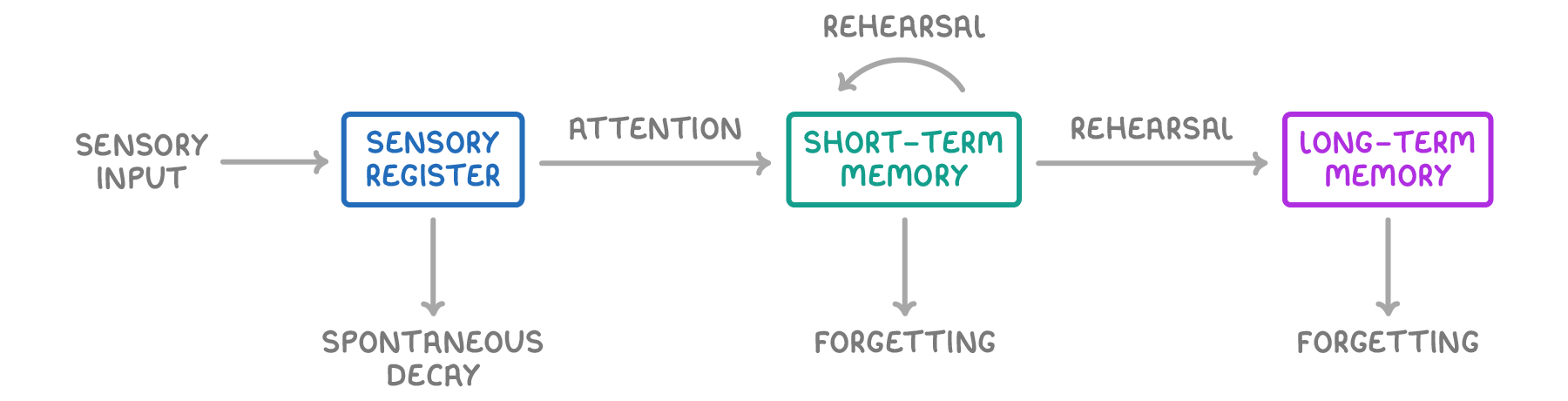
- Entry into the sensory register - Environmental stimuli, such as visual or auditory inputs, first enter the sensory register, which holds raw sensory data briefly.
- Transfer to short-term memory - If attention is directed towards the information in the sensory register, it moves to short-term memory (STM), which has limited capacity and duration.
- Transfer to long-term memory - Through rehearsal, information in STM can be encoded and passed to long-term memory (LTM), where it may be stored indefinitely and can be retrieved back to STM when needed.
This model emphasises the linear progression of information, with rehearsal acting as a key mechanism for strengthening and transferring memories.
Evidence supporting the multi-store model
Several studies and phenomena provide support for the multi-store model's distinction between STM and LTM, highlighting how information is processed and recalled differently in each store.
The primacy and recency effects in list recall
- Primacy effect - People tend to remember the first few items in a list better than those in the middle, as early items are rehearsed more and transferred to LTM.
- Recency effect - The last few items are recalled well because they remain in STM at the end of the task, with STM's capacity around seven items allowing recent words to displace earlier ones without entering LTM.
- Effect of preventing rehearsal - Preventing rehearsal through an interference task eliminates the primacy effect, supporting the model's emphasis on rehearsal for LTM transfer.
Evidence from amnesia and brain damage cases
Korsakoff syndrome:
- Individuals with this condition, often linked to chronic alcoholism, show intact recency effects (suggesting preserved STM) but impaired recall of earlier list items, indicating damaged LTM.
Milner et al. (1957) case study of HM:
- Participants and procedure - HM, suffering severe epilepsy, underwent surgery removing parts of his hippocampus, after which his memory was assessed.
- Results - He retained the ability to form STM but could not create new LTM, supporting separate stores.
- Conclusions - The case demonstrates that damage to specific brain areas affects LTM formation while leaving STM functional.
These findings align with the model's view of distinct, interacting memory stores.
Limitations of the multi-store model
Despite its supporting evidence, the multi-store model has been criticised for oversimplifying memory processes and not fully accounting for real-world memory formation.
Key criticisms of the multi-store model
- Overemphasis on rehearsal - In everyday situations, information often enters LTM without deliberate rehearsal, such as recognising smells, which cannot be easily rehearsed.
- Assumption of unitary stores - The model treats STM and LTM as single entities, but evidence from brain-damaged patients suggests multiple types of STM, challenging this simplicity.
- Lack of real-life applicability - It does not explain how some memories form effortlessly without passing through all stores in sequence.
The working memory model
The working memory model, developed by Baddeley and Hitch in 1974, refines the concept of STM by portraying it as an active, multi-component system rather than a passive single store. It focuses on how STM processes and manipulates information temporarily.
Core features of the working memory model
- Working memory acts as an active processor, handling tasks like problem-solving and comprehension.
- It includes a central executive, which directs attention and has limited capacity, overseeing subordinate 'slave' systems that also have restricted capacities.
- Unlike the multi-store model, it reduces the focus on rehearsal as the primary transfer mechanism to LTM, viewing it as one of several processes.
Components of the working memory model
The model consists of specialised subsystems that handle different types of information, coordinated by the central executive.
Subsystems in the working memory model
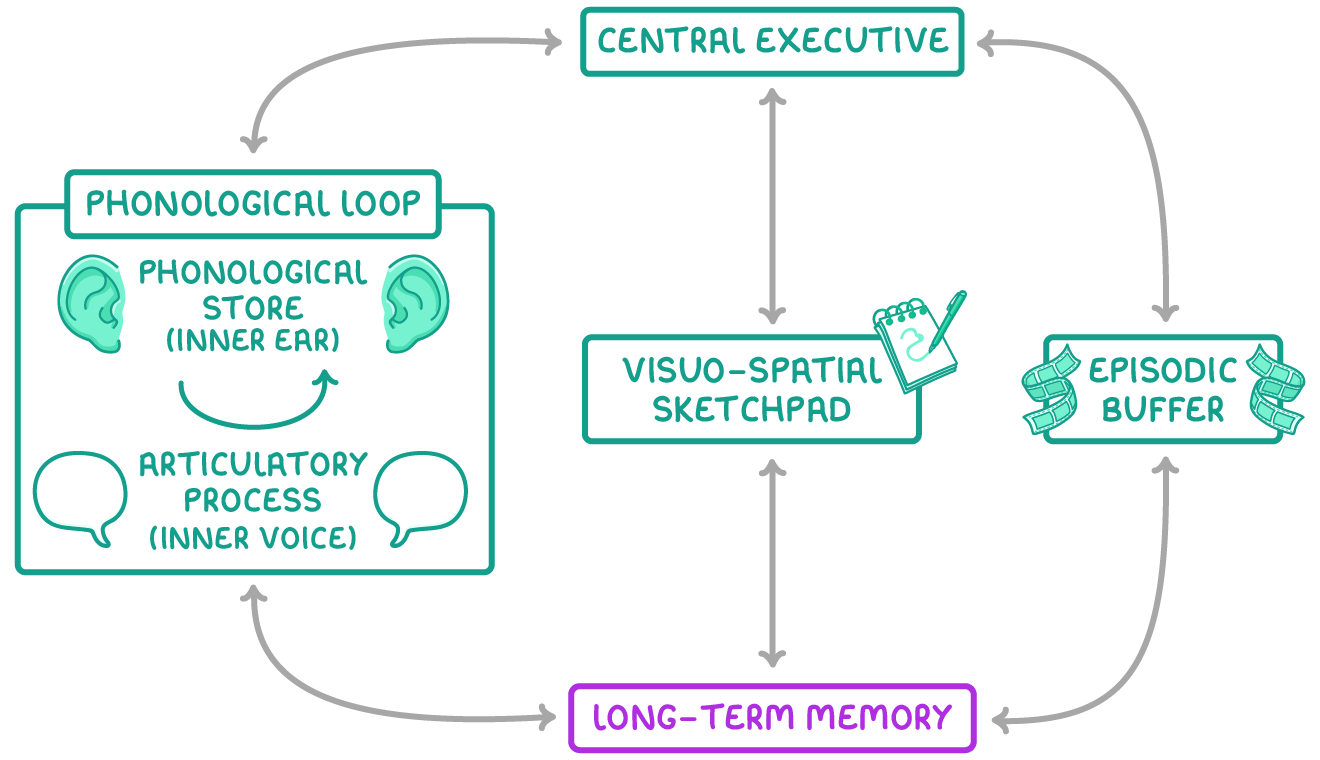
- Phonological loop - Processes auditory and speech-based information, comprising the phonological store (acts like an inner ear for holding sounds) and the articulatory process (functions as an inner voice for rehearsing verbal data).
- Visuo-spatial sketchpad - Manages visual and spatial data, enabling temporary storage and manipulation of images or locations.
- Episodic buffer - Added by Baddeley in 2000, this integrates information from the other subsystems and LTM to form coherent episodes or scenes, providing a brief storage space for combined sensory inputs.
Experimental evidence for the working memory model
Research using dual-task paradigms demonstrates the model's separate subsystems, as performance declines when tasks overload the same component but remains stable when different components are used.
Interference tasks supporting the model
- Simultaneous tasks using the same subsystem (e.g., two verbal tasks engaging the phonological loop) impair performance due to limited capacity.
- Tasks using different subsystems (e.g., a verbal task with a visual one) do not interfere, allowing normal performance.
Key studies on the working memory model
Shallice and Warrington (1974) case study of KF:
- Participants and procedure - KF, a brain-damaged patient, was tested on recall of verbal and visual information.
- Results - He showed deficits in verbal recall but intact visual processing.
- Conclusions - This supports distinct components, with damage to the phonological loop but a functioning visuo-spatial sketchpad.
Gathercole and Baddeley (1993) laboratory experiment:
- Method - Participants were divided into groups: one followed a moving light while describing angles, another did the light task with a verbal one.
- Results - Performance was worse on same-system tasks but unaffected on mixed-system tasks.
- Conclusions - The findings validate the model's separate, capacity-limited subsystems.
Strengths of the working memory model
The model offers a more nuanced explanation of STM than the multi-store approach, supported by empirical evidence and practical applications.
Advantages over the multi-store model
- Explanation of diverse STM functions - Case studies like KF show how specific impairments affect only certain subsystems, providing evidence for multiple STM components.
- Reduced reliance on rehearsal - It accounts for memories entering LTM without rehearsal, viewing it as just one process among many.
- Real-world relevance - Dual-task studies, such as those by Gathercole and Baddeley, demonstrate how the model explains everyday multitasking without interference between different systems.
Weaknesses of the working memory model
While influential, the model has been critiqued for vagueness in some areas and limited scope.
Key limitations of the working memory model
- Vague central executive - This component is poorly defined, often just described as 'attention' without clear mechanisms, making it hard to test empirically.
- Focus only on STM - The model does not address how information transfers to LTM or explain long-term processes.
- Reliance on laboratory research - Supporting studies are highly controlled, potentially lacking ecological validity as they may not reflect complex, real-world memory use.
- Over-simplification of integration - The episodic buffer, while useful, is a later addition and may not fully capture how subsystems interact in dynamic scenarios.