2.4 - Obesity
The definition and classification of obesity
Obesity occurs when an individual has an excessively high body mass index (BMI), which indicates they are carrying too much adipose (fatty) tissue. BMI is used to classify obesity, but the thresholds differ across ethnic groups.
BMI thresholds for obesity
- People of white heritage - Obesity is indicated by a BMI of 30 kg/m² or higher.
- People of black, Asian, and certain other minority ethnic groups - Obesity is indicated by a BMI of 27.5 kg/m² or higher, as these groups face a higher risk of conditions like type 2 diabetes at lower BMI levels.
Normal BMI ranges
- People of white heritage - A normal BMI is between 18.5 and 25 kg/m².
- People of black, Asian, and certain other minority ethnic groups - A normal BMI is between 18.5 and 23 kg/m².
Obesity is typically caused by consuming more calories than are burned through physical activity, though genetic conditions and certain medications can also increase the risk. Projections suggest that by 2050, over half of the global population could be obese. The most effective treatments involve a balanced diet and regular exercise, although some people opt for weight-loss pills or surgical interventions.
Biological explanations for obesity
Biological explanations focus on genetic and physiological factors that contribute to obesity, emphasising how inherited traits and brain mechanisms influence body weight.
Genetic influences on obesity
Genes play a significant role in determining adult weight. Certain genetic mutations can disrupt normal appetite regulation, leading to excessive fat storage. For example, deficiencies in leptin, a protein produced by adipose tissue that signals when fat reserves are full, can fail to suppress hunger, resulting in overeating and obesity.
Role of the hypothalamus in eating behaviour
The hypothalamus regulates eating by controlling hunger and satiety. Damage to specific areas, such as the ventromedial hypothalamus (VMH), known as the satiety centre, can cause uncontrolled overeating. This disruption leads to a failure in recognising when to stop eating, contributing to weight gain.
Psychological explanations for obesity
Psychological explanations consider how cognitive, social, and environmental factors interact with biological drives to influence eating patterns and body weight.
The boundary model
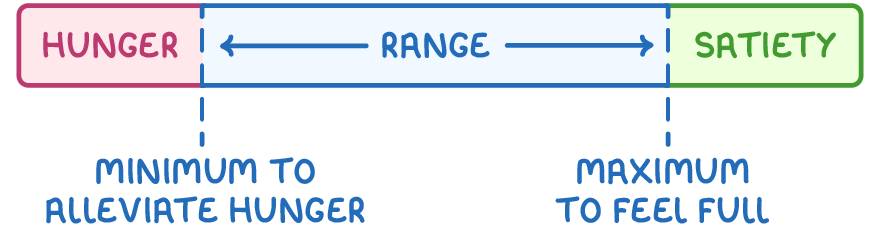
The boundary model, proposed by Herman and Polivy in 1983, explains eating behaviour through a combination of biological and external influences.
Key features:
- Biological drives - Hunger sets a minimum level for food intake to meet bodily needs, while satiety prevents excessive consumption by signalling fullness.
- Psychological and environmental factors - These expand the range between hunger and satiety boundaries, allowing social cues, emotions, or availability of food to affect how much is eaten.
- Overall regulation - Biological pressures generally maintain eating within a healthy range.
Restraint theory

Restraint theory suggests that attempts to diet or restrict food intake can paradoxically lead to overeating and weight gain.
Key features:
- Cognitive boundaries in dieting - Restrained eaters (dieters) set mental limits on food consumption. Once this boundary is crossed, disinhibition occurs, leading to a "giving up" mindset and excessive eating.
- Loss of hunger cues - Chronic dieting can impair the ability to recognise natural hunger and satiety signals, causing individuals to eat beyond biological needs.
- Path to obesity - Regularly exceeding these boundaries can contribute to long-term weight gain.
Research studies supporting explanations for obesity
Several studies provide evidence for both biological and psychological explanations, highlighting genetic, physiological, and behavioural factors.
Stunkard et al (1986) on genetic influences
- Participants - 540 adult adoptees from Denmark.
- Procedure - Researchers compared the adoptees' weights with those of their biological and adoptive parents.
- Results - There was a strong correlation between the adoptees' weights and their biological parents' weights, but no significant relationship with adoptive parents.
- Conclusions - Genetic factors have a major influence on adult weight, while environmental factors appear to play a minimal role. This is supported by twin studies.
- Evaluation - The study provides robust evidence for heritability but may be reductionist.
Montague et al (1997) on leptin deficiency
- Participants - Two severely obese children (male and female cousins) with high levels of adipose tissue.
- Procedure - Genetic analysis was conducted to examine DNA mutations related to appetite regulation.
- Results - A mutation was found in the DNA controlling leptin production, leading to a deficiency in this protein.
- Conclusions - Leptin deficiency prevents the brain from receiving signals that fat reserves are sufficient, resulting in unchecked appetite and obesity.
- Limitations - While effective in rare cases, leptin treatments have shown limited success in the general obese population, suggesting it does not explain most instances of obesity.
Hetherington and Ranson (1940) on hypothalamic damage
- Participants - Laboratory rats.
- Procedure - Researchers surgically lesioned the VMH in the rats' hypothalami and monitored their eating behaviour.
- Results - The lesioned rats exhibited excessive overeating and developed obesity.
- Conclusions - Damage to the VMH disrupts satiety signals, leading to uncontrolled food intake and weight gain.
- Limitations - Findings from animal studies may not fully generalise to humans.
Herman and Mack (1975) on disinhibition in dieters
- Participants - Dieting and non-dieting students.
- Procedure - Participants were given varying amounts of milkshake (none, one, or two) as a preload, followed by unlimited access to ice cream for tasting.
- Results - Non-dieters ate less ice cream after consuming more milkshake, while dieters ate more ice cream after larger preloads, demonstrating a counter-regulation effect.
- Conclusions - Dieters exhibit an "all-or-nothing" mentality; perceiving a diet failure leads to disinhibition and overeating, supporting restraint theory.
- Evaluation - The study highlights psychological triggers for overeating but does not explain why some dieters succeed without overeating or why individuals with anorexia can restrict intake without becoming obese.
Strengths and limitations of explanations for obesity
Explanations for obesity offer valuable insights but also face challenges in fully accounting for its causes.
Strengths of biological explanations
- Therapeutic applications - Understanding genetic and physiological factors enables the development of targeted treatments, such as hormone therapies.
- Research support - Studies like those on leptin and hypothalamic lesions provide empirical evidence for biological mechanisms.
Limitations of biological explanations
- Generalisability issues - Animal-based research, such as rat studies, may not apply directly to human behaviour due to species differences.
- Environmental oversight - The rapid global rise in obesity rates points to significant roles for factors like food availability and quality, which biological views may undervalue.
Strengths of psychological explanations
- Holistic perspective - Models like the boundary model integrate biological drives with social and cognitive influences, offering a comprehensive view.
- Practical implications - Restraint theory explains dieting failures and can inform more effective weight management strategies.
Limitations of psychological explanations
- Incomplete explanations - Theories fail to account for successful dieters or conditions like anorexia, where restraint does not lead to obesity.
- Overemphasis on behaviour - They may neglect underlying biological predispositions that interact with psychological factors.