1.1 - Psychodynamic Approach
Origins and assumptions of the psychodynamic approach
The psychodynamic approach explores how internal mental processes drive personality and behaviour. It highlights the role of unconscious influences in shaping human actions.
Key figures and development
Sigmund Freud (1856-1939) founded the psychodynamic approach in the late 19th and early 20th centuries. The term combines "psycho," meaning mind, with "dynamic," referring to activity or change. Freud's ideas shifted focus from physical causes of mental issues to psychological ones.
Core assumptions underlying the approach
- Behaviour stems from unconscious motivations that individuals are unaware of.
- From birth, people possess innate biological drives, such as needs for food, sleep, and warmth.
- Experiences in childhood play a major role in forming adult personality and can contribute to psychological disorders.
Levels of consciousness and the structure of personality
Freud proposed that the mind operates across different levels of awareness, influencing thoughts and actions. He also described personality as consisting of three interacting components that develop over time.
The three levels of consciousness
- Conscious - Contains thoughts and perceptions that a person is currently aware of.
- Preconscious - Holds information that can be easily brought into awareness, such as familiar memories like a home address.
- Unconscious - Stores repressed desires, fears, and memories that provoke high anxiety if recalled; these can surface indirectly, for example through slips of the tongue. Access to this level often requires guidance from a psychoanalyst.
The tripartite structure of personality
Personality comprises three elements that can conflict, leading to internal tension.
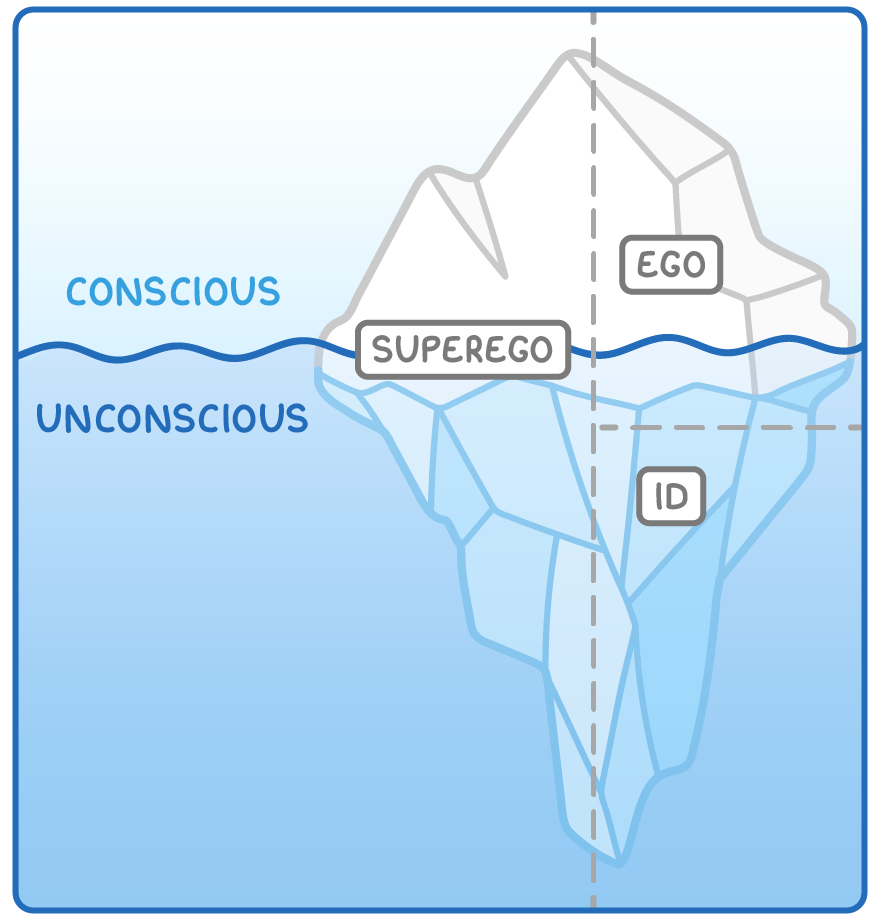
The three components of personality:
- Id - The primitive, instinctual part present from birth; driven by the pleasure principle, it seeks instant gratification of aggressive and sexual urges, explaining impulsive behaviour.
- Ego - Develops in the initial few years of life; operates on the reality principle, acting rationally to balance the id's demands with external constraints; functions across conscious and unconscious levels.
- Superego - Emerges between ages four and six; represents moral standards learned from parents and society; generates guilt for wrongdoing and spans conscious and unconscious levels.
Conflicts arise when the id demands immediate satisfaction, but the superego enforces ethical rules, creating anxiety that the ego must resolve.
Defence mechanisms and their role in managing anxiety
Defence mechanisms are unconscious strategies employed by the ego to reduce anxiety from personality conflicts. They protect mental well-being by distorting reality or redirecting emotions.
Common defence mechanisms
- Repression - Pushing distressing thoughts or memories out of conscious awareness, such as forgetting a traumatic event like an assault.
- Denial - Refusing to accept a painful reality, for instance, an individual with a dependency issue insisting no problem exists.
- Displacement - Shifting negative feelings onto a less threatening target, like directing frustration from work towards an object or unrelated person.
These mechanisms help maintain psychological balance but can become maladaptive if overused.
Psychosexual stages of development
Freud theorised that personality evolves through five stages, each centred on gaining pleasure from a specific body area. Parenting influences the amount of pleasure experienced, and unresolved issues can lead to fixation, affecting adult traits.
The five psychosexual stages
- Oral stage (0-18 months) - Pleasure derived from mouth-related activities like sucking; fixation might result in habits such as overeating.
- Anal stage (18 months-3.5 years) - Focus on bowel control and elimination; issues here could lead to traits like excessive orderliness or messiness.
- Phallic stage (3.5-6 years) - Attention on genitals; involves the Oedipus complex, where a boy desires his mother and resents his father, potentially causing gender-related conflicts if unresolved.
- Latent stage (6 years to puberty) - Sexual drives are suppressed, with energy directed towards social activities and skills.
- Genital stage (puberty onwards) - Mature sexual interests emerge, focusing on relationships with others.
Fixation occurs if a stage provides too little or too much gratification, leading to repressed conflicts that manifest in adult personality or disorders. Freud used psychoanalysis, including case studies, to uncover these influences.
Freud's research into psychosexual development
Freud employed case studies to investigate unconscious processes.
- Method - In-depth analysis of individuals, such as a boy with a phobia of horses, using techniques like dream interpretation to reveal hidden conflicts.
- Results - The study suggested the phobia symbolised repressed Oedipus complex feelings, with the horse representing the father.
- Evaluation - Case studies offer rich, detailed insights but lack generalisability and cannot prove causation due to subjective interpretation.
Evaluation of the psychodynamic approach
The psychodynamic approach has influenced psychology but faces criticism for its methods and assumptions.
Strengths of the approach
- It was the first framework to attribute disorders to psychological rather than solely physical factors.
- It connected mental health issues to unmet biological needs and unresolved conflicts.
- It introduced therapies to access and resolve unconscious issues.
- It underscored the lasting impact of early experiences on development.
Weaknesses of the approach
- Interpretations are subjective, leading to potential bias and unreliability.
- Concepts like the unconscious are difficult to test or disprove scientifically.
- Psychoanalysis is lengthy, costly, and may cause emotional distress.
- It emphasises historical events over present-day solutions.
- Reliance on case studies limits applicability to broader populations.
- Non-experimental methods hinder establishing clear cause-and-effect links.