4.3 - Cognitive Approach to Depression
The cognitive model of depression
The cognitive approach suggests that mental disorders arise from distorted thinking patterns. It emphasises that behaviours stem from thoughts and beliefs, and irrational versions of these can result in unusual behaviours. Various frameworks within this approach illustrate how such flawed cognitions contribute to conditions like depression.
Ellis's ABC model
Ellis (1962) introduced the ABC model to explain how mental disorders develop from specific sequences of events and interpretations.
The ABC model stages
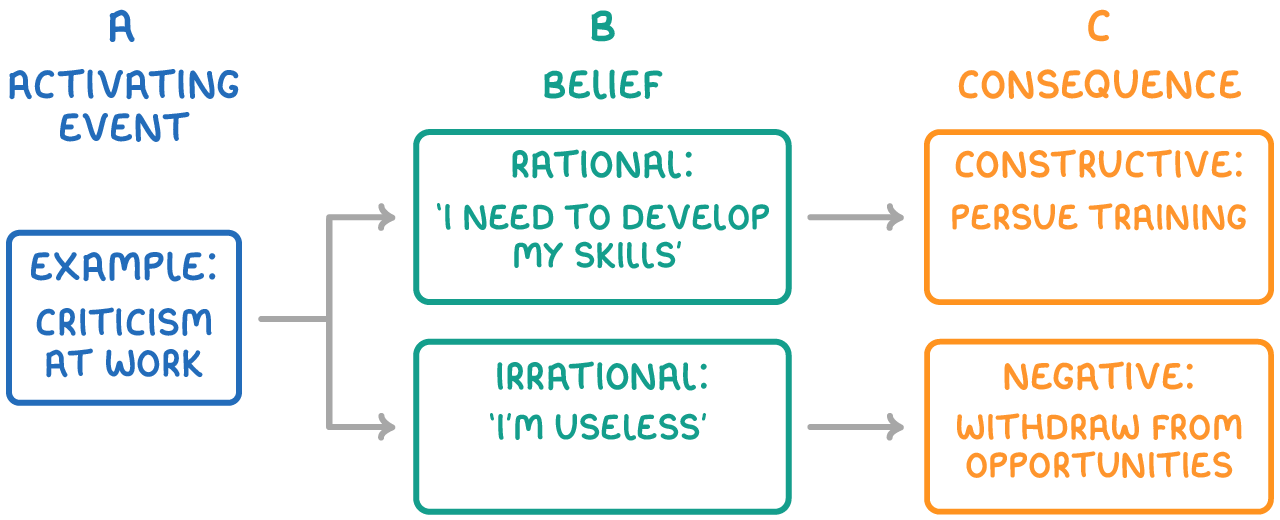
- Activating event (A) - This is the initial trigger, such as receiving criticism in a job setting.
- Belief (B) - The individual forms an interpretation of the event, which could be logical (e.g., "This highlights areas for skill development") or illogical (e.g., "This proves I'm entirely useless").
- Consequence (C) - The belief results in an outcome; logical beliefs lead to constructive responses (e.g., pursuing training), while illogical ones cause harmful responses (e.g., withdrawing from career opportunities).
Beck's negative triad
Beck (1963) proposed the negative triad as a core element in the cognitive explanation of depression, focusing on recurring pessimistic thoughts that reinforce the condition.
The three components of Beck's negative triad
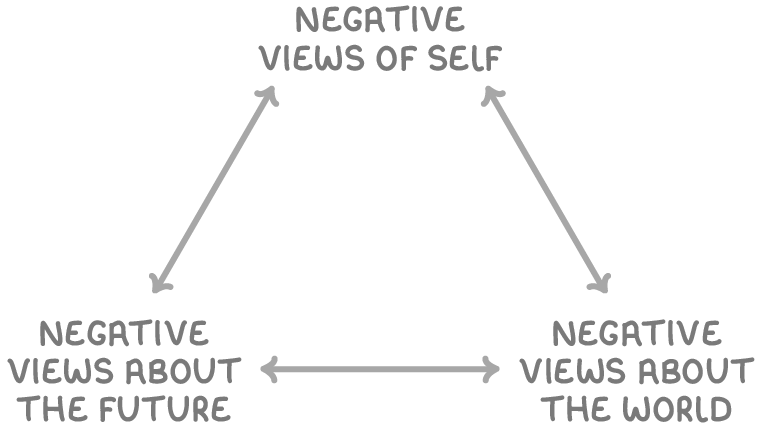
- Negative view of the self - Individuals perceive themselves as inherently defective or inadequate.
- Negative view of the world - They believe external elements, such as social interactions, are overwhelmingly critical or hostile.
- Negative view of the future - There is a sense that difficulties will persist indefinitely, with no prospect of improvement.
These interconnected negative thoughts create a cycle that sustains depressive symptoms.
Strengths and weaknesses of the cognitive explanation
The cognitive approach to depression has notable advantages in understanding the role of mental processes, but it also faces limitations regarding causation and practical implications.
Strengths of the cognitive explanation
- Emphasis on thoughts and beliefs - It highlights the significant influence of internal mental processes in conditions like depression, providing a framework for targeted interventions.
- Success in treatment applications - Cognitive-based therapies have demonstrated effectiveness in alleviating depression.
Supporting research - Harrell and Ryan (1983):
- Hollon and Kendall (1980) created the Automatic Thoughts Questionnaire (ATQ) to assess negative cognitions linked to depression.
- Harrell and Ryan (1983) applied this tool in a study comparing individuals with and without depression.
- Those with depression showed markedly higher scores, indicating more negative thoughts compared to non-depressed groups.
- This supports a link between negative cognitions and depressive symptoms.
Weaknesses of the cognitive explanation
- Uncertainty about causation - Negative thoughts might result from depression rather than cause it, potentially stemming from underlying factors like neurochemical imbalances that then lead to pessimistic thinking.
- Risk of self-blame - The focus on personal cognitions could make individuals feel responsible for their condition, exacerbating feelings of guilt.
Cognitive behavioural therapy for depression
Cognitive behavioural therapy (CBT) seeks to address depression by challenging and modifying distorted cognitions. The process involves recognising unhelpful thoughts and replacing them with more balanced alternatives, primarily concentrating on current issues rather than past events.
The CBT process
- The therapist and client collaboratively pinpoint the client's irrational thoughts and beliefs.
- The therapist guides the client to recognise the inaccuracy of these cognitions, such as disputing the idea of constant failure.
- They establish objectives for adopting healthier thinking patterns, like emphasising past achievements and using them as a foundation for progress.
- While past experiences may be referenced briefly, the emphasis remains on the present.
- Clients are often advised to maintain a journal to track thoughts, emotions, and behaviours, aiding in pattern recognition.
Advantages of cognitive behavioural therapy
- Promotion of self-reliance - CBT equips individuals with strategies for managing their own symptoms, reducing ethical concerns compared to treatments like medication that may foster dependency.
- Suitability for specific personalities - Brandsma et al (1978) found CBT especially beneficial for those who are self-critical and experience guilt over perceived shortcomings.
Research evidence - DeRubeis et al (2005):
- Examined CBT against antidepressant medication in a trial with a placebo control.
- Both CBT and medication outperformed the placebo, with similar overall effectiveness, though CBT was less successful with inexperienced therapists.
- CBT provides a viable alternative to drugs, particularly with skilled practitioners.
Long-term benefits - Hollon et al (2005):
- Followed up on DeRubeis et al's participants after treatment cessation.
- Those who discontinued CBT had lower relapse rates than those who stopped medication, comparable to those continuing medication.
- CBT offers enduring protection against relapse.
Disadvantages of cognitive behavioural therapy
- Time and cost implications - Sessions can be lengthy and expensive, and combining CBT with other methods, such as medication, might enhance outcomes.
- Dependence on therapist expertise - As shown by DeRubeis et al (2005), effectiveness diminishes with less experienced therapists, making medication a preferable option in such cases.
- Potential for self-blame - The therapy's focus on personal thoughts might lead clients to feel at fault for their depression.