4.1 - Definitions in Mental Health
Deviation from ideal mental health
Abnormality can be defined by how far a person's characteristics stray from an ideal state of mental wellbeing. This approach focuses on positive traits that indicate good mental health, with their absence suggesting potential issues.
Jahoda's criteria for ideal mental health
Marie Jahoda proposed six key conditions that represent optimal mental functioning. Failing to meet these may indicate abnormality:
- Positive self-attitude - Having high self-esteem and a favourable view of oneself.
- Self-actualisation - Achieving personal growth and realising one's full potential.
- Resistance to stress - Being able to cope effectively with life's pressures without becoming overwhelmed.
- Personal autonomy - Making independent decisions and feeling in control of one's life.
- Accurate perception of reality - Viewing the world realistically, without distortions or biases.
- Adaptation to the environment - Successfully adjusting to changes and mastering everyday challenges.
Evaluation of deviation from ideal mental health
Strengths:
- Emphasises positive aspects of mental health rather than just problems.
- Provides a comprehensive framework for assessing overall wellbeing.
Limitations:
- The criteria are difficult for most people to fully achieve, potentially labelling many as abnormal.
- Standards are subjective and can vary between individuals; for example, someone with antisocial traits might rate highly on self-attitude and stress resistance but still exhibit problematic behaviour.
- Requirements differ across cultures and personal circumstances, making universal application challenging.
Deviation from social norms
Abnormality is sometimes identified when behaviour breaks the unwritten rules or expectations of a society. These norms guide acceptable conduct, and violating them can signal mental health concerns.
Social norms are the shared standards of behaviour within a group or culture. Behaviour that deviates significantly from these is seen as abnormal. For instance, actions considered typical in one society might be viewed as unusual in another.
Evaluation of deviation from social norms
Strengths:
- Accounts for cultural differences in what is considered normal.
- Helps explain why certain behaviours are addressed through mental health interventions.
Limitations:
- Norms vary widely between cultures, so there is no global standard for abnormality.
- This definition can be misused to suppress dissent or non-conformity, such as labelling political protesters as abnormal.
- Norms evolve over time; for example, homosexuality was classified as a mental disorder until 1974 but was later declassified when evidence showed it was more widespread and not inherently harmful.
- Historical and cultural biases, such as double standards for male and female behaviours, can lead to unfair judgements.
Failure to function adequately
This definition views abnormality as an inability to manage everyday life effectively. When someone cannot cope with routine demands, their mental health may be considered atypical.
Diagnostic criteria for failure to function adequately
Several indicators suggest a person is not functioning well:
- Dysfunctional behaviour - Actions that go against societal expectations and hinder daily life.
- Observer discomfort - Behaviour that makes others feel uneasy or distressed.
- Unpredictable behaviour - Impulsive or erratic actions that seem out of control.
- Irrational behaviour - Decisions or thoughts that appear illogical or unreasonable.
- Personal distress - Experiencing intense, prolonged emotional suffering.
Meeting several of these criteria often points to abnormality.
Evaluation of failure to function adequately
Strengths:
- Focuses on practical impacts, making it useful for identifying when intervention is needed.
- Recognises that abnormality affects both the individual and those around them.
Limitations:
- Some people with mental health issues remain "high functioning," such as those who maintain jobs despite substance dependence.
- Judgements about what constitutes adequate functioning can be subjective and influenced by cultural expectations.
- It may overlook cases where distress is internal but not visibly disruptive.
Statistical infrequency
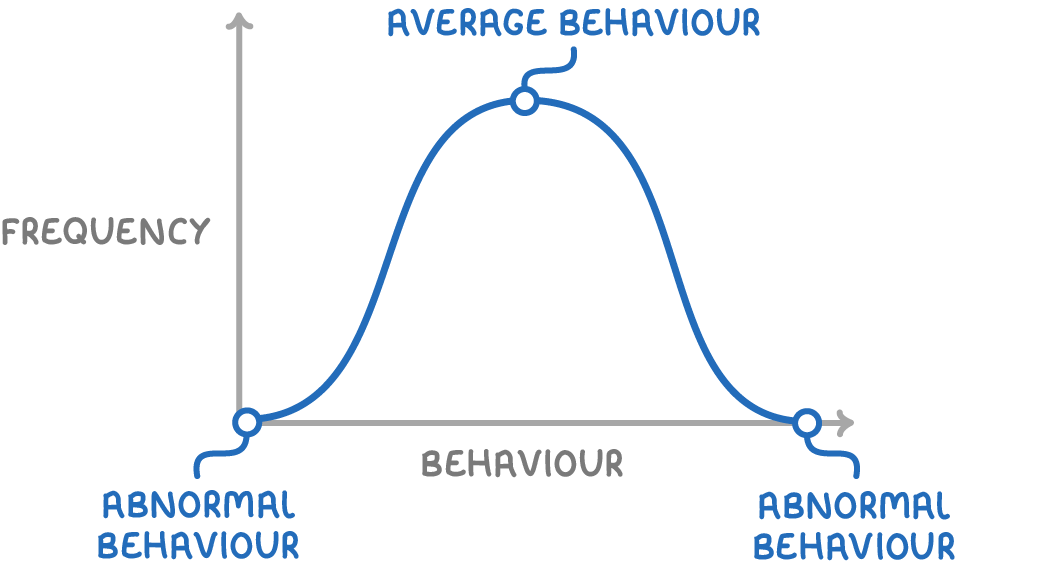
Abnormality can be defined by how rare a behaviour or trait is within a population. Traits that fall far from the average, as shown on a normal distribution curve, are considered atypical.
Behaviours or characteristics are abnormal if they occur infrequently. For example, extreme scores on measures like intelligence or mood would qualify as rare.
Evaluation of statistical infrequency
Strengths:
- Provides an objective way to identify rarity using data and distributions.
- Useful for conditions where prevalence is low, aiding diagnosis.
Limitations:
- Rarity does not always mean abnormality; desirable traits like very high intelligence are infrequent but positive.
- No clear boundary separates normal from abnormal, as cut-off points are arbitrary.
- Some mental health issues, such as mild depression, are common and would not qualify as abnormal under this definition.
- It fails to distinguish between rare behaviours that are harmless and those that indicate psychological problems.
- Hassett and White (1989) noted that statistical rarity alone is not enough to define mental disorders, as it ignores context and impact.
Symptoms associated with mental illnesses
Mental illnesses often present through specific signs that disrupt normal functioning. These symptoms help in identifying and classifying disorders.
Common symptoms of mental illnesses:
- Impairment of intellectual functions - Difficulties with memory, understanding, or processing information.
- Mood alterations - Changes that lead to distorted or delusional views of situations.
- Delusional beliefs - Fixed, false ideas, such as feelings of persecution or unfounded jealousy.
- Disordered thinking - Problems in evaluating situations logically or communicating thoughts clearly.
These symptoms can vary in intensity and combination, often requiring professional assessment for diagnosis.