1.11 - Conservation Of Energy
- 1
The concept of kinetic energy and how to calculate it
- 2
Gravitational potential energy due to an object's position
- 3
The law of conservation of energy
- 4
An example applying energy concepts to a pendulum system
Kinetic energy

Kinetic energy is the energy that an object possesses due to its motion. To calculate the kinetic energy of an object, use the formula:
Where:
Ek = kinetic energy (J)
m = mass (kg)
v = speed (m s-1)
Worked example - Kinetic energy of a rolling ball
Calculate the kinetic energy of a ball rolling with a velocity of 5 m s^-1^ and a mass of 2 kg.
Step 1: Formula
Step 2: Substitution and correct evaluation
Gravitational potential energy
Gravitational potential energy is the energy stored in an object as a result of its vertical position within a gravitational field.
It is calculated using the formula:
Where:
- m = mass (kg)
- g = acceleration due to gravity (9.81 m s^-2^).
- h = height above reference point (m).
Worked example - Gravitational potential energy of a raised ball
Let's calculate the gravitational potential energy of a ball that weighs 1 kg and is raised to a height of 10 meters.
Step 1: Formula
Step 2: Substitution and correct evaluation
Conservation of mechanical energy
The law of conservation of energy states that energy is only transformed from one type to another; it is neither created nor destroyed.
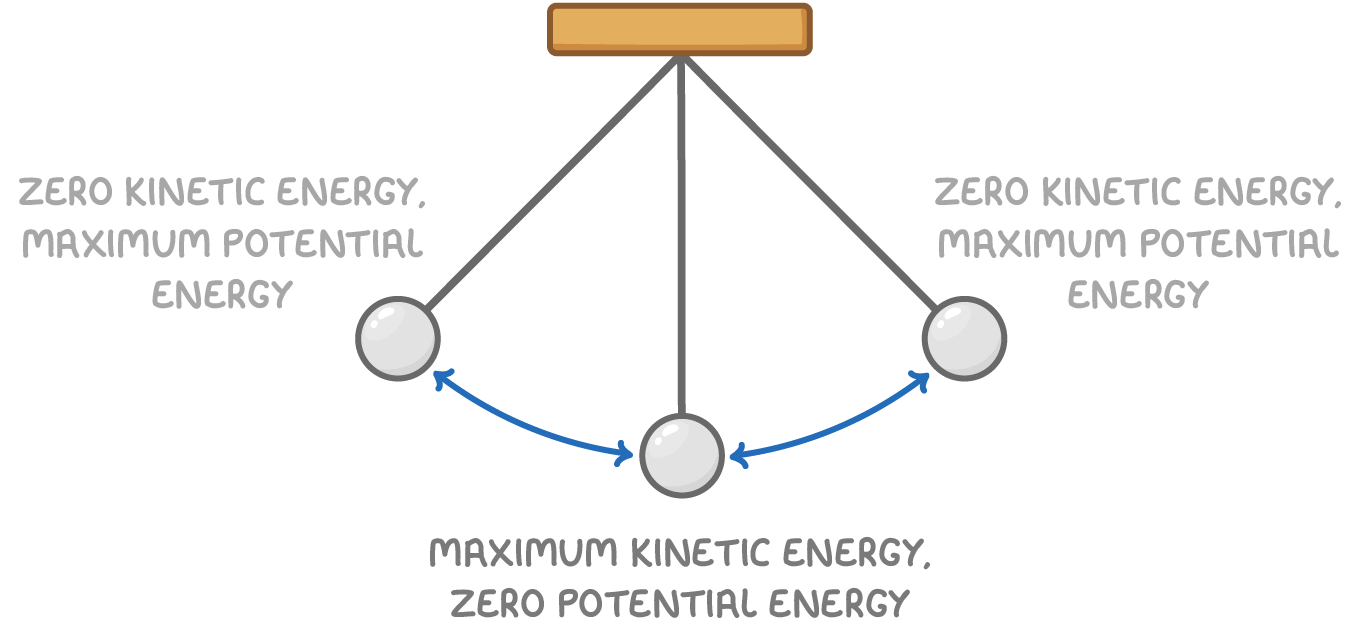
In the case of a pendulum, the total mechanical energy is maintained throughout its motion. As it swings, the pendulum's energy constantly transforms between kinetic energy and potential energy.
Key points:
- At the highest points of its swing, the pendulum has maximum potential energy and minimum kinetic energy.
- At the lowest point of its swing, the pendulum has maximum kinetic energy and minimum potential energy.